How Many Types of Piles Are There?
By installation method, piles fall into 2 main groups: driven piles and bored piles. Split further by material and construction method, there are 8 types used in practice in Thailand.
- 3 types of driven pile — driven prestressed concrete piles (I-section and square), spun piles, and steel H / pipe piles
- 5 types of bored pile — dry-process bored piles, wet-process bored piles, barrettes, CFA and micropiles
Driven piles install quickly and are easy to inspect, but generate high noise and vibration. Bored piles cause little vibration and come both in small sizes that fit narrow lanes (dry-process bored piles, micropiles) and in large sizes that carry thousands of tonnes per pile (wet-process bored piles, barrettes). If you are not yet sure whether your building needs piles at all, read Spread footing or pile foundation? first.
← Scroll to see the full table →
| Group | Type | Capacity/pile (typical range) | Key strength |
|---|---|---|---|
| Driven piles | Driven prestressed concrete pile | 20–120 t | Lowest cost, easy to inspect; suits houses and low-rise buildings on open sites |
| Spun Pile | 30–300 t | Hollow; segments can be spliced to go deep; higher capacity than I-section piles | |
| Steel H / pipe pile | 50–500 t | Can be extracted and reused; suits temporary works and ports | |
| Bored piles | Dry-process bored pile | 20–80 t | Low vibration, small rig; suits extensions and urban houses |
| Wet-process bored pile | 200–2,000+ t | Reaches deep sand layers; suits high-rise buildings and bridges | |
| Barrette | 1,000–4,000+ t | Rectangular section; high lateral resistance | |
| CFA / Auger Cast | 80–500 t | Fast and quiet; no support fluid needed | |
| Micropile | 10–50 t | Small diameter; can work inside buildings and in tight spaces |
The capacity ranges are typical values in Thai construction and match the detailed comparison table below. Design values must come from an engineer's calculation together with soil investigation results.
The chart below arranges all 8 pile types by group, with their actual cross-sections and common sizes. The bars underneath show each type's capacity range per pile from the same table on a logarithmic scale. Note the 50–100 t band, where several pile types are available — this is exactly where the decision has to be made on soil layers and site constraints.
How to Choose a Pile: A 4-Step Decision
Choosing the right pile takes 4 steps in order: know the soil layers, know the load per pile, filter by site constraints, then confirm by testing. The question "which pile should I use?" cannot be answered until you know what soil lies beneath the site. The correct sequence starts from soil data, not from price.
- Know the soil layers first — a soil investigation tells you how deep the bearing layer for the pile tip is, whether dense sand or gravel layers will obstruct driving, and where the groundwater level is.
- Know the load on each pile — the structural engineer calculates it from the column layout and design loads, giving a figure in tonnes per pile, which determines what pile size is adequate.
- Filter the options by site constraints — access width, neighboring buildings, noise, vibration, schedule and budget.
- Confirm by testing — a static load test or PDA proves that the selected pile actually carries the load in that site's soil, not just on paper.
Skipping any step is risky, but skipping the first does the most damage: piles that do not reach the bearing layer keep settling after occupancy, and the cost of remedial work later far exceeds the cost of a soil investigation.
The 3D view below places 5 pile types in the same soil profile, showing how each pile's tip reaches a different bearing layer. It also compares a pile-driving rig, whose vibration travels to neighboring buildings, with a small boring rig. The panel on the right summarizes the 4 steps above.
Which Pile for a House, a High-Rise or a Factory?
1–2 storey houses on open sites usually start with driven I-22 / I-26 piles; houses on narrow lanes or extension works usually use micropiles or dry-process bored piles; high-rise buildings use wet-process bored piles or barrettes. This table is a starting point for discussion with your designer, not a ready-made conclusion, because the actual choice must be based on the soil boring results for that specific site.
← Scroll to see the full table →
| Scenario | Primary option | Secondary option | Reason |
|---|---|---|---|
| 1–2 storey house, open site, outside the city | Driven pile I-22 / I-26 | Spun Ø30 | Lowest cost per unit capacity, fast installation |
| House/townhouse on a narrow lane with adjoining neighbors | Micropile | Dry-process bored pile Ø35-50 | Low vibration, small rig fits narrow lanes |
| Extension or underpinning of an existing building | Micropile | Dry-process bored pile | Can work in tight spaces under or beside the existing building without demolition |
| 3–5 storey building with space for machinery | Driven pile I-30 / I-40 or spun pile Ø35-40 | Dry-process bored pile | Adequate capacity, better value than large bored piles |
| High-rise/condominium in the city center | Wet-process bored pile Ø80-150 | Barrette | High capacity, can reach deep sand layers, no vibration |
| Super high-rise with column loads of several thousand tonnes | Barrette | Bored pile Ø150-200 | Large section, good resistance to moment and lateral load |
| Factory/warehouse, large site, many piles | Driven pile or spun pile | CFA (Auger Cast) | Fast repetitive production, cost per pile is controllable |
| Ports, bridges, waterfront structures | Spun Pile Ø60-120 | Steel pile (pipe pile) | Resists bending moment and lateral loads from water/vessels |
| Temporary works, shoring, crane foundations | Steel H-pile | — | Can be extracted and reused; fast to install/remove |
| Preventing soil collapse in deep excavations | Sheet pile or diaphragm wall | — | An earth-retaining system, not a building load-bearing pile |
What to Check Before Choosing a Pile: 6 Criteria
There are 6 criteria for screening pile types: soil layers, load per pile, neighbors and site conditions, budget, schedule, and quality inspection after installation. Criteria 1–2 come from the soil investigation and the designer, while criteria 3–6 narrow the remaining options to suit the site.
1. Soil Layers and the Depth the Pile Must Reach
The soil profile determines whether a pile carries load by friction along its shaft (skin friction), by bearing at the tip (end bearing), or both. In Bangkok and its surrounding provinces, soft clay several tens of meters thick means most piles must reach the stiff clay layer or the first sand layer before they can carry load effectively. Read about Bangkok's soil profile
What to look for in the boring log is the SPT N-value versus depth. If the bearing layer is deeper than driven piles can reach, or an intermediate dense sand layer is too hard to drive through, the choice is automatically pushed toward bored piles. On large driven-pile jobs, engineers may use wave equation analysis to check driveability in advance.
2. The Load Each Pile Must Carry
This figure comes from the structural designer, not from a generic table. Once the load per pile is known, it is compared with the allowable capacity of each pile type. If there are so many piles per footing that they sit close together, the pile group efficiency must also be considered, because a pile group carries less than the sum of its individual piles.
The law sets its own ceiling too: the legally permitted allowable capacity may be lower than the calculated value unless test results confirm it (see the summary of the Ministerial Regulation on foundations B.E. 2566 (2023)).
3. Neighbors and Site Constraints
Pile driving produces both noise and vibration waves that travel through the soil to neighboring buildings. Where old buildings, hospitals or laboratories are nearby, the usual approach is to switch to a bored system, together with a pre-construction condition survey of adjacent buildings and vibration monitoring during the works to prevent later disputes.
Physical constraints also narrow the options quickly. A pile-driving rig needs wide access and room to turn around, while a micropile rig can enter a 2-3 m wide lane or work inside buildings with limited headroom.
4. Budget — Compare per "Tonne of Capacity", Not per Pile
A common mistake is comparing prices per pile. The cheapest pile per unit may require several times as many piles, making it more expensive overall. A more accurate comparison takes the total cost (piles + installation + pile-head cutting + mobilization of machinery) divided by the total capacity obtained.
← Scroll to see the full table →
| Type | Cost per pile | Cost per tonne of capacity |
|---|---|---|
| Driven PC pile | 💰 | 💰 Lowest |
| Spun Pile | 💰💰 | 💰💰 Fairly low |
| Dry-process bored pile | 💰💰 | 💰💰 Medium |
| CFA / Auger Cast | 💰💰 | 💰💰 Medium |
| Wet-process bored pile | 💰💰💰 | 💰💰 Medium (large piles carry a lot) |
| Barrette | 💰💰💰💰 | 💰💰 Medium |
| Steel pile | 💰💰💰 | 💰💰💰 High (tied to steel prices) |
| Micropile | 💰💰 | 💰💰💰💰 Highest |
The 💰 levels are a relative comparison for illustration only. They are not SPN's service prices and not market prices at any particular time. Actual prices depend on material prices, site conditions and each contractor. Request quotations directly from pile suppliers or piling contractors.
5. Schedule and Site Production Rate
If the schedule is tight, driven systems have a clear advantage because they can install dozens of piles per day, whereas large bored piles manage only a few per day per rig, and you must also wait for the concrete to gain age before testing, which adds more time. Read about concrete age before testing
6. How Well Quality Can Be Inspected After Installation
This criterion is often forgotten but matters a great deal for cast-in-place piles, because the concrete underground cannot be seen. Large bored piles and barrettes should have sonic tubes cast in when the reinforcement cage is installed, so that Cross-Hole Sonic Logging can be performed later. Without them, the inspection options become far fewer and more expensive. This decision must be made before concreting, not after a problem arises.
How Many Tonnes Can Each Pile Type Carry? 8 Types Compared
Capacity per pile varies widely by type, from 10–50 t for micropiles to 1,000–4,000+ t for barrettes. Working depths also range from about 6 m to 70 m. The table below compares size, depth, load capacity and vibration in one place.
← Scroll to see the full table →
| Type | Common sizes | Working depth | Capacity/pile | Vibration | Best for |
|---|---|---|---|---|---|
| Driven PC pile | I-18 to I-40 cm | 6-25 m | 20-120 t | High | Houses, low- to mid-rise buildings, open sites |
| Spun Pile | Ø25-Ø120 cm | 6-40 m (spliced) | 30-300 t | High | Mid- to large-size buildings, ports, bridges |
| Dry-process bored pile | Ø35-Ø60 cm | 15-25 m | 20-80 t | Low | Extensions, urban houses, low-rise buildings |
| Wet-process bored pile | Ø80-Ø200 cm | 25-65 m | 200-2,000+ t | Low | High-rise buildings, condominiums, bridges |
| Barrette | 0.8-1.5 × 2.4-3.0 m | 30-70 m | 1,000-4,000+ t | Low | Super high-rise buildings, works with high lateral loads |
| CFA / Auger Cast | Ø40-Ø100 cm | 15-30 m | 80-500 t | Low | Works requiring speed and low noise |
| Micropile | Ø10-Ø30 cm | 10-30 m | 10-50 t | Very low | Underpinning, tight spaces, work inside buildings |
| Steel H/pipe pile | H 200-400 mm · Ø30-Ø120 cm | 10-50 m | 50-500 t | High | Temporary works, ports, steel structures |
Figures are typical ranges in Thai construction. Design values must come from an engineer's calculation together with the soil investigation results for each site.
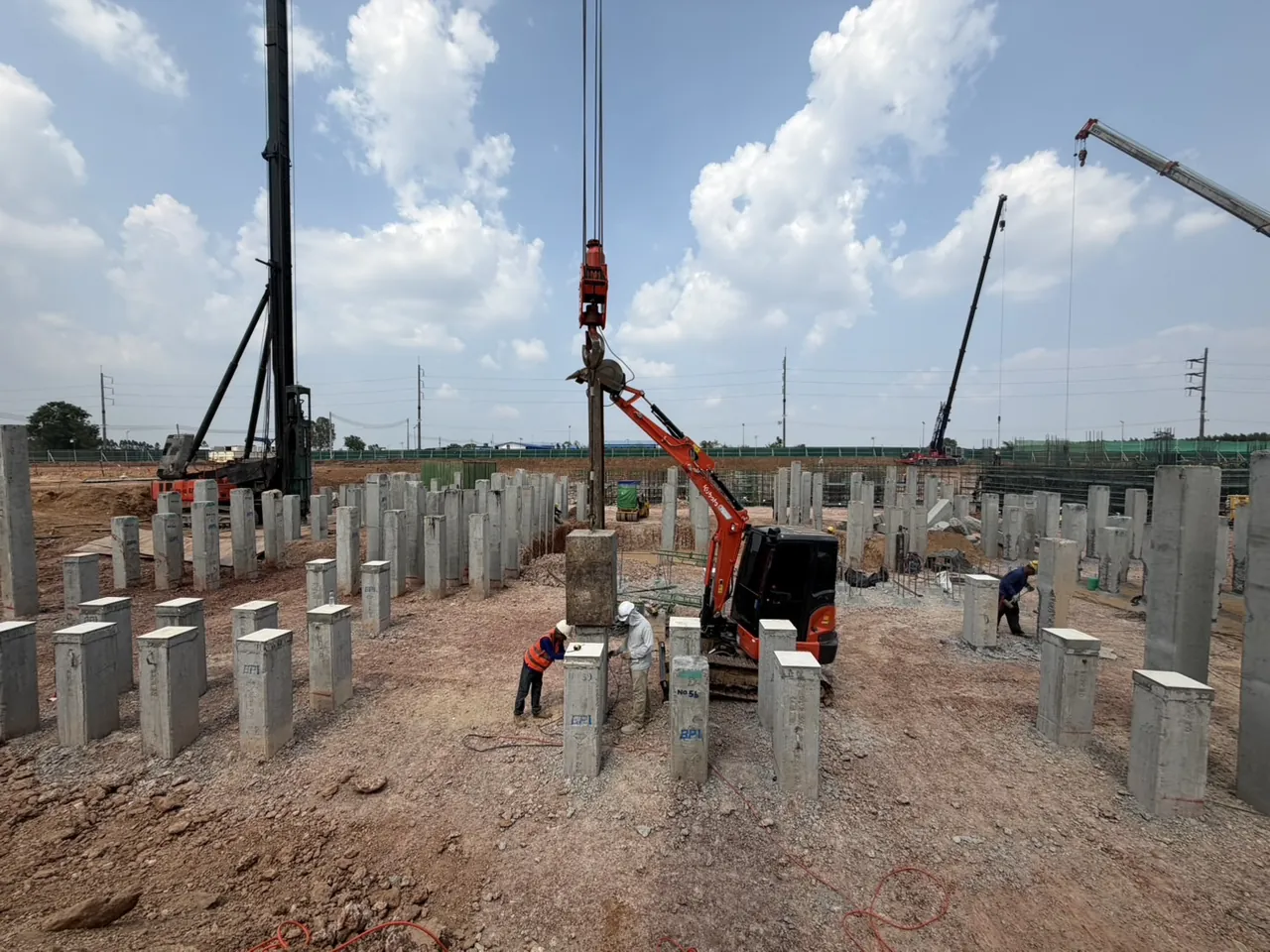
1. Driven Prestressed Concrete Pile (Driven PC Pile)
Prestressed concrete piles are precast in a factory, with cross-sections including I-section, solid square, T-section and hexagonal. They are driven with a drop hammer rig or a diesel hammer. Most residential houses use I-22 and I-26, while commercial buildings use I-30 to I-40.
- Strengths — the lowest cost per tonne of capacity, factory-controlled concrete quality, dozens of piles installed per day, and the soil around the pile is densified during driving, which increases friction.
- Watch out for — high noise and vibration; difficult to drive through dense sand or gravel; risk of pile breakage or refusal leaving piles shorter than designed; and welded splices require strict quality control.
Suitable for: detached houses, townhouses, small- to mid-size commercial buildings, and factories and warehouses on open sites away from other buildings.
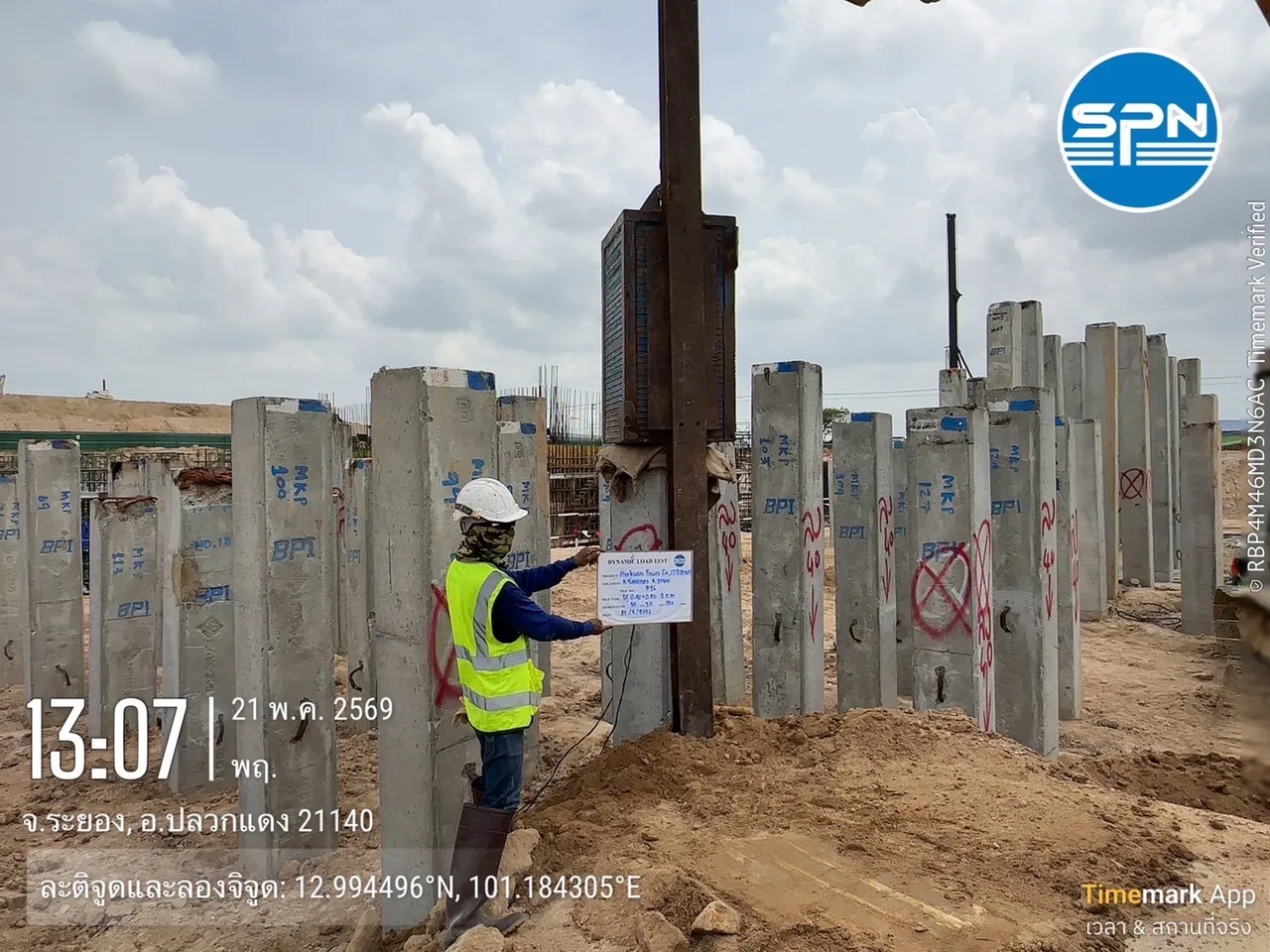
2. Spun Piles and Hollow Prestressed Piles
A spun pile is a driven prestressed concrete pile with a hollow circular section; common sizes are Ø25–120 cm. It is made by centrifugal casting, which gives denser concrete than ordinary cast piles. Spun piles are graded by prestress level into Class A, B and C, which differ in bending moment resistance. "Hollow piles" that are not made by spinning are used in a similar way, so they are usually grouped together.
- Strengths — higher load and bending capacity than solid driven piles of similar size; can be spliced to go deeper; and the dense concrete stands up well to waterfront environments.
- Watch out for — high vibration like other driven piles, higher price, and the key weak point is the splice weld. If the weld does not cover the full section it becomes a failure point, so spun pile weld inspection should be part of the work plan.
Suitable for: mid- to large-size buildings, ports, bridges, waterfront structures, and works needing more capacity than standard driven piles but not yet requiring bored piles.
3. Dry-Process Bored Pile
A small rig drills out the soil one lift at a time, with a temporary steel casing to prevent collapse; the reinforcement is then placed and the concrete poured. Common sizes are Ø35 to Ø60 cm, about 15-25 m deep, which suits the stiff clay layer in the Bangkok area. The limitation is that it only works when the borehole stays dry enough. If sand with inflowing groundwater is encountered, it must switch to the wet process.
- Strengths — very low vibration, the rig fits tight spaces, and the length can be adjusted on site to actual soil conditions straight away. It is the main choice for extensions and houses on narrow lanes.
- Watch out for — quality depends almost entirely on the crew's workmanship. Common problems are necking from soil caving into the hole and segregated concrete. The actual concrete volume must be checked against the calculated volume for every pile.
Suitable for: extensions to existing buildings, urban houses, low-rise buildings next to neighbors, and works where vibration is not allowed.
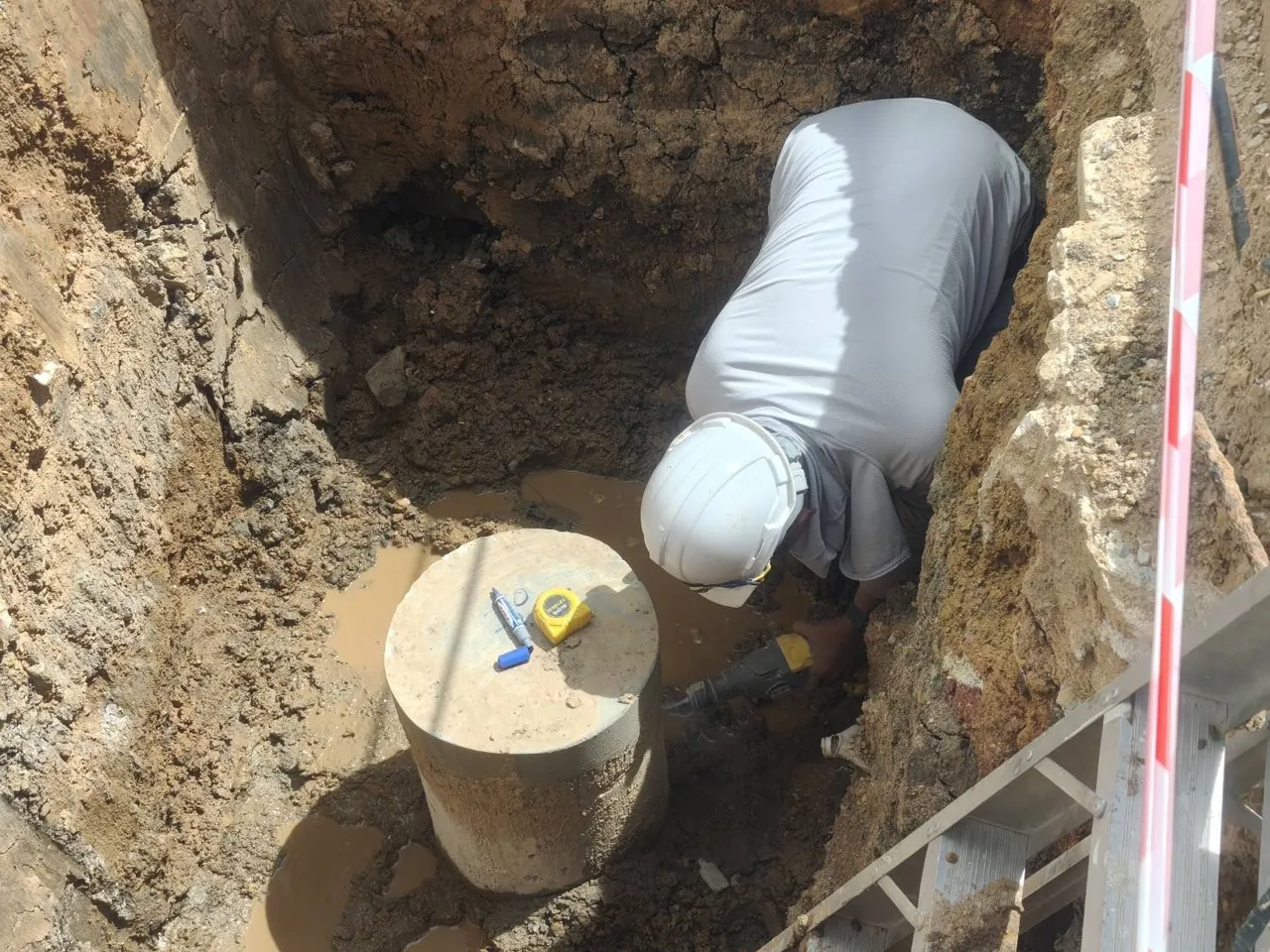
4. Wet-Process Bored Pile
Drilled with a large rig using a support fluid to stabilize the borehole walls (bentonite or polymer), which allows drilling through water-bearing sand layers to depths of 25-65 m. Sizes range from Ø80 to Ø200 cm. It is the main system for high-rise buildings in Bangkok because the pile tips must reach the deep sand layer.
- Strengths — very high capacity, up to thousands of tonnes per pile, so fewer piles are needed per footing; low vibration; and integrity can be checked well if sonic tubes are cast in beforehand.
- Watch out for — needs space for spoil stockpiles, slurry pits and waste management. Base cleanliness is critical: if the bottom is not cleaned properly, sediment forms at the pile tip and causes abnormally large settlement.
Suitable for: high-rise buildings, condominiums, bridges, factories with heavy machinery, and any work where the bearing layer is deeper than driven piles can reach.
5. Barrette Pile
A cast-in-place pile with a rectangular section, excavated with a grab or a cutter (hydromill) of the same type used for diaphragm walls. Common sizes are 0.8-1.5 m thick and 2.4-3.0 m long, reaching depths of 60-70 m. In engineering terms it is a form of bored pile, but its different shape gives it specific advantages.
- Strengths — more soil contact area than a round pile of the same concrete volume, so it develops higher friction, and the long side can be oriented in the direction of the largest lateral load. It suits high-rise buildings that must resist wind and seismic loads, and it can be built continuously with the basement diaphragm walls using the same equipment.
- Watch out for — high cost per pile and the need for a specialist contractor; worthwhile only when column loads are genuinely very high. Inspection requires planning sonic tube positions to cover the wide cross-section.
Suitable for: super high-rise buildings, projects with deep basements, and works where lateral load governs the design.
6. CFA / Auger Cast Pile
Drilled with a continuous flight auger running the full depth. On reaching the required level, concrete or mortar is pumped through the hollow stem of the auger while the auger is withdrawn, and the reinforcement cage is then pushed into the fresh concrete. No support fluid or steel casing is needed.
- Strengths — much faster than conventional bored piles, quiet, low vibration, and no bentonite slurry to dispose of. Suits works with many piles in the same layout.
- Watch out for — reinforcement can only be placed to a shallower depth than in conventional bored piles, so it is unsuitable for works with high lateral or uplift loads. Quality depends on controlling the concrete pumping rate against the auger withdrawal rate; if they do not match, necking occurs. And without cast-in sonic tubes, later inspection is difficult.
Suitable for: factories, warehouses, large housing estates, and works in communities that need both speed and quiet.
7. Micropile
A small-diameter bored pile, Ø10-30 cm, drilled with a small rig. A steel pipe or deformed bar is inserted as the load-carrying core, and grout is then injected to bond it to the surrounding soil. Capacity comes mainly from skin friction, not end bearing.
- Strengths — the lowest vibration of all pile types; the rig fits narrow lanes and works inside buildings with low ceilings, making it the main method for underpinning existing buildings without demolition.
- Watch out for — low capacity per pile, so many piles are needed, giving the highest cost per tonne of capacity. Quality depends on the grouting and on the steel pipe joints, which are far more frequent than in other pile types.
In the Thai market, the term "micropile" is also used for small concrete piles driven or jacked into the ground in short segments that are welded together, which by installation method are driven piles. Both kinds share the same point of concern: closely spaced joints along the entire length.
Micropiles assembled from short segments with welds closely spaced along their length reflect the wave signal back from every joint, making the results impossible to interpret. Quality control must therefore rely on inspecting the welds during installation, together with PDA or a static load test instead. Read more in House extensions on micropiles: do they need pile testing?
Suitable for: underpinning old buildings, extensions in confined areas, buildings that large machinery cannot reach, and repairs of settled foundations.
8. Steel Piles (Steel H-Pile and Pipe Pile)
Piles made from rolled steel H-sections or circular steel pipes, which may later be filled with concrete. In Thailand they are common in ports, bridges, foundations for steel structures and temporary works. They can be installed by driving or by vibration (vibratory hammer).
- Strengths — easily extended by welding, can be cut to level on site, high tensile and bending resistance, drives through hard soil better than concrete piles, and can be extracted and reused in temporary works.
- Watch out for — price is tied to volatile steel prices, and the design must include a corrosion allowance or a corrosion-protection system, especially in saline soil, brackish water and tidal zones.
Suitable for: ports, bridges, breakwaters, crane foundations and temporary shoring, as well as locations needing piles that resist uplift.
Can Sheet Piles Be Used as Load-Bearing Piles for Buildings?
No. A sheet pile is an earth-retaining system, not a load-bearing pile for buildings. Sheet piles are steel or concrete sections with interlocking edges, driven or vibrated into the ground side by side to form a wall that holds back soil and water during excavation. Their job is to resist lateral earth pressure, not to transfer building loads down to firm strata.
In practice, sheet piles are therefore used together with load-bearing piles, not instead of them. Structures that must both retain soil and carry building loads usually use diaphragm walls, which are designed to do both. See more earth-retaining options in Types of retaining walls and Temporary earth-retaining case study.
Why Do People Choose the Wrong Pile? 6 Common Mistakes
The most common mistakes are choosing a pile before knowing the soil layers and comparing price per pile instead of per unit of capacity. All 6 mistakes below often end in settlement or remedial costs higher than what was saved.
1. Using a Stock House Design That Already Specifies Piles, Without Soil Boring
Stock house designs are drawn on an assumed soil profile that may not match the actual plot. Two plots only a few hundred meters apart in the Bangkok suburbs can have sand layer depths differing by several meters. Does a 2-storey house need soil boring?
2. Comparing Price per Pile Instead of per Unit of Capacity
The cheapest pile per unit usually has the lowest capacity as well. Multiplied by the number of piles needed, it can cost more than the option that looked more expensive at first — not counting the larger footings needed to accommodate many piles.
3. Forgetting Negative Skin Friction in Soft Soil
In soft clay areas with new fill or groundwater pumping, the soil around a pile settles more than the pile itself and adds downward load on the pile instead of supporting it. This is called negative skin friction. If it is not allowed for in design, piles calculated as just adequate become inadequate.
4. Choosing Shorter Piles Than Needed to Save Construction Cost
Piles whose tips stop in soft soil keep settling for years, not just once. The symptoms that follow are floors separating from walls, sticking doors and windows, and diagonal cracks at the corners of openings. See warning signs of foundation problems and settlement problems on filled ground.
5. Choosing a System That Cannot Be Inspected, Then Dealing With It Later
For every cast-in-place pile, the decision on casting in sonic tubes must be made before concreting. Without them, if doubts arise later, the inspection options are fewer — for example concrete core drilling, which is expensive and can only be done on a few piles.
6. Mistaking Sheet Piles or Short Hexagonal Piles for Building Load-Bearing Piles
Hexagonal piles only a few meters long are designed for parking slabs, walkways or fences, not building foundations, and sheet piles are an earth-retaining system. Using them for the wrong purpose is a common cause of settlement in low-cost extension works.
What Tests Does Each Pile Type Need?
Driven concrete piles, spun piles and dry-process bored piles are checked for integrity with the seismic integrity test; wet-process bored piles, barrettes and CFA use CSL or TIP; micropiles and steel piles focus on weld inspection. All types confirm load capacity with a static load test or a dynamic test. For precast piles, testing focuses on confirming the pile was not damaged during driving and reached the design layer; for cast-in-place piles, it focuses on the continuity of concrete that cannot be seen. An overview of each method is in Complete guide to pile testing methods.
← Scroll to see the full table →
| Pile type | Integrity check | Capacity check | Points to watch closely |
|---|---|---|---|
| Driven PC pile | Seismic Integrity Test (DPT 1551-51) | PDA (ASTM D4945 / DPT 1252-51), Static (ASTM D1143 / DPT 1251) | Cracks from driving and the blow count for the last 10 blows |
| Spun Pile | Seismic Integrity Test + inspection of splice welds | PDA, Static | Weld quality at every joint |
| Dry-process bored pile | Seismic Integrity Test | PDA, Static | Actual concrete volume vs calculated |
| Wet-process bored pile / barrette | CSL (tubes must be cast in beforehand), TIP (ASTM D7949-25) | Static, High-Strain, O-Cell | Base cleanliness before concreting |
| CFA / Auger Cast | TIP, or CSL if tubes were cast in | Static, PDA | Concrete pumping rate vs auger withdrawal rate |
| Micropile | Weld inspection and grouting records (no seismic test) | PDA, static, uplift test | Pipe welds closely spaced along the full length |
| Steel pile | Weld inspection by NDT of steel welds | PDA, Static | Corrosion and remaining wall thickness |
A seismic integrity test starts at about THB 100–150 per pile and PDA starts at about THB 5,500 per pile. These prices exclude travel and equipment mobilization, which are charged extra according to the distance to site. Compared with the far higher cost of underpinning a building that has already settled, testing is the hardest item to cut from a foundation budget · See our pile testing services · How many piles need testing? · Pile testing prices 2026
Summary
No single pile type is best for every project. Driven piles remain the best value when the site allows; wet-process bored piles and barrettes are necessary when the bearing layer is deep and loads are high; micropiles solve problems other piles cannot reach; and CFA and steel piles are specialist options that pay off under certain conditions.
The sequence that leads to the right decision is always the same: know the soil first, then the load, then filter by site constraints and budget, and finish with testing to confirm. Choosing by price per pile is a shortcut that often ends in repair costs far greater than the savings.
SPN Soil Engineering's engineering team can advise on soil data and testing plans suited to each pile type from the design stage onward.