Why Test Piles?
Testing is needed to confirm two main things: load capacity (Capacity), that the pile actually carries the design load, and integrity (Integrity), that the pile has no internal defects. Piles are underground and cannot be seen after construction. If a pile cannot carry the design load, or has cracks, segregated concrete or insufficient length, the building may settle later.
Each test method answers a different question. This article summarizes all methods in one place, with links to the dedicated article for each method. For the legal requirements, see the summary in Pile testing under the 2023 Foundation Ministerial Regulation
How Many Types of Pile Testing Are There?
Pile testing has 3 main methods, classified by what is measured and the level of force applied to the pile, plus 2 supplementary methods for checking the concrete of bored piles:
- Seismic Integrity Test (Low Strain) — a light tap with a hand hammer on the pile head checks "integrity" and length. Low impact force, economical, fast, and suitable for testing large numbers of piles
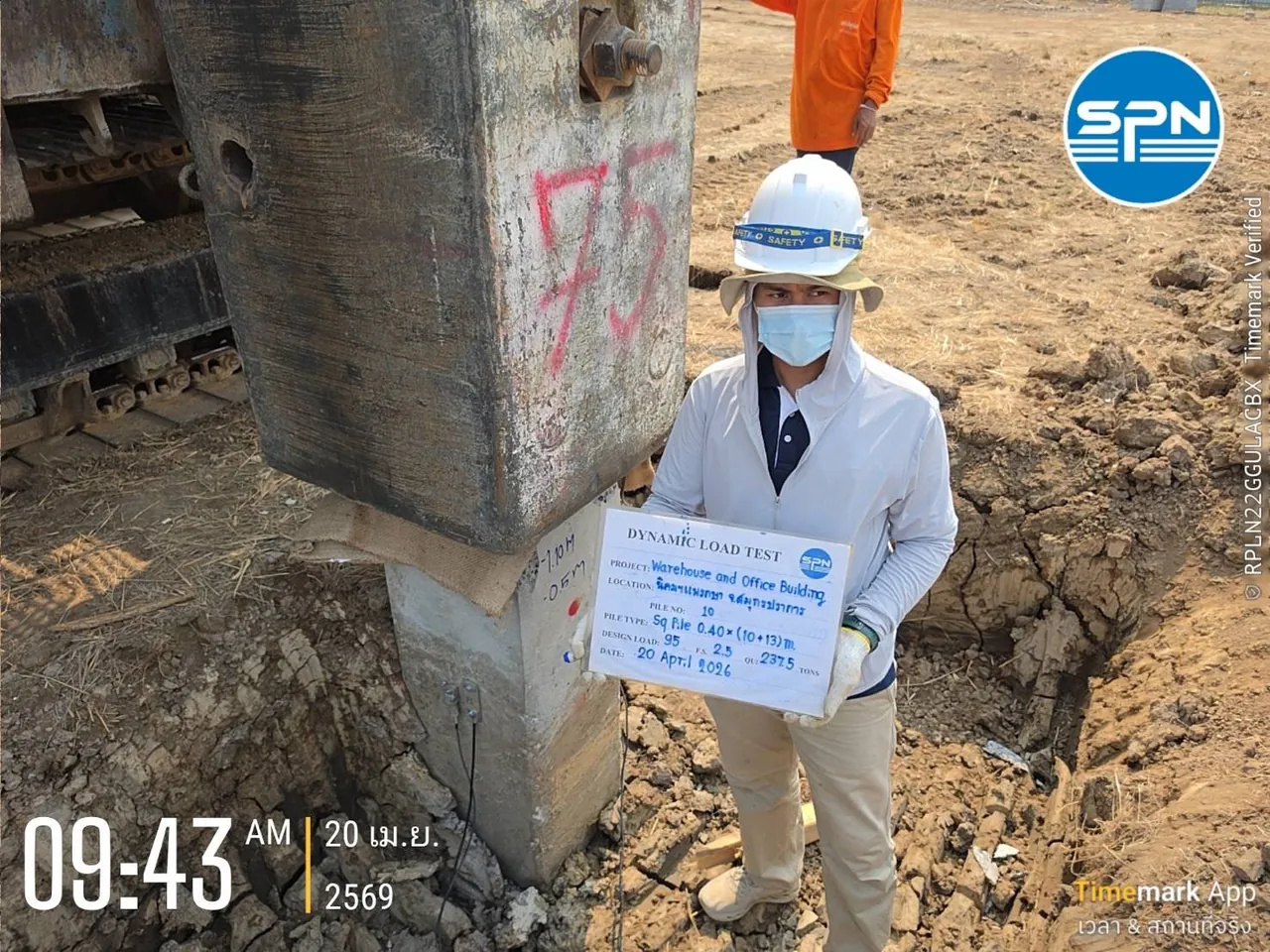
- Dynamic Load Test (PDA, High Strain) — a drop weight delivers a high-strain impact and stress waves are measured to evaluate "load capacity". Several piles can be tested per day
- Static Load Test — real load is applied directly to the pile, so it serves as the reference value for load capacity, but it is slow and costly, so usually only a few piles are tested
- Supplementary methods for bored piles — Cross Hole Sonic Logging (CSL) sends sound waves between tubes cast into the pile to check the integrity of large-diameter bored piles, and the Coring Test drills concrete cores out of the pile body to check quality
The figure below brings all methods together in one map. The three upper cards are arranged from low force to high force and show what each method measures, how fast it is and which standard it references. The bottom strip helps you choose a method based on the question you need answered.
1) What Can a Seismic Integrity Test (Low Strain) Detect?
The Seismic Test, or Low Strain Integrity Test, checks pile integrity and length but does not measure load capacity. An accelerometer is attached to the pile head, the pile is tapped lightly with a hand hammer, and the reflected wave is measured to see whether there are cracks, reductions in cross-section or abnormal length.
Its strengths are that it is fast, economical and suitable for large numbers of piles, so it is widely used to check piles across a whole project. The main standard is DPT 1551-51; ASTM D5882-16 was withdrawn by ASTM in 2025.

The limitation is that the Seismic Test does not evaluate load capacity; it only tells whether the pile is sound and approximately how long it is. For details of the method and interpretation, see the article Seismic Test: Pile Integrity Testing (Low Strain)
2) How Does a Dynamic Load Test (PDA) Measure Load Capacity?
The Dynamic Load Test, or PDA Test (named after the Pile Driving Analyzer), evaluates load capacity from the stress waves generated when a drop weight strikes the pile head with a high-strain impact. Strain gauges (Strain Gauge) and accelerometers (Accelerometer) are attached in pairs on opposite sides of the pile below the pile head to record the force and velocity of the wave.
A single test evaluates load capacity, integrity and pile stresses during impact. Its strengths are that it is fast and much more economical than a Static Load Test, with several piles tested per day. Reference standards are ASTM D4945 and DPT 1252-51.
The field data is further analyzed by signal matching (CAPWAP) to evaluate the static capacity and separate shaft friction from end bearing. For the full principles, see Dynamic Load Test (PDA Test), and for how to read the results, see PDA Test result interpretation
3) Why Is the Static Load Test Used as the Reference?
The Static Load Test is used as the reference because it measures load capacity directly from real load, without back-calculating from waves. Load is applied to the pile head in increments with a hydraulic jack pushing against kentledge or a reaction system, and the corresponding settlement is measured. The results are then interpreted using criteria such as the Davisson Method.
Reference standards are ASTM D1143 and DPT 1251. The trade-offs are that it takes a long time, requires a reaction system or kentledge, and is costly, so usually only a few piles in a project are tested.

For the method and site preparation, see Static Pile Load Test: Testing Pile Capacity by the Static Method
How Do Seismic, Dynamic (PDA) and Static Tests Differ?
The three methods differ in what they measure, the force level applied, speed and the accuracy of the capacity value. Seismic answers the integrity question, while PDA and Static answer the load capacity question. Summarized in one table:
← Scroll to see the full table →
| Topic | Seismic (Low Strain) | Dynamic / PDA (High Strain) | Static Load Test |
|---|---|---|---|
| Measures | Integrity + length | Load capacity + integrity | Load capacity (direct) |
| Force level | Low (hand hammer) | High (drop weight) | Sustained real load |
| Velocity | Very fast, many/day | Fast, many/day | Slow per pile |
| Capacity accuracy | Capacity not assessed | High (with CAPWAP analysis) | Direct measurement (reference value) |
| Standard | DPT 1551-51 · ASTM D5882-16 (withdrawn 2025) | ASTM D4945 · DPT 1252-51 | ASTM D1143 · DPT 1251 |
| Best for | Integrity checks on large numbers of piles | Confirming capacity of many piles | Calibrating capacity on a few piles |
Which Pile Testing Method Should You Choose?
Choose based on the question you need answered; in practice, several methods are often combined:
- To check the integrity of large numbers of piles → start with the Seismic Test, as it is fast and economical
- To confirm load capacity on many piles → use the Dynamic Load Test (PDA)
- For a reference value of load capacity → select a few piles for Static Load Testing to calibrate
- For large-diameter bored piles or suspected concrete quality in the pile → consider CSL or the Coring Test in addition
For an in-depth comparison of the two capacity methods, see Dynamic vs Static Load Test: Which One to Choose, and if you have not yet chosen a pile type, see Comparing driven, bored and spun piles
The pile type also affects which methods can be used. Seismic, PDA and Static can be used on both driven and bored piles. CSL requires tubes to be cast into the pile before concreting, so it must be planned before construction, and the Coring Test drills a core through the concrete of a bored pile. Read more about the differences in How testing differs for bored piles and driven piles
The 3D view below shows where the equipment for each method is placed: the Seismic sensor is on the pile head, the PDA gauges are below the pile head, and the CSL probes are lowered into tubes cast into the bored pile.
The number of piles to be tested and the methods used should follow the project specification and the judgment of the responsible engineer; there is no fixed formula for every job. See the guidelines in How many piles should be tested, or consult the SPN engineering team to plan testing that suits your project.
Which Standards Apply to Pile Testing?
Pile testing in Thailand references 2 main groups: US ASTM standards and DPT standards of the Department of Public Works and Town & Country Planning. SPN's pile testing follows these standards, and reports are certified by a licensed civil engineer (COE) and can be used for building permit applications:
- Dynamic Load Test (PDA) — ASTM D4945 and DPT 1252-51
- Seismic Integrity Test — DPT 1551-51 (ASTM D5882-16 withdrawn in 2025)
- Static Load Test — ASTM D1143 and DPT 1251
- Cross Hole Sonic Logging (CSL) — ACI PRC-228.2 (ASTM D6760 withdrawn in 2025)
For the scope of each DPT standard, see DPT pile testing standards: which ones apply
How Much Does Pile Testing Cost?
Starting prices are about THB 100–150/pile for the Seismic Test, about THB 5,500/pile for the PDA Test and about THB 50,000–150,000+/pile for the Static Load Test. Actual prices depend on the number of piles, pile size, test load and site conditions. Reference prices with standards are summarized in one table:
← Scroll to see the full table →
| Test method | Standard | Starting price | Best for |
|---|---|---|---|
| Seismic Integrity Test | DPT 1551-51 · ASTM D5882-16 (withdrawn 2025) | About THB 100–150/pile | Integrity checks on large numbers of piles across a whole project |
| Dynamic Load Test (PDA) | ASTM D4945 · DPT 1252-51 | From about THB 5,500/pile | Quickly confirming the load capacity of many piles |
| Static Load Test | ASTM D1143 · DPT 1251 | About THB 50,000–150,000+/pile, depending on test load and reaction system | Calibrating the reference value of load capacity on a few piles |
Note: These prices exclude travel and equipment mobilization, which are charged extra based on the distance to site.
CSL and Coring Test prices depend on pile size and number. Get a free quotation within 24 hrs. For more pricing details for each method, see Pile Testing Prices 2026
This article is provided as engineering knowledge. The choice of test method, number of piles to test, appropriate concrete age and interpretation of results should follow the project specification and the judgment of a licensed engineer.