Home About Services Soil Investigation & Testing Pile Testing Topographic Survey Geotechnical Instrumentation Structural Testing (NDT) Environmental Site Assessment Geotechnical Design Civil & Structural Design Articles View all → ASTM Standards for Soil Boring Thai Foundation Regulation 2023 Interpreting SPT N-values Pile Testing Methods Explained Soil Bearing Capacity Careers Contact · Request a quote
Geotechnical Investigation & Soil Testing

Soil Investigation in Thailand: Soil Boring, Field Tests and Soil Laboratory

SPN’s soil investigation service covers the whole job: soil boring with SPT sampling, field and laboratory tests to ASTM standards, and boring logs and reports signed by a licensed civil engineer. We work on land, in rivers and offshore, so designers have real ground data before choosing foundations and piles. We work nationwide across Thailand from our office in Bang Sao Thong, Samut Prakan, near Bangkok.

  • Engineering team with 20+ years of experience
  • 500+ projects nationwide
  • Nationwide: all 77 provinces
  • ASTM standards
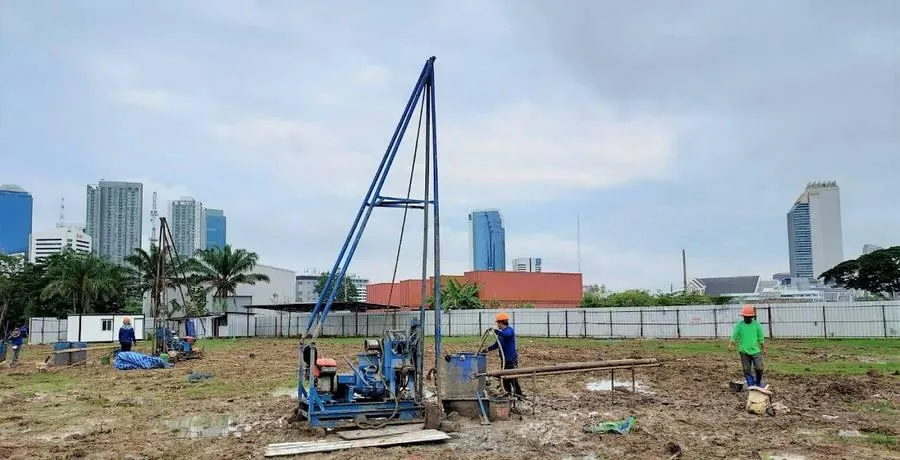
Soil boring rig at a condominium project in Bangkok

Service overview: soil investigation and soil testing

Soil investigation (soil boring) means drilling boreholes to sample the ground and run the Standard Penetration Test (SPT) every 1.5 m, to find the soil layers, groundwater level and bearing capacity before foundation and pile design. SPN’s service covers field tests, laboratory tests, over-water and offshore boring, and reporting. Owners, contractors and designers can all use the same report, including for building permit applications.

Scope

What it covers

  • Soil boring with SPT every 1.5 m
  • Field tests, e.g. CPT, vane shear, plate bearing, field density
  • Laboratory tests, e.g. classification, triaxial, consolidation, rock, soil chemistry
  • Boring in rivers, at ports and dams, and offshore
When to use

When you need it

  • Before designing foundations and piles for houses, buildings and factories
  • Large projects such as condominiums, oil depots, dams and ports
  • Checking compacted fill and pavement layers (field density, DCP)
  • Supporting building permit applications
Deliverables

What you receive

  • Boring logs with soil layers and SPT N-values
  • Groundwater level and laboratory results
  • Report signed by a licensed civil engineer
  • Report within 10 days for jobs of up to 3 boreholes

Field tests for foundation investigation and design

These tests give the soil properties for footing and pile design and bearing capacity.

  • Standard Penetration Test (SPT)ASTM D1586The main boring test: a 63.5 kg hammer falling 76 cm drives a split spoon sampler and the N-value is recorded every 1.5 m for foundation and pile design.
  • Cone Penetration Test (CPT)ASTM D3441 / D5778A 10 cm² cone pushed at 2 cm/s records tip resistance (qc) and sleeve friction (fs) continuously, suited to soft clay and silt.
  • Field Vane Shear TestASTM D2573A vane rotated in soft clay measures undrained shear strength (Su) in place, for soils hard to sample undisturbed such as soft Bangkok clay.
  • Plate Bearing TestASTM D1195 / D1196, DPT 1253-62A 30–75 cm steel plate loaded by hydraulic jack gives bearing capacity and modulus of subgrade reaction (k) for raft, strip footing and slab-on-grade design.
  • Over-water and offshore soil boringASTM D1586 / D1587The rig works from a floating platform or steel pontoon with steel casing through the water, for SPT and Shelby tube sampling at bridges, ports and dams.

Field tests for roads, fill and compaction

These tests control construction quality and support pavement layer design.

  • Field Density Test (Sand Cone)ASTM D1556Measures in-place density and moisture of fill against Standard or Modified Proctor maximum dry density to check the specified % compaction.
  • Dynamic Cone Penetrometer (DCP)ASTM D6951A 20 mm cone driven by an 8 kg hammer gives a DCP index converted to CBR on site, for subgrade and subbase of roads, airfields and car parks.
  • Field CBR Test (In-Situ CBR)ASTM D4429-09a guideline (withdrawn by ASTM in 2018)A standard piston pressed into the soil in a test pit records the load-penetration curve, giving a more precise CBR than DCP for pavement design.
  • Light Penetrometer (Kunzelstab, KPT)DIN 4094 guideline (now replaced by DIN EN ISO 22476-2)A rod of standard weight is driven to check soil density quickly over large areas, roads and fill.

Special investigation, sampling and in-situ measurements

These cover direct inspection, rock and concrete coring, groundwater monitoring and geophysical, thermal and permeability measurements.

  • Test PitA pit 1–5 m deep is dug to inspect soil layers and existing foundations by eye and take undisturbed samples, for extensions, repairs and tight sites.
  • Rock Coring (NMLC triple tube)ASTM D2113Rock core is recovered with an NMLC triple tube core barrel and RQD is calculated, for dams, tunnels and power plants on rock.
  • Concrete CoringASTM C42Cores drilled from an existing structure are tested for compressive strength, and coring also opens a window to the soil below.
  • Observation / Monitoring WellA PVC pipe installed in the borehole tracks groundwater level over the long term, for EIA work and groundwater control.
  • Downhole Seismic TestASTM D7400Measures Vs and Vp in each soil layer with geophones in the borehole, giving shear modulus (G₀) and Site Class to ASCE 7 for seismic design.
  • Electrical Soil Resistivity TestASTM G57Measures apparent resistivity (Ω·m) with the four-point Wenner array for grounding design and buried pipe corrosion risk.
  • Soil Thermal Conductivity TestASTM D5334 (IEEE 442)A thermal needle probe measures thermal conductivity (λ) and resistivity on site, for geothermal systems and underground cable derating.
  • In-Situ Permeability TestISO 22282-2 / ISO 22282-3Falling or rising head tests, or packer (Lugeon) tests in rock, give the permeability (k) of the soil mass for dewatering, excavations and dams.

Laboratory tests: index and physical properties

These 5 tests classify soil to USCS and give basic design values.

  • Natural Water ContentASTM D2216Finds the moisture content (w %) of the soil to describe its natural state and to calculate other parameters.
  • Unit Weight / Bulk DensityASTM D7263Finds soil unit weight (γ, t/m³) for lateral earth pressure, settlement and stability calculations.
  • Specific GravityASTM D854Finds Gs, used to calculate void ratio and degree of saturation.
  • Grain Size Analysis (Sieve / Hydrometer)ASTM D6913 / D7928Separates particle sizes by sieving, with hydrometer analysis for fine-grained soil, for USCS classification.
  • Atterberg LimitsASTM D4318Finds the liquid limit, plastic limit and plasticity index (LL, PL, PI) used to classify clay.

Laboratory tests: shear strength and settlement

These 4 tests give parameters for foundation design, settlement and stability.

  • Unconfined Compression TestASTM D2166Finds qu to calculate the undrained shear strength of clay (Su = qu/2).
  • Direct Shear TestASTM D3080Finds the friction angle (φ) and cohesion (c) for retaining wall and slope design.
  • Triaxial Test (UU / CU / CD)ASTM D2850 / D4767 / D7181Gives shear strength parameters in total and effective stress (c, φ, c′, φ′) for stability analysis.
  • Consolidation TestASTM D2435Gives Cc, Cr, Pc and Cv to calculate the size and rate of settlement of buildings on soft clay.

Laboratory tests: permeability and erosion

These 2 tests support dams, embankments, excavations and dewatering design.

  • Permeability TestASTM D5084 / D2434Fine-grained soil is tested in a flexible wall permeameter and sand or gravel by the constant head method, giving k (m/s).
  • Pinhole Test (Dispersion)ASTM D4647Shows whether a clay is dispersive (Class D / ND), which means a risk of internal erosion in embankments and dams.

Laboratory tests: compaction, subgrade and cement-stabilised materials

These 3 tests control the quality of pavement layers and cement-treated materials.

  • Compaction Test (Modified Proctor)ASTM D1557Finds maximum dry density and optimum moisture content (MDD, OMC) to set field compaction criteria.
  • California Bearing Ratio (CBR) TestASTM D1883Finds the bearing strength of subgrade soil for pavement thickness design.
  • Soil-Cement UCSASTM D1633Tests the compressive strength of soil-cement or cement-mixed crushed rock specimens at the specified curing age.

Laboratory tests: rock

These 2 tests are used with rock coring for foundations on rock, dams and tunnels.

  • Rock Uniaxial Compressive Strength (Rock UCS)ASTM D7012Tests the compressive strength (σc, MPa) of intact rock core to assess foundations on rock.
  • Point Load TestASTM D5731Gives a quick rock strength index, Is(50), from core or rock lumps along the full borehole length.

Laboratory tests: soil chemistry

These 3 tests assess ground conditions that affect concrete, steel and buried pipes.

  • Soil pHASTM D4972Measures soil pH to assess the corrosion environment for buried materials.
  • Water-Soluble Sulfate and ChlorideASTM C1580 / AASHTO T 291Finds sulfate and chloride content to assess the risk to concrete and reinforcement in footings and piles.
  • Organic ContentASTM D2974Finds the organic content of soils such as peat and marine mud, which affects settlement and cement stabilisation.

Which soil tests fit your project?

SPN recommends a test set by project type, so you get the design parameters without paying for tests you do not need.

Project typeRecommended test setPurpose
Houses and small buildingsSPT + Field Vane ShearEconomical foundation design
High-rise buildings and factoriesMultiple SPT boreholes + CPT + Plate BearingFoundation and pile design
Roads, runways and earth fillField Density Test + DCP TestCompaction quality control for every layer
Dams, embankments and over-water worksSPT on floating platform + Vane Shear + Test PitInvestigating soil layers under water
Projects on rockRock Coring + RQD analysisFoundation quality on rock for dams, tunnels and power plants
Environmental and groundwater workObservation Well + monitoringLong-term groundwater level monitoring

Where has SPN done soil investigation in Thailand?

Over-water and offshore boring · Gulf of Thailand

Soil boring in rivers, dams and the Gulf of Thailand

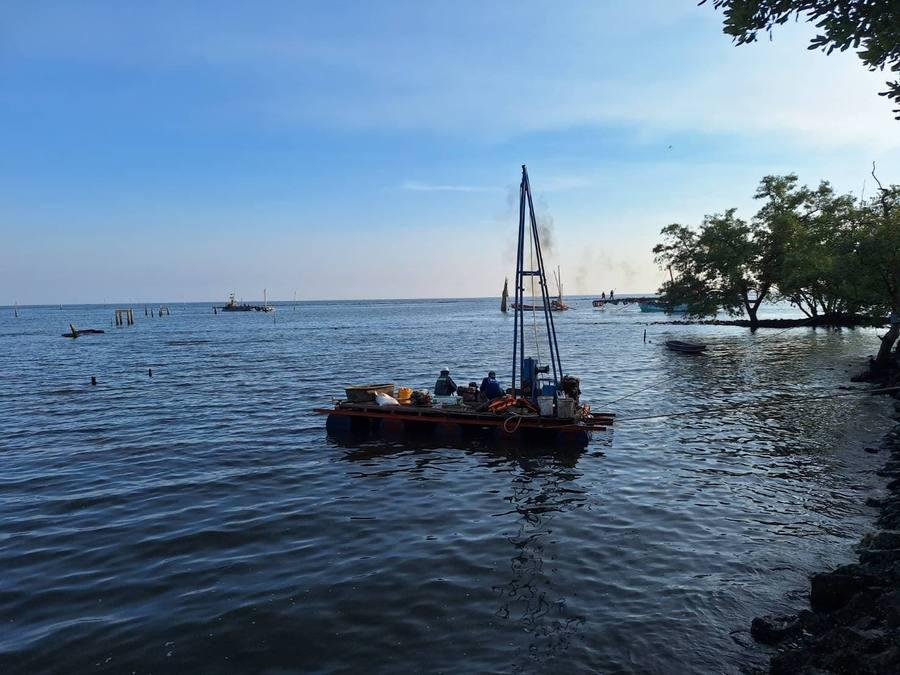
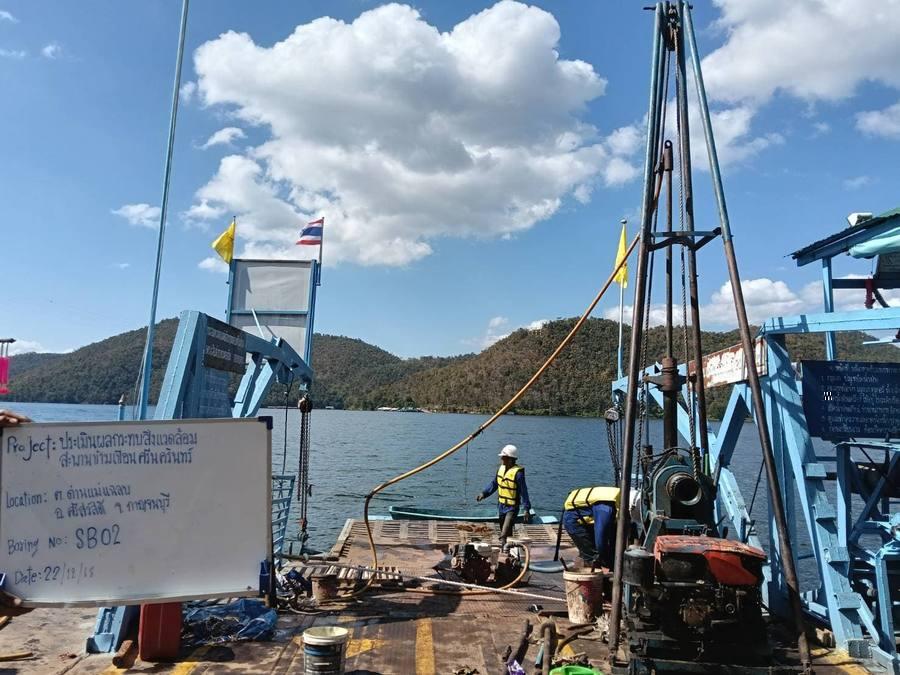
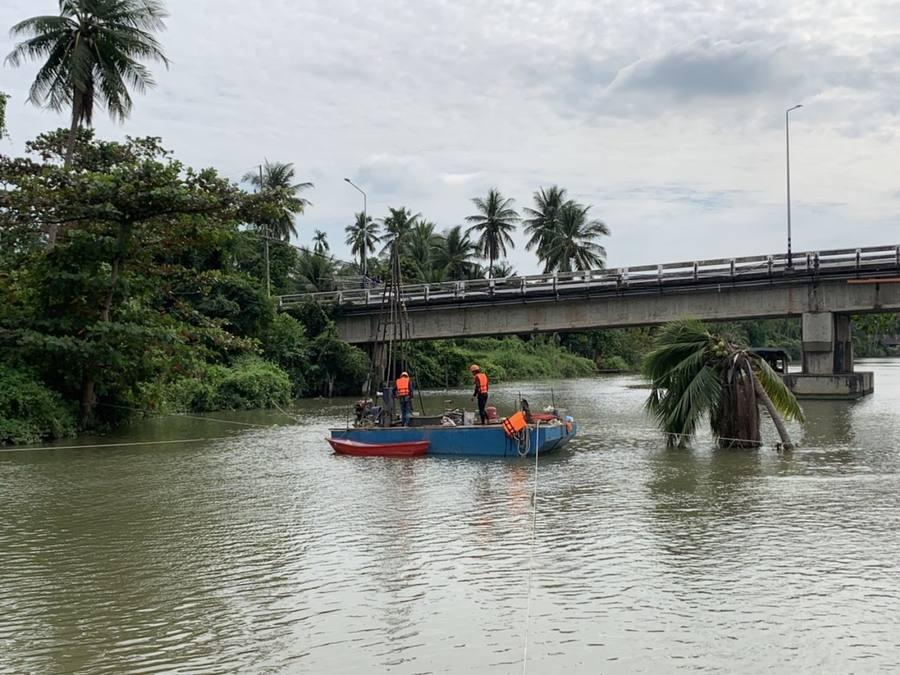
SPN bores from anchored floating platforms, held at 4 points or by spud legs, with steel casing through the water into the bed soil. Sites include rivers in Prachinburi and Nakhon Pathom, a bridge in Ayutthaya, a dam face in Kanchanaburi, an LPG terminal and the Gulf of Thailand.

  • Floating platform anchored at 4 points or spud legs
  • Steel casing through water into bed soil
Full case study (Thai) →
Soil boring and SPT · Chonburi, Rayong (EEC)

Industrial and energy projects in Chonburi and Rayong

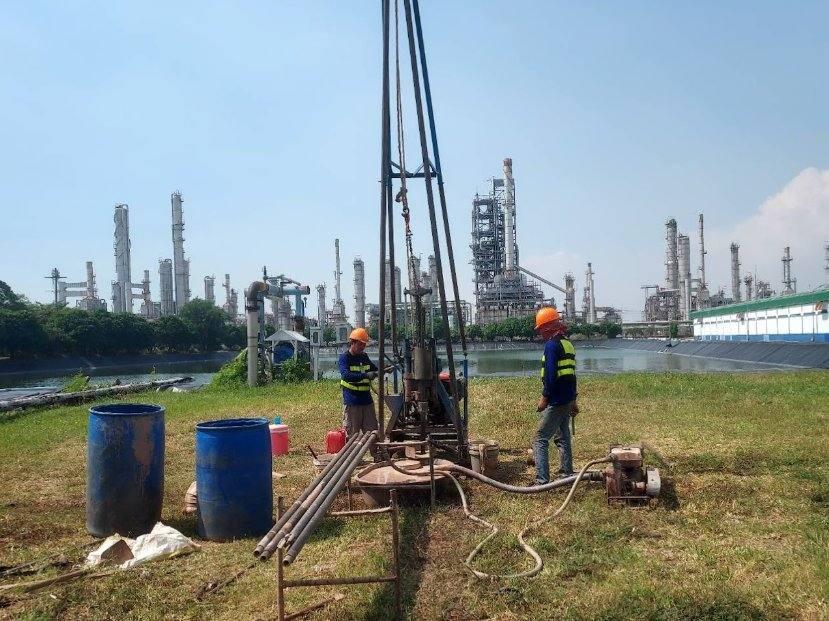
SPN has bored inside a petrochemical industrial estate in Rayong under the plant's permit-to-work system, and on Rayong factory projects with SPT and lab tests for machine and building foundations. Chonburi work includes an LPG port, fuel tanks and a deep excavation.

  • Plant permit-to-work and safety system followed
  • Team reaches Chonburi and Rayong sites within one day from Bang Sao Thong
Full case study (Thai) →
Soil boring, SPT, Shelby tube · Bangkok

Condominium in central Bangkok

For a condominium in central Bangkok, SPN bored down to the bearing sand layer with SPT and Shelby tube sampling, through soft Bangkok clay about 12–20 m thick.

  • Boring down to the bearing sand layer
  • Soft Bangkok clay about 12–20 m thick
Full case study (Thai) →

Site photos from SPN projects

Offshore soil investigation from a floating barge in the Gulf of Thailand
Offshore boring, Gulf of Thailand
Soil boring on a floating platform at a dam face in Kanchanaburi
Dam face boring, Kanchanaburi
River soil boring under a bridge in Ayutthaya
River boring under a bridge, Ayutthaya
Soil boring inside a petrochemical industrial estate in Rayong
Petrochemical industrial estate, Rayong
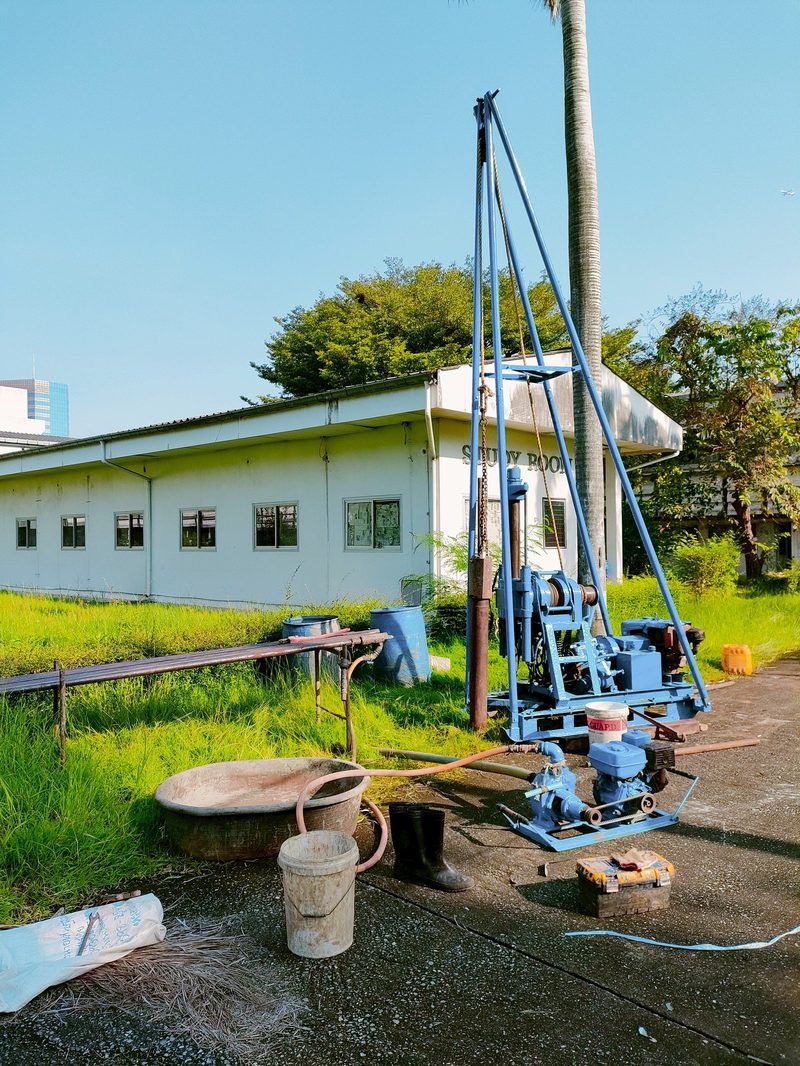
Standard Penetration Test (SPT) with a soil boring rig, ASTM D1586
SPT soil boring rig
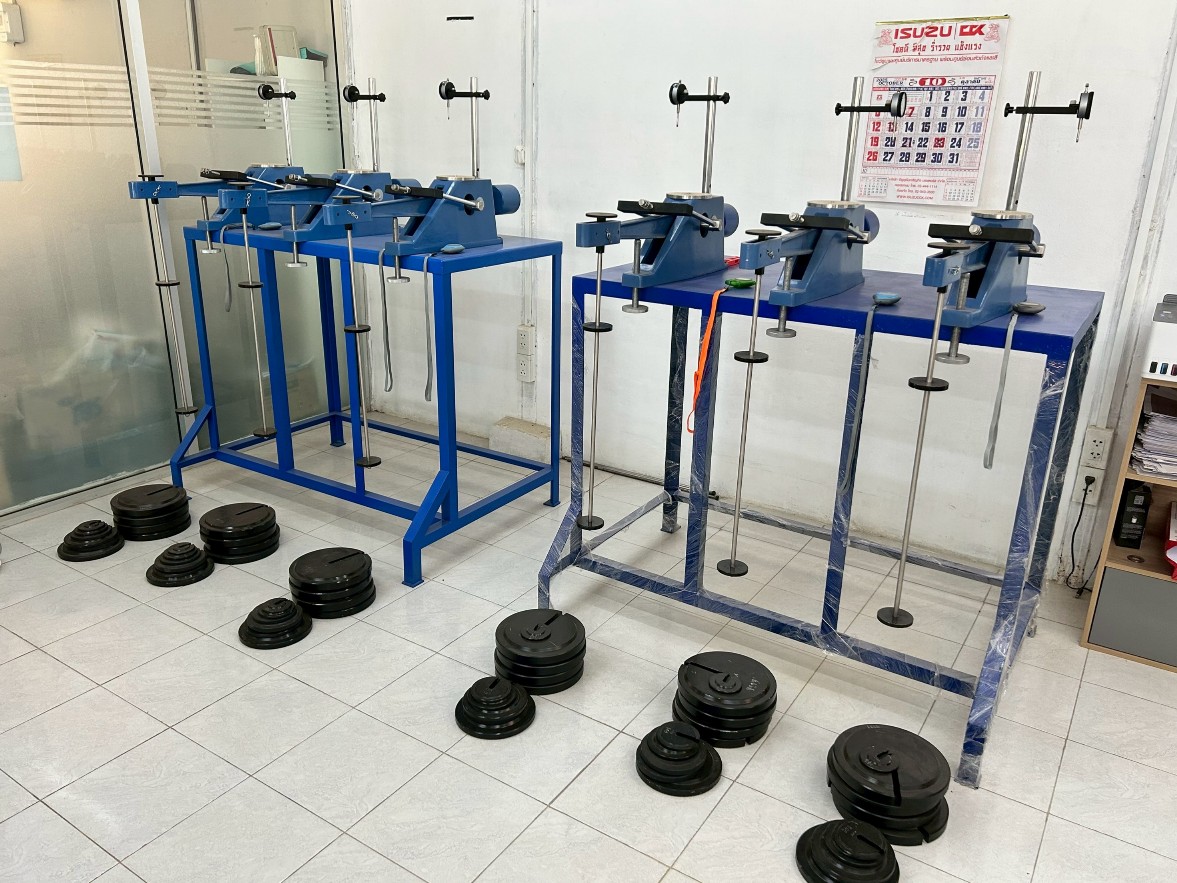
Consolidation test in the SPN soil laboratory, ASTM D2435
Consolidation test, SPN soil laboratory

How does a soil investigation project with SPN work?

  1. Send project detailsSend the location, building type or storeys, and site plan if available, by phone, LINE or email.
  2. Planning and quotationAn engineer sets the boreholes, depth and tests, with a quotation within 24 hours.
  3. Boring and field testingSPT every 1.5 m, split spoon (SS) and Shelby tube (ST) samples, and groundwater level, on land or over water.
  4. Laboratory testingSamples are tested to ASTM standards. Basic tests take about 3–5 days.
  5. Analysis and reportBoring logs and soil profile with lab results, checked and signed by the engineer.
  6. Report deliveryWithin 10 days for up to 3 boreholes, ready for design and building permit submission.

What do you receive from a soil investigation?

  • Boring log and soil profile showing soil layers over the full bored depth
  • SPT N-value every 1.5 m
  • Groundwater level (GWL)
  • Relevant laboratory test results
  • Report signed by a licensed civil engineer (Council of Engineers Thailand licence)
  • Report within 10 days for jobs of up to 3 boreholes
  • A report you can use for foundation design, building permit applications and bank submissions

Why work with SPN in Thailand?

Coverage
Nationwide, all 77 provinces of Thailand. Office in Bang Sao Thong, Samut Prakan, near Bangkok and Suvarnabhumi Airport.
Scope
Testing, investigation and engineering design only. SPN does not take construction work, so recommendations stay independent.
Reports
Signed by a licensed civil engineer (Council of Engineers Thailand licence) and usable for Thai building permit submissions.
Language
Quotations and coordination in English or Thai.
Quotation
Free quotation within 24 hours. Send drawings, site location or TOR to info@spnth.com or LINE @spnth.

Frequently asked questions about soil investigation in Thailand

How long does soil investigation take?
One borehole 15–30 m deep takes 1–2 days in the field, and a typical job of 5–10 boreholes takes 3–7 days, depending on the site and soil conditions.
What is a boring log?
A boring log is the record of the soil layers over the full depth of a borehole. It shows soil type, SPT N-value and groundwater level, and engineers use it to design footings and piles.
How much does soil investigation cost in Thailand?
Soil investigation is priced per project, based on the number of boreholes, the depth to stiff soil, site conditions and mobilisation distance. Send the site location for a free quotation within 24 hours.
What information do you need for a quotation?
Send the site location, number of boreholes and depth if known, and the project type, such as house, building, factory or road. If unsure, an SPN engineer will set the boreholes, depth and tests.
Are soil test reports certified by an engineer?
Yes. Every report is signed by a licensed civil engineer (Council of Engineers Thailand licence). You can use it for building permit applications and bank submissions.
Do you work outside Bangkok?
Yes, SPN works in all 77 provinces of Thailand. Our office in Bang Sao Thong, Samut Prakan, gives the fastest access to Bangkok and its vicinity, and we work regularly in the EEC (Chonburi, Rayong, Prachinburi) and Central Thailand (Ayutthaya, Saraburi, Kanchanaburi).
What is the difference between SPT and CPT?
SPT recovers soil samples and works in almost all soils, including dense sand and stiff soil that CPT cannot push through. CPT gives continuous, more consistent data in clay and sand but cannot pass gravel or rock. In practice SPT is the main method and CPT is added where more detail is needed.
How long does soil laboratory testing take?
Basic laboratory tests take 3–5 days. A consolidation test takes 7–14 days and a triaxial test 7–10 days, depending on the number of samples.
Can you do soil boring in rivers or offshore?
Yes. SPN bores in rivers, under bridges, at dam faces, in ports and in the Gulf of Thailand from a floating platform or steel pontoon held by anchors or spud legs. Steel casing goes through the water and soft soil, then SPT and Shelby tube sampling follow the same standards as on land.