Home About Services Soil Investigation & Testing Pile Testing Topographic Survey Geotechnical Instrumentation Structural Testing (NDT) Environmental Site Assessment Geotechnical Design Civil & Structural Design Articles View all → ASTM Standards for Soil Boring Thai Foundation Regulation 2023 Interpreting SPT N-values Pile Testing Methods Explained Soil Bearing Capacity Careers Contact · Request a quote
Structural Testing & NDE

Non-Destructive Testing of Concrete and Structural Inspection in Thailand

SPN’s structural testing service covers everything from concrete and rebar testing and existing foundation and pile assessment to load tests of floors, bridges and roads and building damage assessment. Most methods need no demolition and the building stays in use, and results are summarised in a report signed by a licensed engineer for repair, extension or purchase decisions. We work nationwide across Thailand from our office in Bang Sao Thong, Samut Prakan, near Bangkok.

  • Concrete, foundation and load testing
  • Nationwide, all 77 provinces
  • Free quotation within 24 hours
  • Reports signed by a licensed civil engineer
SPN engineers scanning a concrete pavement with ground penetrating radar (GPR) in Thailand

Service overview: structural testing and NDE

Non-destructive evaluation (NDE) assesses the strength and condition of an existing structure, such as concrete strength, rebar position, voids under slabs and the length of existing piles, without demolition. SPN combines methods to suit the purpose of each job, from concrete strength and rebar detection to existing-pile assessment, load testing and damage assessment.

Scope

What it covers

  • Concrete and rebar: core test · rebound hammer · UPV · GPR · rebar scan
  • Existing foundations and piles: Parallel Seismic · Side Echo · pull-out test
  • Load tests of floors, warehouse slabs, bridges/piers, roads and machine foundations
  • Neighbouring buildings, vibration, post-fire and post-earthquake assessment
When to use

When you need it

  • Buildings with cracks or unusual settlement
  • Old buildings without drawings, before extension or change of use
  • Before installing racks or heavy machines, or raising vehicle limits on bridges and roads
  • Before buying or leasing a building, or building next to existing structures
Deliverables

What you receive

  • Test results and assessment of remaining strength
  • Cause of damage with repair recommendations
  • Report signed by a licensed engineer
  • GPR, rebound hammer and UPV results within 3–5 working days of site work

Concrete quality and strength

These tests measure the compressive strength, uniformity and remaining service life of concrete in the actual structure.

  • Core Drilling & Compressive StrengthASTM C42Cylindrical concrete cores are drilled from the structure and tested for compressive strength in the laboratory. It gives the most reliable strength value.
  • Rebound Hammer / Schmidt HammerDPT 1502-51, ASTM C805, BS EN 12504-2A spring hammer measures surface hardness, and the rebound number is converted to an estimated compressive strength. It is fast and suits screening of large areas before choosing core locations.
  • Ultrasonic Pulse Velocity (UPV)ASTM C597, DPT 1504-51High-frequency sound pulses are sent through the concrete to assess quality and uniformity and to detect internal voids or cracks.
  • Carbonation Depth TestBS EN 14630Phenolphthalein is applied to a fresh concrete face to measure how deep carbonation has penetrated. The result indicates remaining service life and the risk of rebar corrosion.

Crack, void and rebar detection

These methods use electromagnetic waves and specialist instruments to find what cannot be seen inside a structure or below the ground surface.

  • Ground Penetrating Radar (GPR)DPT 1507-51, ACI PRC-228.2 (concrete); ASTM D6432 (subsurface)GPR scans concrete for rebar, cover, voids and embedded pipes, and surveys below ground for pipes, buried objects and cavities. Detection depth depends on antenna frequency and site materials.
  • Rebar Locator / Cover MeterDPT 1505-51, BS 1881-204Locates reinforcing bars and measures their size and concrete cover without drilling. It is used to plan core locations.
  • Half-Cell Potential TestASTM C876, DPT 1506-51Measures the electrical potential of the reinforcement through the concrete surface to produce a corrosion map. It suits older structures and aggressive environments.
  • Crack Mapping & MonitoringCracks are surveyed and mapped, their width and length measured, and changes tracked with crack gauges. This separates cracks that have stopped from cracks that are still growing.

Existing foundation and pile assessment

These tests find the length and integrity of existing piles and foundations that have no drawings, and the holding capacity of anchors in concrete.

  • Parallel Seismic TestASTM D8381A borehole is drilled parallel to the pile and wave arrival times are recorded with a hydrophone to find the pile length without removing the structure. It suits old buildings with no construction drawings, before alteration or repair.
  • Side Echo TestDPT 1551-51Tests the integrity of piles and foundations where the pile head cannot be reached, by striking the side face in an excavated pit and recording the signal with an accelerometer. It gives qualitative results that complement the Parallel Seismic Test.
  • Pull Out TestASTM E488Anchor bolts, chemical anchors and threaded studs in concrete are pulled with a hydraulic jack while the load-displacement curve is recorded. It confirms holding capacity before machinery or steel structures are installed.
  • Foundation & Structural InspectionDPT 1501-51, DPT 1902-62Engineers inspect foundations, beams, columns and slabs for damage, settlement and deterioration. The report includes maintenance and repair recommendations.

Load testing and capacity assessment

This group confirms whether floors, bridges, roads and foundations can carry a new service load, by real load testing or by assessment from test results and calculation.

  • Floor Loading TestACI 318 Chapter 27, ACI 437.2Test load (water ponding, water tanks or sandbags) is placed on the actual slab while deflection and recovery are measured. It confirms that the floor carries the required load before use.
  • Warehouse floor assessment for racks and forkliftsSlab thickness and rebar are measured with GPR or cores and concrete strength is tested. Point loads from selective rack legs and forklift wheels are then checked against the existing slab before installation.
  • Bridge and pier load testAASHTO MBE, ACI 437.2Trucks or known weights are applied while deflection is measured with LVDTs and strain with strain gauges. Diagnostic and proof load tests confirm a vehicle load rating.
  • Concrete road and yard assessment for cranes and trailersSlab thickness, rebar and concrete strength are checked, and the subgrade is tested with a Plate Bearing Test. Wheel and outrigger loads from cranes or trailers are then compared with the capacity of the existing road or yard.
  • Machine foundation, tank base and concrete column inspectionChecks cracks, concrete strength, rebar position and settlement of old machine foundations, tilted or settled tank bases and cracked concrete columns.
  • Structural Back AnalysisDPT 1902-62Back-calculation from test results and site data to find the cause of damage, assess remaining capacity and plan strengthening.

Damage and building condition assessment

These services record building condition before and after an event and assess whether a building can stay in use, needs repair or needs strengthening.

  • Dilapidation Survey of adjacent buildingsRecords the condition of neighbouring buildings before foundation or excavation work, with dated and located photos, a crack map and crack gauges. It serves as evidence in crack disputes.
  • Vibration MonitoringDIN 4150-3, BS 7385-2Measures peak particle velocity (PPV) at adjacent buildings during pile driving, excavation or machine operation. Results are compared with the criteria required by the project.
  • Post-fire building assessmentDPT 1902-62, ACI 562Heat damage to concrete and reinforcement is assessed by condition survey, core tests, UPV and rebound hammer. Members are graded by damage level to decide whether they can be repaired or must be replaced.
  • Post-earthquake building inspectionATC-20, DPT 1902-62A rapid inspection classifies safety (green, yellow or red tag), followed by detailed testing where damage is found. The result states whether the building can stay in use or needs repair and strengthening.
  • Technical Due Diligence before purchase or leaseStructural condition survey, review of documents and drawings, concrete and rebar tests at critical points, and assessment of existing foundations.

Which test gives which result?

Each method answers a different question, so engineers usually combine a fast screening test with a confirming test.

TestStandardResultUsed for
Core DrillingASTM C42f'c (MPa)Confirming actual concrete strength
Rebound HammerDPT 1502-51 / ASTM C805Rebound numberFast preliminary survey
Ultrasonic Pulse VelocityASTM C597 / DPT 1504-51Vp (m/s)Concrete quality, internal voids
Ground Penetrating RadarDPT 1507-51 / ACI PRC-228.2 (concrete); ASTM D6432 (subsurface)RadargramRebar, voids, pipes and buried objects
Half-Cell PotentialASTM C876 / DPT 1506-51mV vs CSECorrosion risk of reinforcement
Pull Out TestASTM E488Load (kN)Anchor bolt holding capacity
Parallel Seismic TestASTM D8381Length (m)Length of existing piles and foundations
Floor Loading TestACI 318 Chapter 27 / ACI 437.2Deflection (mm)Load capacity of floor slabs

Where has SPN done this work?

Floor Load Test · Bangkok

Water-ponding floor load test before alteration, Thung Khru

SPN load tested a 32 cm cast-in-place RC slab (span 3.75 × 4.00 m) in a 2-storey RC building before alteration, with water ponded 64 cm deep (640 kg/m²) and held for 24 hours. Measured deflection was 0.50 mm and the slab passed the ACI 318-19 Chapter 27 criteria for a design live load of 400 kg/m².

  • Test load 640 kg/m² for 24 hours
  • Deflection 0.50 mm, passed ACI 318-19 Ch. 27
Full case study (Thai) →
Parallel Seismic · Samut Prakan

Existing pile length at a factory with no foundation drawings, Bang Sao Thong

An existing factory had no foundation drawings, so SPN ran Parallel Seismic tests on 2 piles and found pile toes at about 22.60 to 23.35 m depth. The results were combined with borehole BH-1, drilled to 30.45 m.

  • Pile toes about 22.60 to 23.35 m
  • Borehole BH-1 to 30.45 m
Full case study (Thai) →
Pull Out & Core Test · Chonburi

Anchor pull-out and concrete core tests on an existing building, Chonburi

SPN carried out pull-out tests of chemical anchors to ASTM E488 and concrete core tests to ASTM C42 on an existing building in Chonburi. The project gallery also shows a pull out test at Sirius Project, Chonburi.

  • Chemical anchor pull-out, ASTM E488
  • Concrete cores, ASTM C42
Full case study (Thai) →

Site photos from SPN projects

SPN engineers performing ultrasonic pulse velocity (UPV) tests on floor beams in an office building
UPV testing of beams in an occupied office building
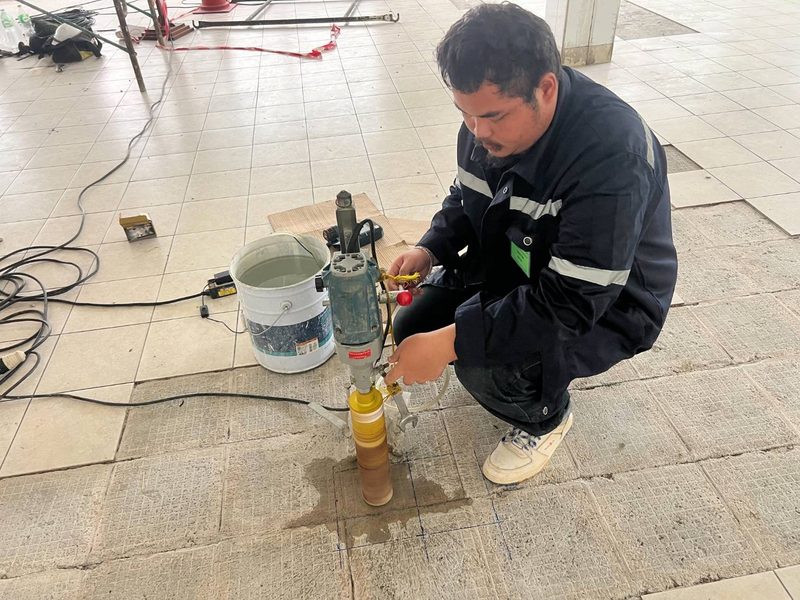
Drilling a concrete core from a building floor slab with a diamond core barrel
Concrete core drilling from a floor slab
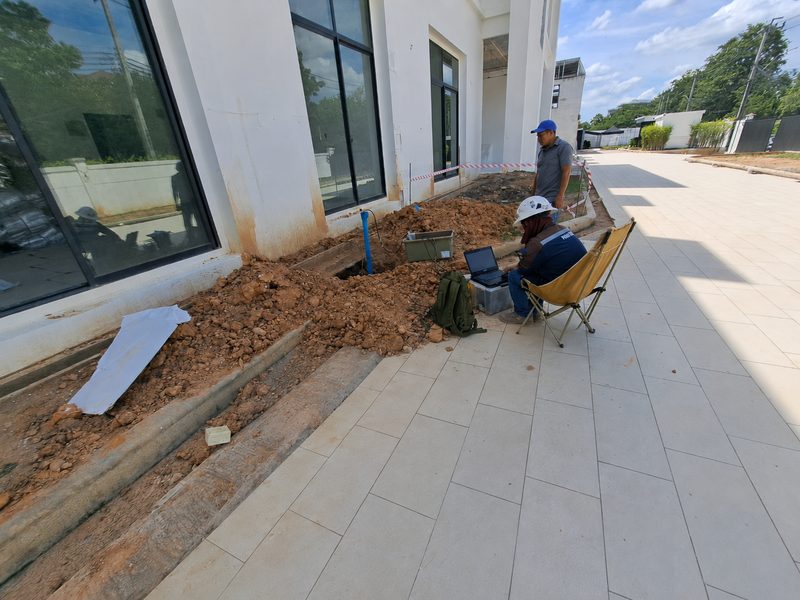
Parallel Seismic Test data acquisition beside an existing building
Parallel Seismic Test data acquisition beside a building
Pull out test of an anchor bolt with a hydraulic jack and dial gauge in Chonburi
Anchor pull out test, Chonburi
Rebound hammer test on a concrete pedestal supporting a steel column in a factory
Rebound hammer test on a column pedestal
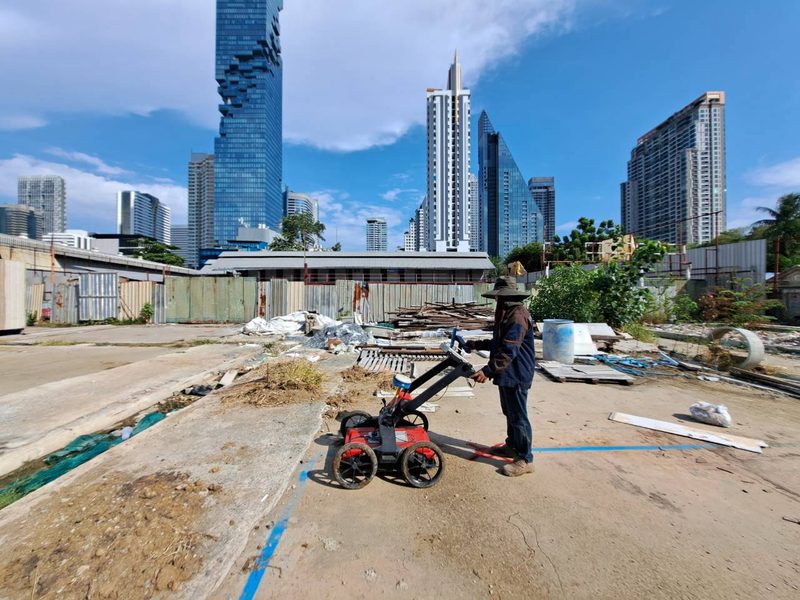
Ground penetrating radar subsurface scan on a construction site in Sathorn, Bangkok
GPR subsurface scan, Sathorn, Bangkok

How does a structural testing project with SPN work?

  1. Send information and photosTell us the location, building age, drawings (if any), photos of cracks or areas of concern and your objective, by LINE, phone or email.
  2. Test plan and quotationAn engineer selects the methods, number of test points and report level to match your objective, and sends a quotation within 24 hours.
  3. Site testingMost field work takes 1 day and can be done while the building is in use. Every test point is marked and photographed.
  4. Laboratory testingConcrete cores are tested for compressive strength in the laboratory, which takes about 7 to 14 days.
  5. Analysis and assessmentResults from all methods are processed together and compared with standard criteria to assess remaining capacity and the cause of damage.
  6. Signed reportThe report is signed by a licensed engineer and includes repair recommendations. GPR, rebound hammer and UPV reports are ready within 3 to 5 working days after site work.

What do you receive?

  • Engineering report signed by a licensed civil engineer (Council of Engineers Thailand licence)
  • Test results with the standard used for each method, such as core strength f'c (MPa), UPV pulse velocity (m/s), rebound numbers and radargrams
  • Marked and photographed location of every test point
  • Rebar position and cover, corrosion map or crack map where these tests are included
  • Deflection and recovery records for floor and bridge load tests, or load-displacement curves for pull out tests
  • Assessment of remaining capacity and likely cause of damage, with repair or strengthening recommendations

Why work with SPN in Thailand?

Coverage
Nationwide, all 77 provinces of Thailand. Office in Bang Sao Thong, Samut Prakan, near Bangkok and Suvarnabhumi Airport.
Scope
Testing, investigation and engineering design only. SPN does not take construction work, so recommendations stay independent.
Reports
Signed by a licensed civil engineer (Council of Engineers Thailand licence) and usable for Thai building permit submissions.
Language
Quotations and coordination in English or Thai.
Quotation
Free quotation within 24 hours. Send drawings, site location or TOR to info@spnth.com or LINE @spnth.

Frequently asked questions about structural testing and NDE

What is the difference between structural testing and NDE?
Structural testing measures strength or capacity directly, for example a floor loading test or a pull out test. NDE (non-destructive evaluation) assesses internal condition without damage, for example GPR, UPV and rebound hammer. In practice the two are usually combined for a complete result.
Should I use core drilling or a rebound hammer?
Use both: a rebound hammer to screen many points quickly, then core drilling at suspect areas to confirm strength. The rebound hammer is fast and non-destructive but less accurate. Core drilling tests real samples in the laboratory to ASTM C42.
What can GPR detect, and how deep?
GPR detects rebar, embedded pipes, voids, internal cracks, cables and other buried objects in concrete and soil. Detection depth is not fixed; it depends on antenna frequency and on the type and moisture of the material. Subsurface surveys in dry sand may reach about 2 to 3 m or more, and much less in wet clay.
How is a Parallel Seismic Test different from PIT or a Side Echo Test?
A Parallel Seismic Test (ASTM D8381) measures pile length from a borehole drilled beside the pile, so it works when the pile head is buried under a pile cap or building. PIT strikes the pile head directly (DPT 1551-51) and needs access to it. A Side Echo Test strikes the side of the foundation in an excavated pit and gives qualitative integrity results; if the goal is to confirm pile length, Parallel Seismic is the more accurate choice.
How is a floor loading test carried out?
Test load is placed on the slab according to a designed load layout, and deflection is measured at mid-span and edges with dial gauges or LVDTs over a 24 to 48 hour test period. Recovery is then measured after unloading. The result confirms that the floor carries its design load before it is put into use.
Can an existing warehouse floor carry racks or forklifts?
This can be checked without breaking the floor. Slab thickness and rebar are measured with GPR or cores and concrete strength is tested, then an engineer checks point loads from rack legs and forklift wheels against the slab capacity. If the calculation is borderline, a floor load test with real load confirms it.
How long does it take to get the report?
Most field work takes 1 day, depending on the number of test points and the area. Concrete cores must be conditioned to ASTM C42 before compressive testing, so core results take about 7 to 14 days in total. GPR, rebound hammer and UPV reports are ready within 3 to 5 working days after site work.
Can the test reports be used for permit applications?
Yes. Every SPN test report is signed by a licensed civil engineer (Council of Engineers Thailand licence) and can be submitted with construction permit applications or to the relevant authorities.
How is structural testing priced, and do you work outside Bangkok?
Structural testing is priced per project, because each building needs a different set of tests and number of points; send drawings and photos for a free quotation within 24 hours. Our engineers work in all 77 provinces from our office in Bang Sao Thong, Samut Prakan and work regularly in Bangkok, the EEC (Chonburi, Rayong, Prachinburi) and central Thailand.