Short answer: not required by law, but strongly recommended
From an engineering standpoint, soil investigation before building a 2-story house should always be done, especially in Bangkok and its vicinity and in provinces with soft clay such as Samut Prakan, Nonthaburi, Pathum Thani, Ayutthaya, and riverside areas.
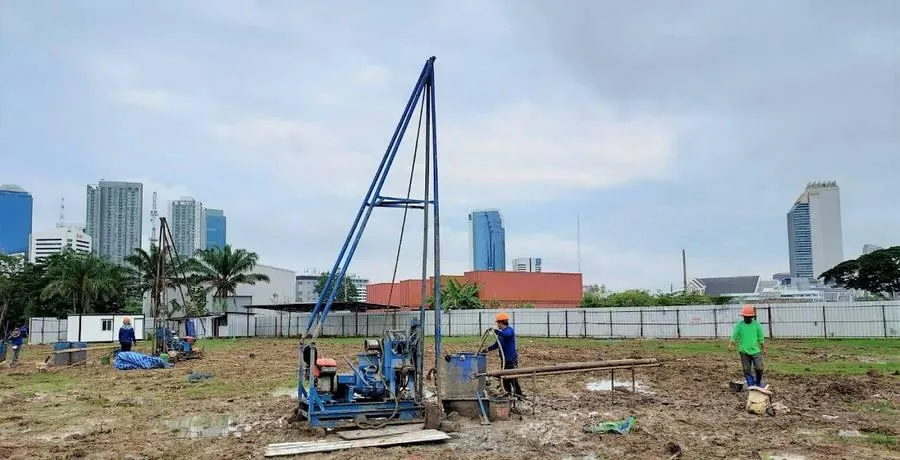
A 2-story house transfers its entire weight to the foundations and every pile. A foundation unsuited to the soil conditions is the main cause of house settlement, wall cracks and doors that no longer close properly over the long term.
What does the law say?
For typical residential houses (1–3 stories and not part of a large housing estate), the key points of the Ministerial Regulation on Building Foundations and Supporting Ground B.E. 2566 (2023) can be summarized as follows:
1. The law does "not require" soil investigation for a typical house
This regulation (Clause 5) does not require typical residential houses to submit a soil investigation report with the building permit application. It applies only to high-rise buildings, extra-large buildings, controlled-use buildings of 4 stories or more, and buildings of 4 stories or more in housing estates, which must have at least 3 investigation points.
2. But there is a "penalty-style restriction" if you do not bore
The same regulation (Clause 7) requires the design engineer to use very low soil bearing values instead, for maximum safety margin. For example, if soft soil is expected, the allowable bearing pressure may not exceed 20 kPa, and even for fresh hard rock it may not exceed 250 kPa — see the full table of presumptive bearing values for every soil type in Can you skip soil boring? Legal presumptive bearing values without a soil investigation
3. The consequences (why you should bore)
When the engineer is forced to use very low bearing values, the foundation must be over-designed — for example, using piles longer than needed or larger, thicker spread footings than usual — which drives up material costs and ends up many times more expensive than a soil investigation.
The law does not require a typical house to have a soil investigation, but in practical and economic terms it is strongly recommended, so the engineer can design economically and safely for the actual soil and prevent long-term settlement. Many banks also ask for a soil boring report when considering high-value home loans.
In short, skipping soil boring is not illegal, but the designer must use low presumptive bearing values, whereas a soil investigation provides real data for a design that fits that particular plot.
3 reasons a 2-story house should have soil boring, even when not required
1. Know the right pile length for "your plot"
The depth of the hard layer that supports pile tips varies from area to area — even within Bangkok, the Thonburi side is several meters deeper than inner Bangkok. Piles that are too short cause settlement; piles that are too long waste money. See soil layer depths and pile lengths by area across Thailand in Bangkok soft clay vs the provinces
2. Prevent uneven settlement (Differential Settlement)
Even if a house settles, you may not notice a problem if it settles evenly. Problems occur when it settles unevenly, causing:
- Diagonal wall cracks that are hard to repair
- Cracked floor tiles and debonded floor screed
- Doors and windows that do not close properly
- Broken water pipes under the floor and leaks
The model below shows a common case: the soft clay layer under the same house varies in thickness. When all piles are the same length with no soil investigation data, the side where pile tips are still in soft clay settles more.
3. Save on long-term repair costs
Soil investigation for a residential house costs THB 20,000–40,000, compared with:
- Wall crack repairs: 💰💰 often many times the cost of a soil investigation, and may need repeated repairs
- Foundation strengthening (Underpinning): 💰💰💰 can be tens of times the cost of a soil investigation
- Opportunity cost during repairs: incalculable
Note: the 💰 levels are a relative comparison; actual costs depend on the damage, the site and each contractor.
Cases where soil boring "may" not be necessary
There are some cases where it may be skipped, but this must be carefully assessed by an engineer:
- A soil boring report from a neighboring project (within 50 m) carried out in the last 3–5 years
- Hillside or hard ground with rock near the surface (e.g. many areas in northern and northeastern Thailand)
- A small single-story house (under 100 m²) on clearly hard ground
Even in the cases above, having clear soil data allows a "right-sized" foundation design. Sometimes the savings from not driving piles longer than necessary more than pay for the soil boring.
Soil boring for a 2-story house: how many holes and how deep?
← Scroll to see the full table →
| House size | No. of holes | Depth | Approx. price |
|---|---|---|---|
| Detached house 100–250 m² | 2–3 holes | 20–30 m | From THB 20,000–40,000 (whole job, incl. basic lab tests + engineer-certified report) |
| Large/luxury house 250+ m² | 3–4+ holes | 25–30+ m | Contact us for a free quote within 24 hrs |
* Prices depend on location and job difficulty and exclude travel and equipment mobilization, which are charged extra according to distance to the site — contact SPN for an accurate quotation.
* Depths follow the EIT 2008 guidelines — boring continues to hard soil/dense sand per the engineer's criteria, with a recommended minimum of about 3 holes where soil layers are non-uniform.
Want price ranges for other building types, such as townhouses, shophouses or factories? Read House soil boring prices 2026 — budgeting guide, and see the engineering criteria for setting the number and depth of boreholes in How many boreholes and how deep?
How long does house soil boring take?
- Days 1–2: the team mobilizes to site, sets up equipment, bores and collects soil samples
- Weeks 1–2: laboratory testing for Water Content, Atterberg's Limits and Unconfined Compression
- Final stage: the engineer analyzes the results and prepares the Boring Log and foundation design recommendations
The total is about 7–14 working days; if you plan about 1 month before construction starts, it will not affect your schedule. To learn what information the Boring Log contains and how to read it, see How to read a Boring Log, made simple
Who should do the boring? What to check before hiring
Most important, the report must be certified by a civil engineer licensed by the Council of Engineers Thailand (COE), with signature and registration number, so it can be used for design and for building permit applications to the relevant authorities. You should also check that the company tests to ASTM standards, has its own laboratory and has a verifiable track record — see the full 7-point checklist in How to choose a soil boring company, and see the scope of SPN's soil investigation services on the Soil investigation and testing page.
Summary: bore before building a 2-story house
Although the law does not require every 2-story house to have a soil boring report, in terms of safety and long-term value, investing THB 20,000–40,000 in soil boring for a home you will live in for 30–50 years is very worthwhile — and to understand everything a soil investigation gives you, read Why do soil investigation before building a house?