Pile Testing Prices 2026: How Much per Pile for Each Method?
Pile testing prices per pile range from hundreds to hundreds of thousands of baht depending on the test type, because each method measures something different and uses different equipment. Here is a summary in one table:
← Scroll to see the full table →
| Test type | Approx. price | What it tests | Reference standards |
|---|---|---|---|
| Seismic Integrity Test | ~THB 100–150/pile | Pile shaft integrity (cracks, necking, voids) | DPT 1551-51 (method per ASTM D5882-16, withdrawn by ASTM in 2025) |
| Dynamic Load Test (PDA) | From ~THB 5,500/pile | Load capacity (estimated from stress waves) | DPT 1252-51 · ASTM D4945-26 |
| Static Load Test | THB 50,000–150,000+/pile | Actual load capacity by applying load on the pile head | ASTM D1143/D1143M-20e1 · DPT 1251 |
Note: the prices above are approximate starting prices and exclude travel and equipment mobilization. Actual prices depend on project conditions. Contact us for a free quotation within 24 hours.
Why Do Prices Differ So Much? Understanding Each Test
Prices that differ many times over reflect differences in time, equipment and labor for each method. The cheaper method is not inferior — each method answers a different question: the seismic test tells you whether the pile shaft is sound, while PDA and static tests tell you how much load the pile can carry.
1) Seismic Integrity Test — the cheapest, because it is fast
The pile integrity test (seismic integrity test) strikes the pile head with a hammer and measures the reflected wave. It takes a few minutes per pile, and one test crew can test dozens of piles per day, so the price per pile is the lowest (~THB 100–150/pile). However, there is usually a minimum charge per site visit, so if the project has few piles, the average price per pile will be higher.
Best for: checking large numbers of bored and driven piles, every pile, before building the foundations. Read the method in detail at Seismic Test: Pile Integrity Testing (Low Strain)
2) Dynamic Load Test (PDA) — mid-range price, tests load capacity
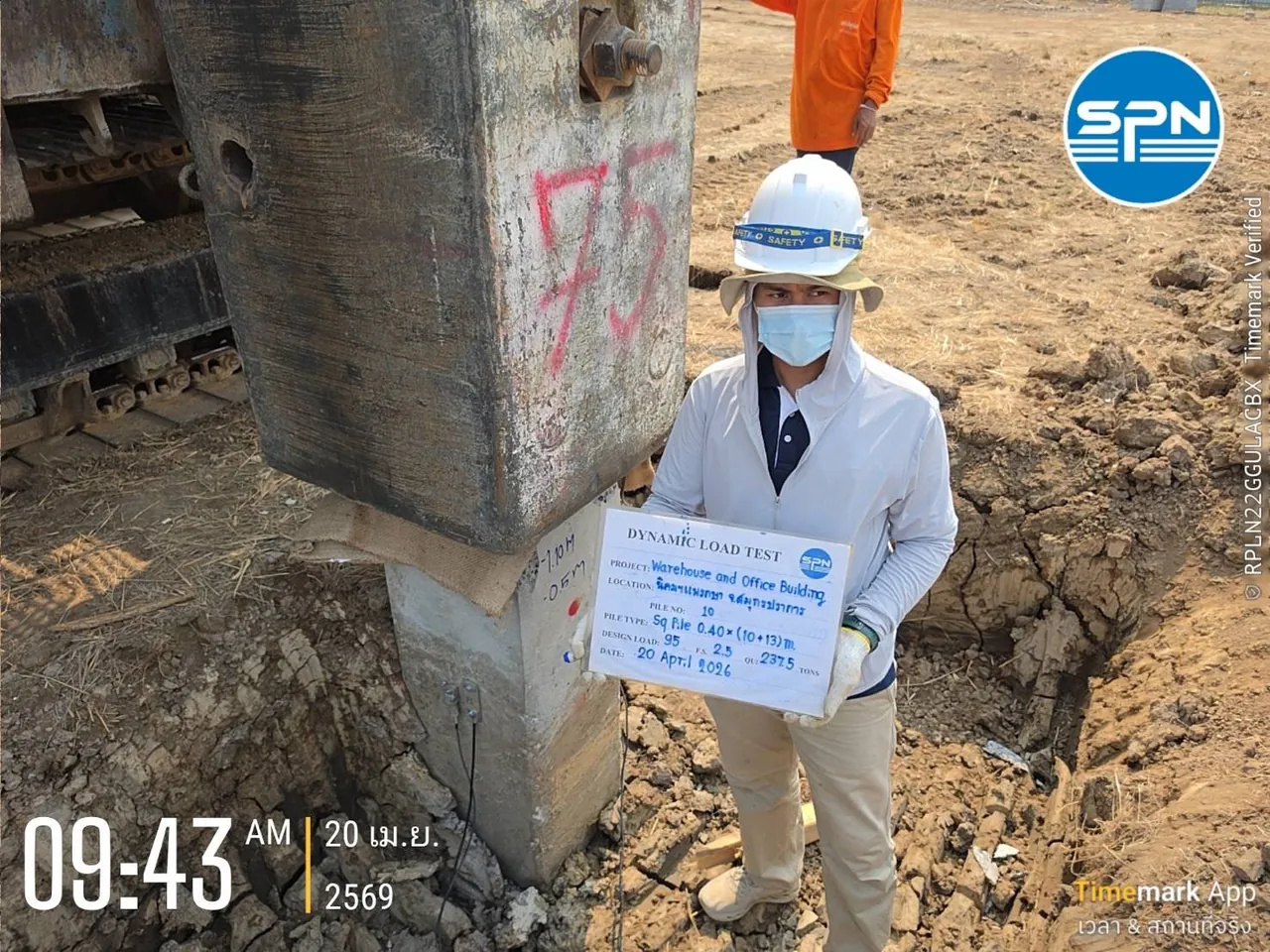
The dynamic pile load test (dynamic load test, PDA) installs strain and acceleration sensors at the pile head, then a drop weight or pile-driving rig delivers an impact to estimate the pile's load capacity. Prices start at approx. THB 5,500/pile; factors that push the price up include:
- Pile size and type — large bored piles need a heavier drop weight and may require an extra rented crane
- Whether a piling rig is on site — if the project already has a pile-driving rig, costs drop considerably
- Number of piles — testing several piles in one site visit lowers the average price per pile. A typical planning figure is about 5–10 points per day when the piles are in the same area (subject to each project's specification)
Best for: projects that need to confirm pile load capacity in less time and on a tighter budget than a static load test. Read the full principles at Dynamic Load Test (PDA Test)
3) Static Load Test — the most expensive, but the most direct test
The static pile load test applies real load to the pile head in increments and measures settlement. It is accepted as the most direct method, but it requires a kentledge system or anchor piles, plus a steel frame and hydraulic jack, and takes several days of preparation and testing. The price is therefore THB 50,000–150,000+ per pile, depending on:
- Maximum test load — typically 2–3 times the design load (subject to each project's specification); the higher the test load, the larger and more expensive the reaction system
- Loading method — kentledge (stacked dead weight) and anchor piles have different costs
- Site conditions — restricted space and difficult access for transport affect the price
Best for: large buildings and projects whose specification requires static testing. Read about the method and preparation at Static Pile Load Test
What Makes Pile Testing Prices Go Up or Down?
Besides the test type, several common factors move the price per pile up or down:
- Number of piles tested — the more piles tested in one visit, the lower the average price per pile
- Site distance — up-country jobs carry travel and crew accommodation costs
- Site readiness — pile heads must be trimmed to a flat surface and accessible; waiting time or extra site preparation incurs costs
- Urgency — rush jobs or work outside normal hours may carry an extra charge
- Reporting and certification — reports are certified by a civil engineer licensed by the Council of Engineers Thailand (COE) and can be submitted for building permits
Choose a test method based on what the project needs to verify — pile shaft integrity or load capacity — and what the design engineer's specification requires. See the full scope of services on the pile testing services page, or consult the SPN engineering team to plan testing that suits your project and budget.
How Many Piles Need Testing? Estimating the Total Project Budget
The number of piles to test is set by the project specification and the judgment of the design engineer. A common approach is seismic integrity testing on all or nearly all piles because it is fast and cheap per pile, while PDA is usually sampled on about 1–2% of all piles and static load tests on fewer still, as the specification requires (subject to each project's specification). For the sampling criteria engineers actually use, see How Many Piles Should Be Tested? Sampling Criteria
A rough budgeting formula: test budget ≈ (number of piles tested × price per pile) + travel and equipment mobilization based on distance, with 2 points to remember:
- There is a minimum charge per site visit — for projects with few piles, the average price per pile will be higher than the starting price
- Combining several tests in one trip saves money — e.g. schedule seismic testing on all piles together with PDA on the number the specification requires in a single site visit, to spread the travel cost
Worked example: a project has 100 piles. If the specification calls for seismic testing on every pile, this part costs approx. 100 × 100–150 = THB 10,000–15,000 plus the site visit charge. PDA sampled at 1–2% is 1–2 piles, starting at approx. THB 5,500–11,000. PDA costs dozens of times more per pile than seismic, but far fewer piles are tested, so these two parts of the budget are similar. If the specification also calls for a static load test, even a single pile (THB 50,000–150,000+) is usually the largest budget item. Requesting a quotation based on actual quantities is therefore more accurate than multiplying the price per pile yourself.
When Can You Test? Concrete Age Affects Schedule and Budget
Concrete piles must reach the age and strength required by the specification before they can be tested. Calling the test crew to site before the piles are ready means paying for another site visit or losing your slot unnecessarily. Sequence casting, driving and testing so they line up — for the concrete age criteria of each test method, see At What Concrete Age Can Piles Be Tested?
What Should a Pile Testing Quotation Include?
Before comparing prices from several firms, check that each quotation states a complete scope and that they are truly comparable:
- Test type, number of piles and reference standards, e.g. DPT 1551-51 (method per ASTM D5882-16, which ASTM withdrew in 2025) · DPT 1252-51 + ASTM D4945-26 · ASTM D1143/D1143M-20e1 + DPT 1251 (compare the three standards at ASTM D5882, D4945, D1143: What's the Difference?)
- Analysis included in the price, e.g. CAPWAP analysis for PDA work
- A report certified by a licensed civil engineer (COE), with signature and registration number, that can be submitted for building permits
- Travel and equipment mobilization, itemized separately according to site distance
- What the client must provide, e.g. pile head preparation, and a piling rig or crane for PDA work
Unusually low prices often leave items out, such as result analysis or travel, and add them later. Clarify before you sign.
Want an Overview of All Pile Test Methods?
If you are not yet sure which test your project should use, read the complete guide comparing seismic, dynamic (PDA) and static load tests before deciding, at How Many Types of Pile Tests Are There? All Methods, and the in-depth comparison of the two capacity tests at Dynamic vs Static Load Test: Which to Choose. If you are also budgeting for soil investigation, see the prices at Soil Boring Prices for Houses 2026
This article is provided for general knowledge and preliminary budgeting. The prices stated are approximate starting prices; actual prices depend on each project's conditions. The choice of test method and number of piles should follow the project specification and the judgment of a licensed engineer.