What Is Blow Count and How Is It Counted?
Blow count is the number of times the hammer strikes the pile head to drive the pile down one specified interval. It is usually recorded as "blows per 30 centimeters" or per foot over the full driving depth.
Counting is straightforward. Before driving, the pile is marked at equal intervals along its length. During driving, the site supervisor counts how many blows it takes for the pile to pass each marked interval and writes it in the Pile Driving Record for that pile.
This value shows how hard or easy driving is through each soil layer. When the pile passes through soft soil, the blow count is low (easy penetration); when it enters stiff soil or sand, the blow count rises clearly. Engineers therefore use a blow count vs depth plot to see whether the pile has reached the bearing layer.
Do not confuse this with the SPT N-value in soil investigation, which is also counted as blows per 30 cm but comes from driving a soil sampler in a borehole, not from driving a pile. Read more in How to read SPT N-values
- Consistently low blow count = the pile is still in soft soil and may need further driving
- Rapidly rising blow count = the pile is entering stiff soil
- Total blow count per pile = used to assess the driving effort and the risk of pile head damage from a large number of blows
What Is Last 10 Blows (Last Ten Blows) and How Is It Measured?
Last 10 Blows (Last Ten Blows) is the total penetration of the pile under the final 10 blows, reported in "millimeters per 10 blows" (mm/10 blows). It is measured at the end of driving to decide whether the pile is firm enough to stop driving.
This value is directly related to the "set", the penetration per blow (mm/blow). Dividing the Last 10 Blows by 10 gives the average set at the end of driving. The smaller the Last 10 Blows (the pile barely moves), the more it indicates that the pile toe is resting on a highly resistant layer.
On site, a mark is made on the pile in line with a fixed reference timber, 10 blows are delivered with the same hammer and drop height, and the distance the mark has moved down is measured in millimeters.
- Small Last 10 Blows = little penetration; the soil at the pile toe is dense
- Large Last 10 Blows = the pile still penetrates steadily; the soil is not yet firm enough
- Usually recorded together with the rebound (the bounce-back of the pile head after impact), which is one of the variables in driving formulas such as the Hiley Formula
The figure below combines both values in one view. The left side shows the marking on the pile and detail A, the method for measuring the Last 10 Blows. The right side is a blow count vs depth chart, where the bars lengthen quickly as the pile enters sand or stiff soil.
How Many Last 10 Blows Before Driving Stops, and Who Sets It?
There is no single Last 10 Blows figure that applies to every project. The design engineer sets the target value for each project based on the pile type and size, the soil layers and the hammer weight used. The site supervisor stops driving when the measured value reaches that criterion.
The Last 10 Blows is used as the criterion because it represents the actual condition at the end of driving. Bearing capacity cannot be measured directly on a piling site during driving, so engineers use the penetration per number of blows (set) as a proxy, based on pile driving formulas such as the Hiley Formula or ENR.
The principle is that part of the hammer energy is converted into work that pushes the pile down (set). If the pile barely moves any more, the soil resistance is high, which relates to the expected bearing capacity.
If the pile reaches the criterion well above the design toe level, do not decide on site; notify the engineer to review first. See the guidance in Piles that refuse before design depth
The exact set criterion must be specified by the responsible project engineer on a case-by-case basis. This article provides general knowledge and is not a design value for your project.

How Do Blow Count and Last 10 Blows Differ?
The two values differ in what they count. Blow count counts the number of blows per fixed penetration (e.g. 30 cm), while Last 10 Blows measures the penetration per fixed number of blows (10). The table below summarizes the definition, measuring interval and how to interpret high and low values.
← Scroll to see the full table →
| Topic | Blow Count | Last 10 Blow |
|---|---|---|
| Definition | Number of blows per penetration interval (blows/30 cm) | Total penetration under the final 10 blows (mm/10 blows) |
| Measuring interval | Over the full driving depth | Only at the end, before stopping |
| Unit | Blows per distance | Distance (mm) per 10 blows |
| Used for | Reading soil layers and driving progress | Deciding the termination criterion |
| A high value means | Stiff soil, hard driving (often entering the bearing layer) | The pile still penetrates a lot (not yet firm enough) |
| A low value means | Soft soil, easy driving | Little penetration, dense soil at the toe (near the termination criterion) |
The most common point of confusion is the "direction" of the values. A higher blow count means harder driving and stiffer soil, while a lower Last 10 Blows means less penetration and denser soil at the pile toe. However, abnormally high or low values are not always good — for example, the toe may be hung up on a thin hard layer or the hammer may be too small — so they should be read together with the soil investigation and pile test results.
The 3D view below shows how values are recorded on site, from marking intervals on the pile to measuring the Last 10 Blows against a reference timber. The panel on the right lists the steps in order and stresses that the recorded values are not yet the bearing capacity.
The Termination Criterion Is Met — Why Is a PDA Test Still Needed?
Because the Last 10 Blows and blow count are only "preliminary indicators", not direct measurements of bearing capacity. Pile driving formulas that convert the set into bearing capacity rest on several assumptions, such as hammer efficiency, pile head condition and energy losses, so they carry errors.
Key limitations to be aware of:
- Driving formulas do not separate end bearing from skin friction
- They say nothing about pile integrity, such as cracks, voids or necking
- Some soils, such as Bangkok soft clay, show strength regain (soil setup), so the actual capacity changes with time after driving (read Restrike Test and Soil Setup)
- The values depend on hammer energy, cushion condition and how carefully the site supervisor records them
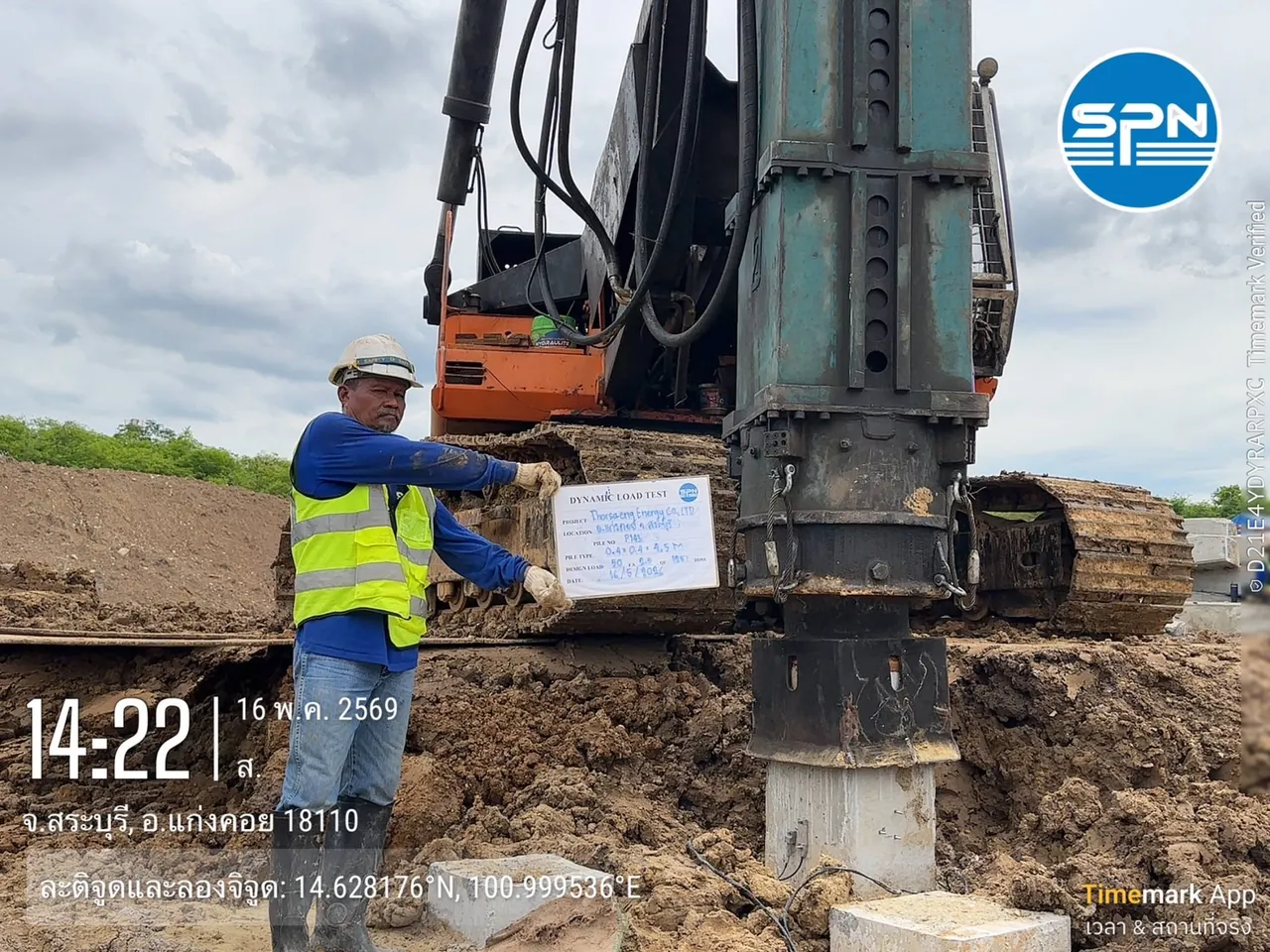
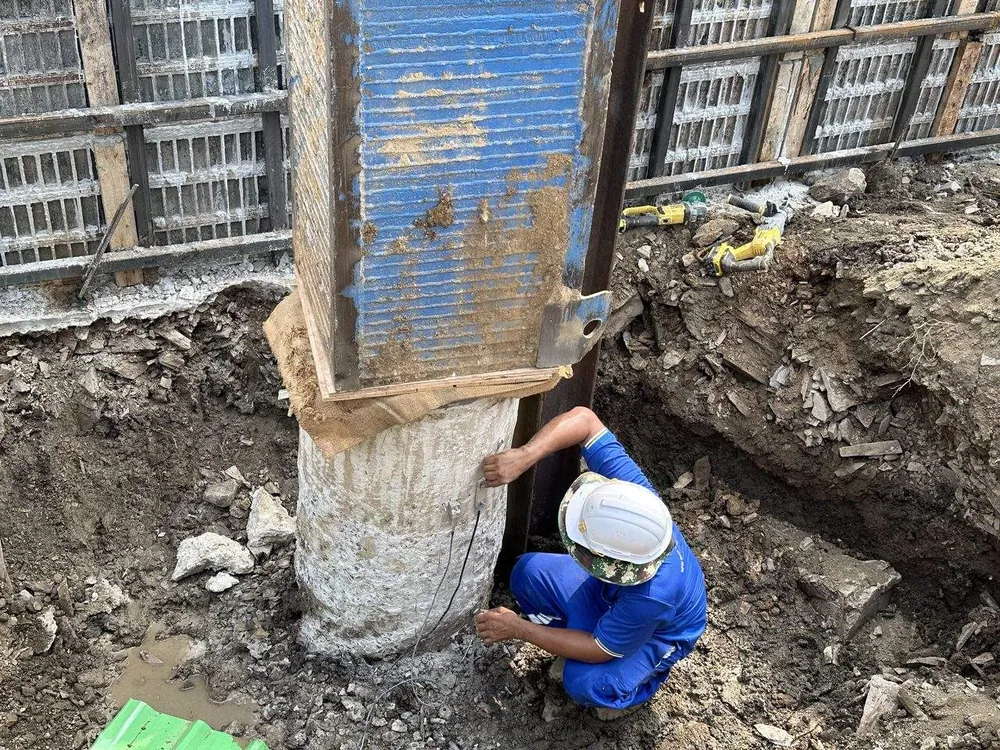
For these reasons, the termination criterion must be confirmed by testing the actual bearing capacity. The method commonly used for driven piles is the Dynamic Load Test (PDA) per DPT 1252-51 and ASTM D4945, which measures actual force and velocity with sensors on the pile head, followed by CAPWAP analysis.
The results separate end bearing from skin friction and are more reliable than reading the set alone. Where bearing capacity must be measured directly by applying real load, a Static Load Test is used. To plan your testing, see our pile testing services.
Summary
Blow count (blows/30 cm) shows the driving progress and soil layers throughout driving, while Last 10 Blows (mm/10 blows) is used to decide when to stop driving at the end, according to the criterion set by the design engineer. Both are good tools for site control, but they are preliminary indicators that must be confirmed with a Dynamic Load Test (PDA) per DPT 1252-51 before you can be confident the pile carries its design load.
Another point to plan alongside is test timing, because concrete piles must wait until the concrete has sufficient age and strength. Read more in Concrete age and pile testing and see how many piles need testing in How many piles to test
Dynamic Load Test (PDA) starts from about THB 5,500/pile. This price excludes travel and equipment mobilization, which are charged extra according to the distance to the site.