This article explains what makes Bangkok soil special, how it differs from other regions, and how this affects foundation selection from an engineering perspective, with a diagram comparing soil profiles in three regions and a 3D model of the effects of land subsidence. All figures are typical values for illustration, not design values for any specific project.
What Is Bangkok Clay, and Why Do Geotechnical Engineers Worldwide Know It?
The soil profile of Bangkok and its surrounding provinces is known in international geotechnical engineering as "Bangkok Clay", recognized as one of the examples of coastal soft clay (Marine Clay) that are the deepest and most complex in Southeast Asia.
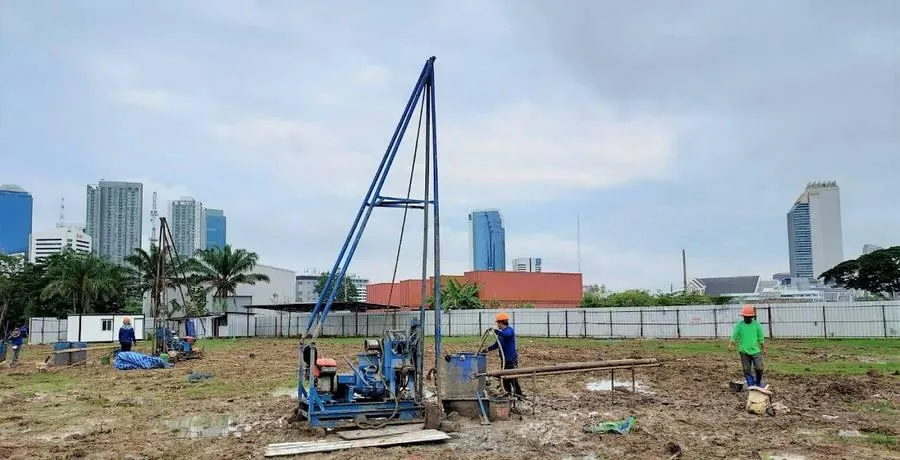
Bangkok Clay is a marine clay deposited in a shallow-sea to estuarine environment on the Chao Phraya floodplain during the Holocene marine transgression. It is a soft to medium stiff clay with a high Plasticity Index.
What Are the Soil Layers Under Bangkok, from Top to Bottom?
Inner Bangkok soil typically starts with topsoil or fill about 2 m thick, followed by soft clay to about 15 m depth, then medium stiff clay, and the first sand layer at about 21–28 m. Actual layer depths vary by location, so every project must confirm them with a soil investigation.
← Scroll to see the full table →
| Soil layer | Depth | Characteristics | SPT N-Value |
|---|---|---|---|
| Weathered Crust | 0-2 m | Fill / desiccated clay | 5-15 |
| Soft Bangkok Clay | 2-15 m | Gray soft clay | 0-4 |
| Medium Stiff Clay | 15-21 m | Medium stiff clay | 5-15 |
| 1st Sand Layer | 21-28 m | First dense sand layer | 30-50+ |
| Stiff Clay | 28-35 m | Stiff clay | 15-30 |
| 2nd Sand Layer | 35-50+ m | Second dense sand layer | 50+ |
Special Properties of Soft Bangkok Clay
- High water content of 60-100%, meaning the soil holds more water than dry solids by weight
- Low undrained shear strength (Su) of 10-25 kPa, so it resists little shear
- High compressibility, so it compresses easily under load
- Sensitive clay, which becomes several times weaker once disturbed
How Do Soil Profiles in Other Regions Differ from Bangkok?
1. The North (Chiang Mai, Chiang Rai, Lampang)
Mostly old alluvium (Old Alluvial) and weathered rock:
- Surface soils are mostly medium to stiff clay
- Rock is found close to the surface (5-15 m) in many areas
- Piles are much shorter; 8-15 m lengths are sufficient
- Some areas can use spread footings directly
2. The Northeast (Khorat, Khon Kaen, Udon Thani)
Sandy to loamy soils mixed with gravel in the upper layers:
- Upper soils have good bearing capacity; SPT N-values often exceed 10 from the surface
- The main issue is expansive soil through the wet and dry seasons
- Piles 6-12 m long in most areas
3. The South (Songkhla, Phuket, Krabi)
Highly variable, depending on terrain:
- Coastal areas: soft clay similar to Bangkok Clay but thinner (5-10 m)
- Hills: residual soil with granite, very good bearing capacity
- Low-lying plains: watch for high groundwater in the rainy season
4. The Bangkok Metropolitan Region (Samut Prakan, Nonthaburi, Pathum Thani, Ayutthaya)
Similar to Bangkok, but with local features:
- Samut Prakan: thicker soft clay than Bangkok, about 18-22 m, so typical piles are often about 25-28 m long
- Western Nonthaburi: soft clay 12-18 m, piles 21-26 m
- Pathum Thani: soft clay thins toward the north, 8-15 m
- Ayutthaya: soft clay interbedded with old sand layers, requiring detailed soil boring
The figure below places the Bangkok soil profile side by side with the North and the Northeast at the same depth scale, making it immediately clear why pile lengths differ several-fold.
Why Must Foundations in Bangkok and the Provinces Be Designed Differently?
1. Pile Lengths Differ by 3-4 Times
← Scroll to see the full table →
| Area | Typical pile length | Reason |
|---|---|---|
| Inner Bangkok | 21-25 m | Through about 13 m of soft clay into the stiff layer / first sand |
| Samut Prakan | 25-30 m | Thicker soft clay, so piles must go deeper |
| Thonburi side | 28-32 m | The stiff layer / first sand is deep or thin in places, so piles often go deeper |
| Chiang Mai | 8-15 m | Rock close to the surface |
| Khorat | 6-12 m | Upper soil has good bearing capacity |
2. Different Foundation Types Are Used
- Bangkok / surrounding provinces: almost all permanent buildings use driven piles or bored piles, because spread footings on soft clay settle a lot and keep settling (compare pile types in Driven, bored or spun piles: which to choose)
- North / Northeast: spread footings can be used in many areas, saving a lot of construction cost
- Hills / weathered rock areas: a mat foundation or strip footing is sufficient
3. Foundation Construction Costs Differ
For the same project (e.g. a 2-storey, 200 m² house), foundation costs vary greatly between areas, depending on pile length and the foundation type required:
- Bangkok: 💰💰💰 High — long piles through the soft clay are required
- Samut Prakan: 💰💰💰💰 Highest — piles longer than in Bangkok
- Chiang Mai: 💰💰 Moderate — spread footings or short piles
- Khorat: 💰 Low — spread footings on sandy soil
*The 💰 levels are a relative comparison only, to illustrate differences between areas, and are not actual prices. Foundation construction cost depends on the structural design, building load, material prices and contractor at the time.
Is Land Subsidence Still a Risk for Bangkok?
Another factor in Bangkok is land subsidence, which was once very severe, reaching about 10-12 cm/year in the early 1980s due to excessive groundwater pumping. After groundwater control measures were enforced, the rate in inner Bangkok fell sharply. A study analyzing InSAR satellite data from Dec 2014–Aug 2023 found that inner Bangkok subsided no more than about 1 cm/year (many points were stable or subsiding only millimeters per year) (Source: Ahmed, Hiraga & Kazama, 2024, Science of the Total Environment). Another study using InSAR data from 2014–2024 found that most of its study area was still subsiding slowly, averaging about 0.3 cm/year (Source: Oh et al., 2026, Geosciences Journal)
However, some points in the surrounding provinces, such as Samut Prakan, Samut Sakhon and Ayutthaya, are still subsiding faster, at more than 2 cm/year in some areas and up to about 5 cm/year according to the same study. Within the city, at some locations such as the Ramkhamhaeng area, the Director-General of the Department of Mineral Resources stated that subsidence is still about 2–3 cm/year (Matichon, Sep 2025). Subsidence therefore varies greatly from area to area. The main causes of subsidence are:
- Past groundwater pumping, which lowered pore water pressure in the soil layers
- Natural consolidation of the soft clay
- Increasing loads from buildings and roads
Because land subsidence lowers the ground around a house while the building on piles does not settle, a gap forms under the house floor (a "floating floor"), which is common in Bangkok. Slab on Pile or Slab on Grade must be designed to tolerate this separation. Soil settling around the piles can also cause negative skin friction, which must also be considered in design.
The 3D model below shows what happens to a house on piles when the ground around it subsides, along with past versus present subsidence rates.
How Should Projects in Each Region Get Started?
Bangkok and Surrounding Provinces
- Carry out a soil investigation for every project, large or small
- Have the engineer set the pile tip layer from the boring results — usually the stiff clay or the first sand layer, depending on building load
- Consider pile testing such as a Static Load Test or Dynamic Load Test (PDA) for medium to large projects
- Design the structure to accommodate ground movement around the building
North / Northeast
- Drill at least 1-2 boreholes to confirm the soil conditions
- Watch for expansive soil in the Northeast
- Watch for erosion of sandy soils in the rainy season
Southern Thailand
- Coastal areas: design as in Bangkok, but shallower
- Hill areas: check slope stability and soil erosion
- Flood-prone areas: design foundations to withstand water pressure
Summary: Why Every Project Needs Its Own Soil Boring Report
Soil profiles in Thailand are highly variable; even within the same province they can differ. Using guesswork or data borrowed from elsewhere risks errors in foundation design.
SPN Soil Engineering has over 20 years of experience in soil investigation across Thailand, understands the particular soil characteristics of each region, and can give advice suited to your project. Contact us for a free consultation.
This article is provided as engineering knowledge. Soil layer thicknesses and pile lengths are typical values for each area. Actual foundation design is the responsibility of a licensed design engineer, based on the project's actual soil data.