How do Dynamic and Static Load Tests differ?
A Dynamic Load Test (PDA) drops a ram onto the pile head and analyzes the resulting stress waves, while a Static Load Test applies real load directly onto the pile — the first is faster and cheaper, the second is the most accurate.
- Strain gauges + accelerometers mounted on the pile head
- Signals recorded during driving or impact
- CAPWAP analysis to determine pile capacity
- Skin friction + end bearing obtained separately
- Testing completed in one day, fast results
- Real dead load (kentledge) or anchor piles for reaction
- Pile loaded by hydraulic jack in gradual increments
- Settlement measured precisely at every load step
- Gives the most accurate load-settlement curve
- Requires more time and equipment
The figure below compares the setup of both methods on the same type of pile — the Dynamic side uses a single impact and reads the answer from the recorded waves, while the Static side needs enough kentledge to push the pile step by step until the load–settlement curve is obtained directly.
Dynamic vs Static comparison table: every aspect
← Scroll to see the full table →
| Topic | Dynamic (PDA) | Static |
|---|---|---|
| Standard | ASTM D4945 · DPT 1252-51 | ASTM D1143 · DPT 1251 |
| Accuracy | High when analyzed with CAPWAP — results may be higher or lower than Static depending on soil conditions, driving energy and setup time (soil setup/relaxation) | Highest — measures load–settlement directly and serves as the reference value (capacity still has to be interpreted by a criterion, e.g. Davisson) |
| Test duration | Half a day–1 day | 1–3 days |
| Relative cost | More economical (from ~THB 5,500/pile) | About 10× or more expensive (THB 50,000–150,000+/pile) |
| Data obtained | Capacity, Integrity, Driving Stress | Load-Settlement, Residual Settlement |
| Accepted for submission to authorities | ✓ Accepted | ✓ Accepted |
| Bored piles | ✓ Possible | ✓ Possible |
| Integrity check | ✓ Preliminary | ✗ No |
| Measures forces in the pile | ✓ Yes (driving stress) | ✗ No |
Note: The prices above exclude travel and equipment mobilization, which are charged extra according to the distance to the site.
Which method should your project choose?
🧭 Choose by situation
Choose Dynamic (PDA) when...
The job has many piles, you need checks during construction, the budget is limited, you need fast results, or the project has no special requirements — suitable for houses, general commercial buildings and medium-sized factories.
Choose a Static Load Test when...
The building is highly critical (hospitals, bridges, silos), the designer needs an accurate load-settlement curve, the contract has special requirements, or a dynamic test gave questionable results that need confirmation.
Use both methods together
Large projects often use a static test as a proof test on representative piles and dynamic tests to check large numbers of piles during construction, balancing accuracy and cost.
The model below shows the "combined" approach on a single project: screen integrity first with the Seismic Integrity Test, run a static test on representative piles to confirm actual behavior, then spread Dynamic (PDA) tests across a large number of piles.
How does the Dynamic Load Test work?
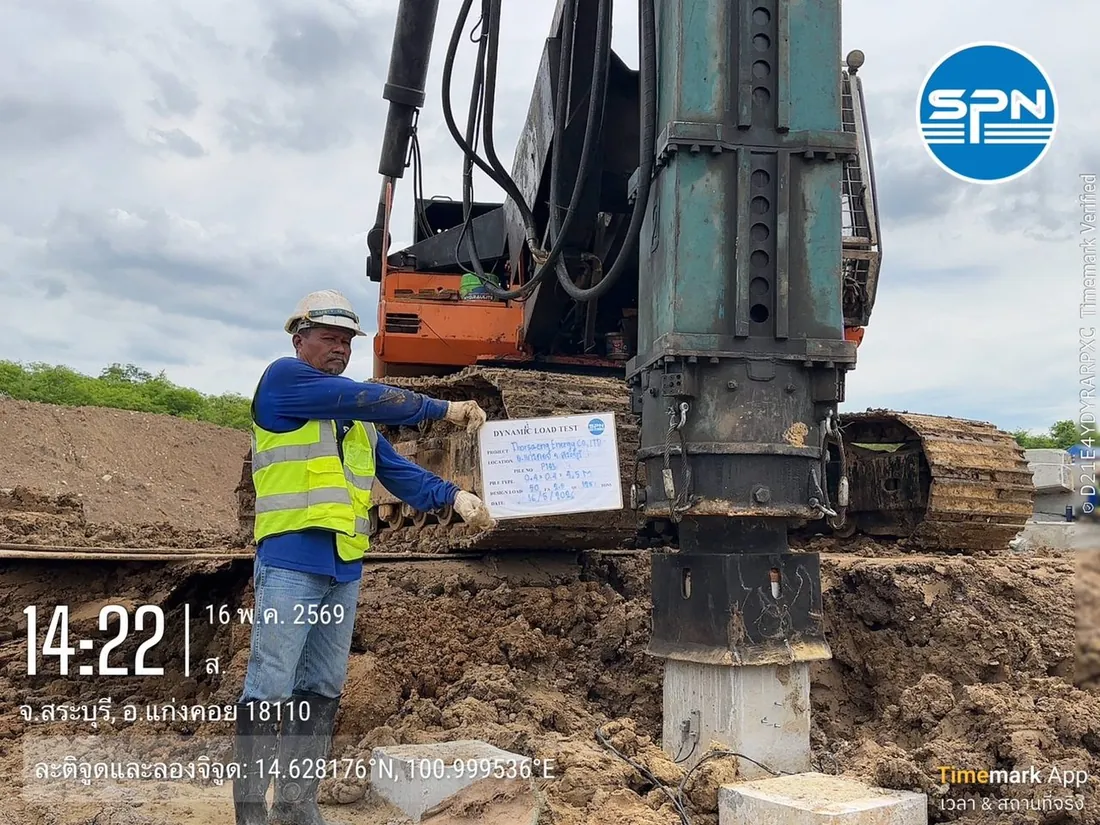
The Dynamic Load Test, or high strain dynamic testing, per ASTM D4945 and DPT 1252-51, works by mounting strain gauges and accelerometers on the pile head; a crane then lifts a ram or hammer and drops it onto the pile head. The instruments record the resulting force and acceleration waves.
The data are then analyzed with the CAPWAP (CAse Pile Wave Analysis Program) software, which calculates:
- Total capacity
- Skin friction for each soil layer
- End bearing at the pile toe
- Compressive and tensile stresses in the pile (driving stress)
Read the detailed PDA test procedure at What Is a Dynamic Load Test (PDA)? Procedure and Interpretation and how to read the analysis results at What Is CAPWAP? Understanding PDA Signal Analysis
A Dynamic Load Test can be done both during driving and after driving (re-strike). A re-strike gives the set-up effect, which shows how much the capacity has increased after a rest period.
How does the Static Load Test work?

A Static Load Test pushes the pile with a hydraulic jack, increasing the load gradually in steps and measuring the pile settlement at each step. There are 2 main methods:
- Kentledge Method — concrete or steel blocks are placed on a steel frame as counterweight, and the jack pushes the pile using this weight as reaction. Suitable for open sites where enough weight can be arranged.
- Anchor Pile Method — anchor piles are installed around the test pile, and steel beams tie the anchor piles to the jack. Suitable for confined sites where placing a large weight is impractical.
Read the full test procedure at What Is a Static Load Test? Procedure, Standards and Interpretation
A Static Load Test gives the load-settlement curve directly, from which the engineer can find the true ultimate load of the pile as well as separate elastic and residual settlement. This information is very valuable for designing buildings with strict settlement requirements.
Seismic Integrity Test — what is the third option?
Besides the two main methods, there is the Seismic Pile Integrity Test (PIT) per DPT 1551-51 (ASTM D5882-16 was withdrawn in 2025), a low strain test that checks only the integrity of the pile, not its bearing capacity. It costs about THB 100–150/pile.
It is ideal for checking all the bored piles on a project economically before running Dynamic or Static tests on selected piles — read an in-depth guide to this method at What Is a Seismic Integrity Test? Check Pile Integrity Before It's Too Late
How much do Dynamic and Static tests cost?
A Dynamic Load Test (PDA) starts at about THB 5,500/pile, while a Static Load Test costs about THB 50,000–150,000+/pile depending on the test load and the reaction method (kentledge or anchor piles) — a difference of about 10× or more.
Note: These prices exclude travel and equipment mobilization, which are charged extra according to the distance to the site.
See detailed prices for every pile test method, with the factors that affect price, at Pile Testing Prices 2026 — PDA, Seismic, Static Load Test or contact us for a free quotation within 24 hours — see the scope of all our pile testing services on the Pile Testing Services page.
What does the 2023 Foundation Ministerial Regulation require for pile testing?
Since the Ministerial Regulation Prescribing Building Foundations and Ground Supporting Buildings B.E. 2566 (2023), choosing a pile test method is no longer just about price or speed, because the law sets the pile's "allowable resistance" according to the source of the value — the more reliable the method of proof, the higher the value the law allows.
← Scroll to see the full table →
| Source of the pile resistance value | Applicable up to | FS equivalent |
|---|---|---|
| Calculated from the soil investigation report (static method) | 40% | 2.5 |
| Static Load Test (real load test) | 50% | 2.0 |
| Dynamic Load Test (PDA) | 40% | 2.5 — must be calibrated against a static method |
Why does Static get 50% but Dynamic 40%? In short, the Static Load Test applies real load and so has low uncertainty, which is why the law allows a higher value (FS 2.0), while Dynamic is an indirect estimate that must be calibrated against a static method (FS 2.5) — read the full explanation of the 40/50/40 criteria, including Clauses 24–25 and the case of piles over 40 t each, at How Much Load Can a Pile Carry by Law? The 40/50/40 Criteria of the 2023 Foundation Regulation
The difference between 50% and 40% can mean fewer or shorter piles across the whole project, saving many times the cost of testing. Medium-to-large projects therefore favor the formula "Static leads, calibrates, Dynamic follows": static tests on a small number of representative piles to confirm actual behavior, then dynamic tests spread across many piles at a controlled cost — satisfying both the law and the budget.
Read the key points of this Ministerial Regulation in full at Summary of the 2023 Building Foundation Ministerial Regulation (B.E. 2566)
Note: This section is a summary for general understanding, not project-specific legal advice. Please check the actual legal text and consult your project's design engineer.