
Does the law require pile testing?
This is the most frequently asked question in pile foundation work, and the most direct answer is that the law does not say "every pile on every project must be tested". Instead, it is written in a way that makes testing a practical necessity — because the law states that the allowable pile resistance an engineer may use in the design calculations depends on how reliable the "source" of that value is.
Put another way: if you want to use a high load capacity, you have to prove it by testing. Without testing, you must accept a lower value, which means longer or more piles — and the total cost is often higher than the cost of testing itself. This is the mechanism that makes pile testing "an option that is hardly optional" for medium-sized and larger projects.
Besides the Ministerial Regulation itself, there are 3 other sources that can, in practice, require testing — often more strictly than the law:
- The design engineer — specifies the number of tests and test methods in the project Specification from the design stage. In real projects, this is the source that "orders testing" most often.
- The owner's contract and TOR — especially public-sector, state-enterprise and large private projects, which often set out the testing proportion clearly in the contract.
- Local building officials — those reviewing the building permit application may request test results to support the design calculations, particularly in soft-soil areas, newly filled land, or high-risk buildings.
The law does not mandate testing "every pile", but it enforces testing through the conditions for using load capacity values — and in practice, those who actually order testing are the design engineer and the contract.
How does the 2023 Foundation Ministerial Regulation relate to pile testing?
The Ministerial Regulation on Building Foundations B.E. 2566 (2023) was published in the Royal Thai Government Gazette on 31 August 2023 and took effect on 28 February 2024, replacing Ministerial Regulation No. 6 B.E. 2527 (1984), which had been in use for almost 40 years (for an overview of the whole regulation, see 2023 Foundation Ministerial Regulation: An Easy-to-Understand Summary). In addition, a Ministry of Interior Notification issued under this regulation (announced on 30 August 2024) serves as secondary legislation with further technical details, including criteria for testing pile resistance.
The part that directly affects pile testing is Clause 24, which sets out the sources of allowable resistance values, with a different cap depending on how the value was obtained, and Clause 25, which states that piles carrying more than 40 tonnes each must be as certified by the designer and calculator.
← Scroll to see the full table →
| Source of resistance value | Applicable up to | FS equivalent |
|---|---|---|
| Calculated from the soil investigation report (static method) | 40% of ultimate resistance | 2.5 |
| Static method test (Static Load Test) | 50% | 2.0 |
| Dynamic method test (Dynamic Load Test) — must be calibrated against the static method | 40% | 2.5 |
These 40/50/40 figures are the heart of the question "does the law require testing?" — with no testing at all, the engineer can only use values calculated from the soil investigation report, capped at 40%. A Static Load Test is therefore the only method the law allows to reach 50% (for details with calculation examples, see How Much Load Can a Pile Carry Under the Law? The 40/50/40 Rule)
It is true that a Dynamic Load Test (PDA) allows 40%, but the law adds the condition that it must be calibrated against static test results, so running PDA alone is not the end of it — well-planned projects therefore typically perform a Static Load Test on 1 test pile and then use PDA to check many more piles across the site.

The diagram below summarizes the “indirect mandate” mechanism of Clause 24 as a 2D diagram — from the cap for each method, to an example of how a higher usable value means fewer piles, to the four sources that actually order testing on construction projects.
Why test piles if they were designed and driven to the drawings?
Because the design is an assumption, while the site is reality. Piles are the only structural element in a building that is invisible once installed and cannot be pulled out for inspection. The main uncertainties come from 3 sources:
- Actual soil layers differ from the borings — boreholes give point data; between them there may be sand lenses, interbedded soft layers, or a hard stratum at varying depth
- Quality of site installation — bored piles may suffer necking or soil inclusions; driven piles may crack from overdriving or have broken heads
- Time and environment — the strength of the soil around a pile changes over time (set-up / relaxation), so testing too early gives results that do not reflect reality (see the right timing in At What Concrete Age Should Piles Be Tested?)
Testing therefore serves 2 purposes at once: proving capacity (does the pile really carry its design load?) and checking integrity (does the pile shaft have defects?) — two different questions answered by different test methods.
What pile test criteria and methods are actually used?
In Thai pile foundation work, three methods are the most common. Each answers a different question, and each has a different legal status.
1. Static Load Test — testing capacity by the static method
Real load is applied to the pile head in increments and the settlement is measured, producing a Load–Settlement curve that reflects the actual behavior of that pile. Testing follows ASTM D1143/D1143M-20e1 together with DPT 1251 (referenced via DPT 1106-64 clause 6.1). It is the most accurate method and the only one the Ministerial Regulation allows to use values of up to 50%, but it takes considerable time and space and costs several times more than other methods, so usually only 1–2 piles per project are tested as a reference (for procedures and interpretation, see Static Pile Load Test and Interpreting Static Load Test Results)
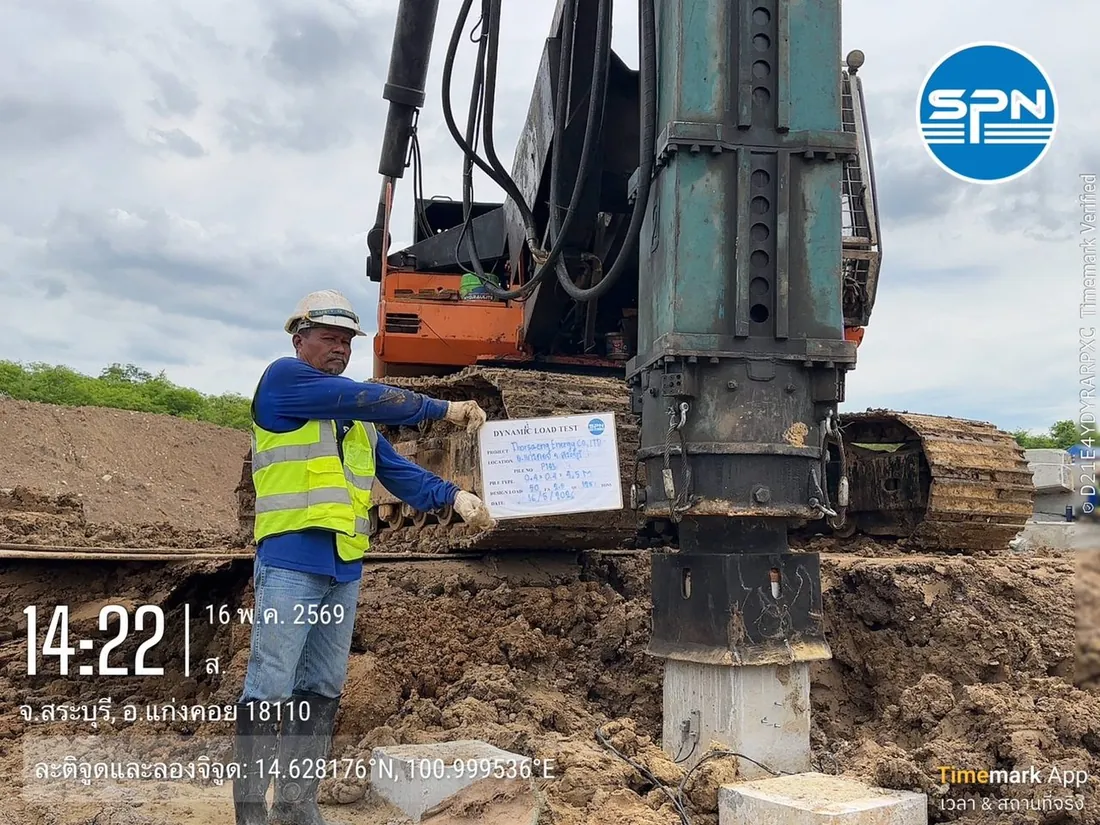
2. Dynamic Load Test (PDA) — testing capacity by the dynamic method
Strain and acceleration sensors are attached to the pile, a hammer is dropped onto the pile head, and the stress waves are analyzed to estimate load capacity. Testing follows ASTM D4945-26 together with DPT 1252-51 of the Department of Public Works and Town & Country Planning. Its advantages are speed, many piles tested per day and low cost per pile, which makes it suitable for checking piles spread across the whole project — but it must be calibrated against static test results as the law requires (see details in Dynamic Load Test (PDA) and the comparison of the two methods in Dynamic vs Static Load Test)
3. Seismic Integrity Test — testing integrity, not capacity
The pile head is tapped with a small hammer and the reflected waves are measured to detect defects such as necking, cracks, or a length that differs from the design. In Thailand, DPT 1551-51 is the main standard, with the international guidance of ASTM D5882-16 as a supporting reference (ASTM withdrew this edition in 2025 with no replacement yet).
ASTM D5882-16 was withdrawn by ASTM in 2025 with no replacement yet, and is in the process of reinstatement — in Thai practice, the main reference standard remains DPT 1551-51, which is still in force as normal. Specification writers should check the latest status with ASTM before citing the standard number in contract documents.
The key point is that a Seismic Integrity Test does not tell you how much load a pile can carry, so it cannot legally replace Static or PDA testing. However, its cost per pile is so low that it can cover the whole project, making it the most cost-effective screening step (read the principles in Seismic Integrity Test and interpretation in Interpreting Seismic Test Results)
← Scroll to see the full table →
| Test method | What it answers | Reference standards | Cap under the Ministerial Regulation |
|---|---|---|---|
| Static Load Test | How much load it carries | ASTM D1143/D1143M-20e1 · DPT 1251 | 50% |
| Dynamic Load Test (PDA) | How much load it carries | ASTM D4945-26 · DPT 1252-51 | 40% (must be calibrated against Static) |
| Seismic Integrity Test | Is the pile shaft sound? | DPT 1551-51 (with reference to ASTM D5882-16 guidance, withdrawn 2025) | — not used to set load capacity |
For an overview of all methods, including Lateral Load Tests and Pile Uplift Tests, see The Complete Guide to Pile Testing Methods. A comparison of the full set of ASTM standard numbers is in Comparing ASTM Standards for Pile Testing
How many piles need testing, and who decides?
The Ministerial Regulation does not specify a fixed number of piles to test. The one who actually sets the number is the design engineer, through the project specification, considering project size, total number of piles, consistency of soil layers, pile type, and the risk level of the building.
A common approach in practice is to combine several methods in layers — Seismic Integrity Tests for screening at a high proportion, PDA for capacity checks at a medium proportion, and a few Static Load Tests as the calibration reference. For principles on setting proportions and example test plans, see How Many Piles Should Be Tested?
A common problem is realizing testing is needed only after all the piles are already installed, so test piles cannot be selected, extra test piles must be added, or a Static Load Test cannot be done because there are no reaction piles — defining the test plan at the design stage is always cheaper and faster.
How are test results used for a building permit application?
Test results are not submitted as a stand-alone document; they serve as the source of the figures in the foundation design calculations certified by the design engineer. Local building officials check whether the resistance values used in the calculations come from a source the law accepts, and whether the cap used matches the source of that value.
A test report that can actually be used as supporting evidence must be complete: pile and project data, test method and reference standards, instrument calibration data, raw data and result graphs, analysis, and the engineer's signature with registration number — see the full list in Pile Test Report Checklist Before Permit Submission and an overview of the submission process in Building Permit Process
For building categories where the Ministerial Regulation requires a soil investigation report with at least 3 boring points, the soil boring report and the pile test report are used together — one describes the soil properties, the other proves the piles actually perform as calculated (see the elements of a legally compliant soil boring report in Soil Investigation Report Checklist)
The 3D model below shows the path of the test results: from the site, to a report signed by the engineer, and then to the source of the figures in the foundation design calculations submitted for the building permit.
Summary: does the law require pile testing?
The answer to "does the law require pile testing?" is that the 2023 Foundation Ministerial Regulation does not require every pile to be tested, but ties the cap on usable resistance values to the source of the value — values calculated from a soil investigation report may use 40%, a Static Load Test 50%, and a Dynamic Load Test 40%, provided it is calibrated against the static method. As a result, almost every project that wants a cost-effective foundation and a smooth permit review needs a pile testing plan, and it should be planned at the design stage, not after the piles are installed — see our full scope of services at Pile Testing Services
This article summarizes the Ministerial Regulation and standards for general understanding only. It is not legal or engineering advice for any particular project. For actual use, rely on the official text of the Ministerial Regulation as published in the Royal Thai Government Gazette and the relevant Ministry of Interior Notifications, and consult the project's licensed engineer.