How do these 3 standards differ? D5882 · D4945 · D1143 comparison table
Each of the 3 standards answers a different question. D5882 (withdrawn 2025) answers “is the pile shaft sound?”, while D4945 and D1143 answer “how much load can it carry?” — D4945 evaluates this from stress waves during impact, whereas D1143 applies a real load and measures settlement. The table below compares the energy used, equipment, time, cost and the companion Thai standards.
← Scroll to see the full table →
| Topic | ASTM D5882 | ASTM D4945 | ASTM D1143 |
|---|---|---|---|
| Test name | Low Strain Impact Integrity Testing (Seismic Integrity Test) | High Strain Dynamic Testing (Dynamic Load Test / PDA) | Static Load Test (Axial Compressive) |
| Latest edition status | Withdrawn D5882-16 — withdrawn by ASTM in 2025, no replacement yet | Active D4945-26 | Active D1143/D1143M-20e1 |
| What it checks | Pile shaft integrity (cracks, necking, voids) | Load capacity (evaluated from stress waves) | Actual load capacity, by direct loading |
| Energy source | Light hand-held hammer tap (low strain) | Drop weight / pile driver impact (high strain) | Hydraulic jack + kentledge or anchor piles |
| Main equipment | Accelerometer on the pile head | Strain transducers + accelerometers, PDA unit | Jack, load cell, dial gauges |
| Gives load capacity | No | Yes (evaluated from waves + CAPWAP) | Yes (most direct — actually measured) |
| Time per pile | Minutes | Hours (including setup) | Several days (including system installation) |
| Relative cost | Lowest (approx. THB 100–150/pile) | Medium (approx. THB 5,500/pile) | Highest (THB 50,000–150,000+/pile) |
| Equivalent DPT standard | DPT 1551-51 (primary reference) | DPT 1252-51 | DPT 1251 |
Prices in the table are approximate ranges per pile and exclude travel and equipment mobilization, which are charged extra according to site distance. See more at Pile testing prices 2026
Each of the 3 standards is like the “head of the family” for a different group of pile test standards, so some project specs also cite other ASTM standards from the same group:
- Integrity group — CSL for bored piles follows ACI PRC-228.2 guidance (ASTM D6760 was withdrawn in 2025), Parallel Seismic uses ASTM D8381/D8381M-21, and TIP uses ASTM D7949-25 (active)
- Rapid loading group — Rapid Load Test uses ASTM D7383
- Static group — uplift uses ASTM D3689, lateral load uses ASTM D3966, and bi-directional testing uses ASTM D8169
The diagram below summarizes the 3 main standards on one page. Note the status tag under each standard (red = withdrawn by ASTM, green = active) and the wedge at the top showing that load, time and cost per pile increase toward the right.
What is ASTM D5882? — Checks the pile "shaft", not capacity
ASTM D5882 (withdrawn by ASTM in 2025, no replacement yet) is the standard for low-strain pile integrity testing (Seismic Integrity Test); its last edition before withdrawal was D5882-16. The pile head is tapped lightly with a hand-held hammer and the reflected wave is measured with an accelerometer on the pile head (Low Strain Impact Integrity Testing). The key points to understand are:
- Used to screen for defects such as cracks, necking, voids or abnormal changes in cross-section
- It cannot tell how much load the pile can carry — a pile with a sound shaft whose toe does not reach the firm bearing layer can still have insufficient capacity
- Because it is fast and economical, it suits testing large numbers of piles or every pile, as a first screening step before capacity testing
Note on standard status: ASTM withdrew D5882-16 in 2025, the same year it withdrew D6760 for CSL testing, and no new edition has replaced it. Integrity testing in Thailand therefore relies on DPT 1551-51 as the primary criterion. If a specification needs to cite ASTM, write “method per ASTM D5882-16 (withdrawn by ASTM in 2025)”. See the list of withdrawn standards and their replacements at Pile test standards update 2026
Read more on the basics of the method at What is a Seismic Integrity Test? and on interpreting the graphs at How to read Seismic Test results
What is ASTM D4945? — Evaluating capacity from stress waves
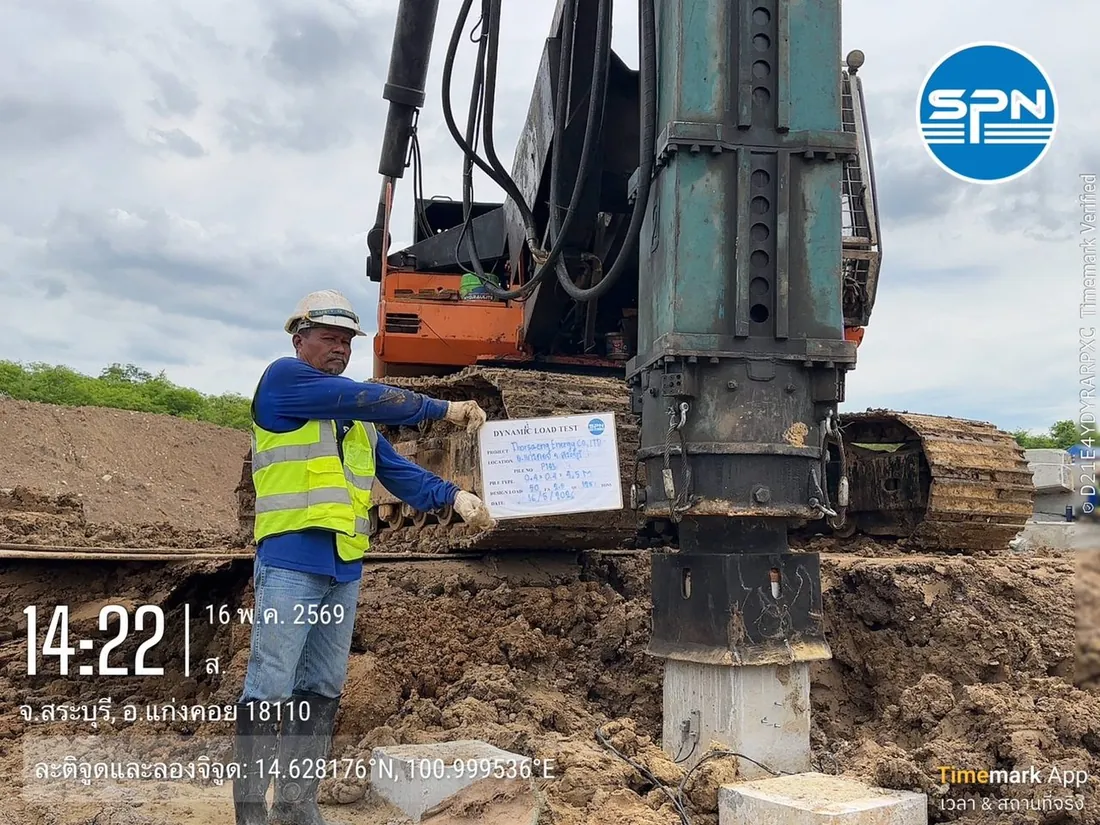
ASTM D4945 is the standard for high-strain dynamic testing of piles (High Strain Dynamic Testing); the current edition is D4945-26, and PDA work in Thailand pairs it with DPT 1252-51. The pile head is struck with enough energy to actually mobilize the pile, and force and velocity signals are measured with strain transducers and accelerometers mounted near the pile head, feeding a Pile Driving Analyzer (PDA):
- Gives an evaluated load capacity, transferred energy and pile stresses during impact, and checks pile integrity at the same time
- The signal data are further analyzed by Signal Matching, such as CAPWAP, to separate shaft friction from toe resistance
- Good practice is to correlate the results with a Static Load Test on the same project when possible, because the static test is the reference test
See details of the method and interpretation at What is a Dynamic Load Test (PDA)? and How to read PDA Test results

What is ASTM D1143? — The most direct reference test
ASTM D1143 is the standard for axial static load testing (compression); the current edition is D1143/D1143M-20e1, and in Thailand it is cited together with DPT 1251. A real load is applied to the pile head in increments with a hydraulic jack, the load is measured with a load cell and settlement with dial gauges, producing a load–settlement curve:
- It is recognized across the industry as the most direct method, because it reproduces actual loading without conversion through wave theory
- It has the highest time and cost, so usually only a few piles are tested, and it is used to calibrate PDA results on large projects
- The standard defines several loading procedures (e.g. Maintained Load) — the project specification states which one to use and to how many times the design load
Read more at What is a pile Static Load Test?
The 3 standards measure at different points on the same pile. Follow the leader lines from the graphs on the left to each equipment set, and see the right-hand panel summarizing how to cite standards correctly in a specification or report.
Which DPT standard matches each ASTM standard?
PDA work per ASTM D4945 is paired with DPT 1252-51 and static work per ASTM D1143 with DPT 1251, while integrity testing relies primarily on DPT 1551-51 because ASTM D5882 was withdrawn in 2025. DPT standards are issued by the Department of Public Works and Town & Country Planning, and projects in Thailand often cite them alongside ASTM:
- DPT 1551-51 — standard for pile integrity testing by the Seismic Test method, following the same approach as ASTM D5882-16, which ASTM withdrew in 2025; the DPT standard is therefore now the primary criterion
- DPT 1252-51 — standard for pile load capacity by the dynamic method (Dynamic Load Test), following the same approach as ASTM D4945 (current edition D4945-26)
- DPT 1251 — static pile load testing (Static Load Test), used together with ASTM D1143/D1143M-20e1
See details of each DPT pile standard at DPT pile testing standards: which ones exist?
If a project specification cites both ASTM and DPT, testing carried out to the standard method, with calibrated equipment and results certified by an engineer, generally satisfies both systems, because the measurement principles are the same. If the wording in the specification contradicts itself, consult the design engineer or supervising engineer before testing begins.
Which standard to use, and when? A practical summary
Choose according to the question you need answered. To know pile shaft integrity, use low-strain testing. To know load capacity, choose between fast results on many piles (PDA) and reference results from real loading (Static).
- Integrity screening of every pile → Seismic Test per DPT 1551-51 (following ASTM D5882-16, withdrawn 2025)
- Confirming load capacity with a limited budget and time → ASTM D4945 (PDA) with DPT 1252-51, sampling at the proportion required by the spec
- Large projects / mandatory spec / reference values needed → ASTM D1143 (Static) with DPT 1251, at least the number required by the spec, and used to calibrate PDA results
The 3 tests do not replace each other but complement each other — well-planned projects often use all three in proportions suited to the risk and budget. See also how many piles to test and compare all methods at the complete guide to pile testing methods
Summary
ASTM D5882 (withdrawn 2025) checks pile shaft integrity, ASTM D4945 evaluates load capacity by the dynamic method (PDA), and ASTM D1143 tests actual load capacity statically (Static). All three answer different questions and complement each other.
On the Thai side, PDA work uses DPT 1252-51, static work uses DPT 1251, and integrity testing (Seismic Integrity Test) relies primarily on DPT 1551-51. When citing ASTM in a specification or report, state the number with the edition year, such as D4945-26 or D1143/D1143M-20e1. Being able to read which standards a specification cites is the first step toward a correct test plan with a controlled budget.
SPN Soil Engineering provides all 3 pile testing methods nationwide across all 77 provinces, with over 20 years of experience. Reports are certified by a licensed civil engineer (COE) and can be submitted for building permit applications.
