Why Is a Withdrawn Standard a Problem in Specifications?
When ASTM withdraws a standard, it means the committee has stopped reviewing and maintaining that document, but it does not mean the test method is wrong or unusable. The document can still be purchased with Historical status, and the test method remains the same one used worldwide. What changes is that ASTM will issue no further revisions unless a Reinstatement is proposed.
The real problem therefore lies in the contract documents, not on site. After the 2025 withdrawal, a specification that says “test per the latest edition of ASTM D5882” points to a document that no longer has a latest edition. This allows multiple interpretations at acceptance and opens the door to disputes between owner and contractor.
A withdrawn standard can still be cited if the edition year is stated clearly, for example writing “ASTM D5882-16” instead of “latest edition”, because stating the year ensures both parties are referring to the same document.
What Is the Status of Each Pile Testing Standard in 2026?
← Scroll to see the full table →
| Standard | Used for | Status (Jul 2026) | How to cite |
|---|---|---|---|
| ASTM D4945-26 | High-Strain Dynamic Testing — PDA / Dynamic Load Test | Active (2026 edition) | Cite ASTM D4945-26 together with DPT 1252-51 |
| ASTM D5882-16 | Low Strain Impact Integrity — Seismic Integrity Test | Withdrawn in 2025 (reinstatement pending) | Test per DPT 1551-51 as the governing criterion, using the method of ASTM D5882-16 (withdrawn 2025) |
| ASTM D6760-16 | Crosshole Sonic Logging (CSL) — integrity testing of bored piles | Withdrawn in 2025, no replacement yet | Cite as ASTM D6760-16 (withdrawn 2025), use ACI PRC-228.2 as the method reference, and state the acceptance criteria directly in the specification |
| ASTM D7949-25 | Thermal Integrity Profiling — thermal integrity testing | Active (reinstated in 2025 with a new title) | Cite ASTM D7949-25 |
| ASTM D8381/D8381M-21 | Parallel Seismic — determining the length of piles already covered by a structure | Active | Cite ASTM D8381/D8381M-21; do not substitute D5882 or D7949 |
| ASTM D1143/D1143M-20e1 | Static Axial Compressive Load — static load test | Active | Cite together with DPT 1251, stating the Procedure and acceptance criteria |
| ASTM D3689/D3689M-25 | Static Axial Tensile Load — uplift test | Active | Cite when testing piles in tension |
| ASTM D3966/D3966M-25 | Lateral Load — lateral load test | Active | Cite when testing piles under lateral load |
| ASTM D8169/D8169M-26 | Bi-Directional Static Load — bi-directional test (O-Cell) | Active (2026 edition) | Cite when an embedded jack cell in the pile is used instead of top kentledge |
The statuses above were first checked in July 2026 and reviewed again in September 2026. Standards can change status at any time, so always confirm the current edition on the ASTM website before writing it into contract documents or a TOR.
The 3D view below brings all seven pile testing methods together on one site. Each method is numbered to match the panel on the right, which shows the standard to cite and its status as of September 2026, for a quick check of specifications or a TOR.
How Do the 3 Status Changes Affect Real Projects?
ASTM D5882 — Seismic Integrity Test

D5882 is the standard test method for low-strain pile integrity testing, the same method commonly called the Seismic Test in Thailand. This standard was withdrawn in 2025, and a proposal to reinstate it is in progress within ASTM.
In practice, projects in Thailand are not greatly affected, because the governing criterion cited is DPT 1551-51 of the Department of Public Works and Town & Country Planning, which remains in force. What needs to change is specification wording such as “latest edition of ASTM D5882” (there has been no latest edition since its withdrawal in 2025): state the edition year instead and make DPT 1551-51 the governing criterion.
ASTM D6760 — Crosshole Sonic Logging (CSL)
D6760 is used for integrity testing of large-diameter bored piles by transmitting sound waves between tubes embedded in the pile. Like D5882, it was withdrawn in 2025, and no new edition has replaced it. Projects that need a method reference therefore commonly use report ACI PRC-228.2 of the American Concrete Institute, which compiles nondestructive test methods for concrete in structures, together with the criteria written into the project specification.
The impact to watch for is that in CSL the acceptance criteria are often taken directly from the standard itself, such as quality grading based on wave travel time and energy reduction. With no further revisions, the specification should state numerical acceptance criteria in the project documents themselves, instead of a single line saying “in accordance with the standard”.
ASTM D7949 — Thermal Integrity Profiling
D7949 tests the integrity of bored piles using the heat generated as concrete cures. The 2014 edition was once in withdrawn status before being reinstated in 2025 as D7949-25, the edition currently in use. It was retitled Standard Test Methods for Integrity Testing of Concrete Deep Foundations by Thermal Methods and covers 3 measurement methods: lowering a probe into embedded tubes (Method A), embedding sensors attached to the reinforcement cage (Method B), and using fiber-optic cable embedded in the pile (Method C).
Parallel Seismic is used to determine the length of piles under completed structures by drilling a borehole beside the pile and lowering a probe into it. The standard that matches this method is ASTM D8381, not D7949 or D5882. Citing the wrong one makes the contract scope inconsistent with what is actually tested.
How to Write Specifications When a Standard Is Withdrawn: 3 Practical Principles
When a previously cited standard is withdrawn, a good specification must still state “which method is used” and “what result counts as a pass” without relying on a document that is no longer maintained. Follow these 3 principles:
- Always state the edition year; never write “latest edition” — write “ASTM D5882-16 (withdrawn 2025)” instead of “latest edition of ASTM D5882” so both parties cite the same document, and add the parenthetical note that it is a withdrawn edition for transparency.
- Make DPT standards the backbone of the specification — projects in Thailand can cite DPT 1252-51 for the Dynamic Load Test and DPT 1551-51 for the Seismic Integrity Test directly, then use ASTM as a supporting document on methodology.
- Write numerical acceptance criteria in the specification — for example the number of piles to be tested, the acceptable quality grade and the procedure when results fail. Writing the criteria yourself keeps the specification usable even if the referenced standard changes status in future.
Do You Need to Cite Both DPT and ASTM?
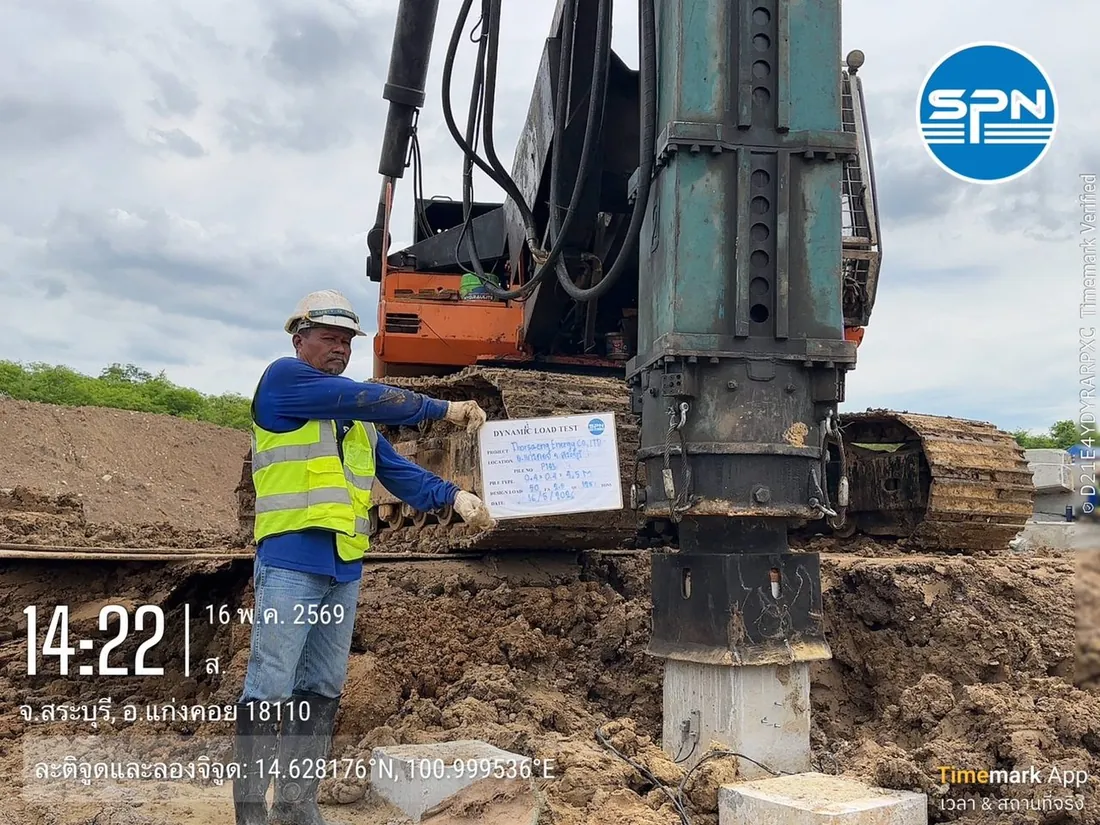
The safest approach for projects in Thailand is to cite both, with DPT as the mandatory criterion and ASTM as the method. DPT standards are issued by the Department of Public Works and Town & Country Planning, so they are familiar to the relevant Thai authorities and are actually used for acceptance, while ASTM provides more detailed technical requirements for equipment and data acquisition.
Conversely, if only ASTM is cited and that standard is withdrawn, the specification is left with just the title of a document no one maintains any more, a risk that is very easy to avoid by adding a DPT line.

Summary: Fix the Specification Wording, Not the Test Method
In 2026, ASTM standards for pile testing changed in 3 key places: D5882 and D6760 were withdrawn in 2025, and D7949 was issued as the new edition D7949-25, while D4945-26, D1143/D1143M-20e1, D3689/D3689M-25, D3966/D3966M-25, D8169/D8169M-26 and D8381/D8381M-21 remain active. (For further comparison of standards, read ASTM Pile Testing Standards Compared and DPT Pile Testing Standards.)
What needs fixing is the specification wording, not the test method: state the edition year instead of “latest edition”, adopt DPT 1252-51 and DPT 1551-51 as the governing criteria for projects in Thailand, and write numerical acceptance criteria into the project documents themselves. If you would like an engineering team to review the standards wording in your project specification or TOR, consult SPN directly.