
What determines the price of field soil testing?
Field soil test pricing is a service fee based on the actual amount of work per trip, not a price per square meter of project area. Every provider prices from the same 5 components:
- Mobilization — travel, equipment transport, and crew accommodation for upcountry sites. This is a fixed cost per trip, independent of the number of points
- Testing cost per point — DCP and Field Density are priced per point (or a day rate when there are many points), while Plate Bearing is priced per point, with each point taking half a day to a full day
- Reaction load — for the Plate Bearing Test only, an excavator, a loaded soil truck or a kentledge frame weighing several tonnes must be placed over the test point. If the site provides it, the price drops noticeably
- Laboratory testing — Field Density requires the Maximum Dry Density from a Compaction Test (ASTM D698 / D1557) of that fill material before the percent compaction can be calculated; priced per material sample
- Engineering report — data processing, graphs, summary tables, and certification by an engineer licensed by the Council of Engineers Thailand (COE)
Because mobilization is a fixed cost per trip, testing 5 points versus 15 points on the same day costs less than 3 times as much — grouping all test points into a single trip, or testing alongside soil investigation work already on site, is the most effective way to reduce the total cost. A common sequence on large fill projects is DCP screening across the whole plot first, followed by Field Density and Plate Bearing only at the required points.
Which methods cost less and which cost more? Price levels compared
The table below compares the relative price level of each field soil test method, where 💰 is the lowest per-point price group and 💰💰💰 is the highest. Use it for preliminary budgeting and to choose the method that answers the question you need answered:
← Scroll to see the full table →
| Test method | Reference standards | What it tells you | Pricing unit | Price level |
|---|---|---|---|---|
| DCP (Dynamic Cone Penetrometer) | ASTM D6951 | DCP Index converted to in-situ CBR of shallow soil; finds soft spots in fill | Per point / per day | 💰 |
| Kunzelstab (KPT) | Guidance: DIN EN ISO 22476-2 | Blows per penetration depth; assesses shallow soil density for houses and small roads | Per point / per day | 💰 |
| Field Density — Sand Cone | ASTM D1556 · DPT 2204-57 | In-place dry density, expressed as % compaction of fill layers | Per point + Compaction Test per material sample | 💰 |
| Field Density — Nuclear Gauge | ASTM D6938 | Instant on-site density and moisture; suits multi-layer fills needing frequent checks | Per point / per day | 💰💰 |
| Plate Bearing Test | ASTM D1195 / D1196 · DPT 1253-62 | Load–settlement curve and Modulus of Subgrade Reaction (k) for designing slabs on grade, spread footings and pavement layers | Per point (half day–1 day/point) + reaction load | 💰💰💰 |
💰 = low price group · 💰💰 = medium · 💰💰💰 = high — this compares methods for preliminary budgeting only and is not SPN's service price list. Actual prices depend on the number of points and site conditions and exclude travel and equipment mobilization costs, which are charged extra depending on the distance to site — contact us for a free quotation within 24 hours.
DCP has the lowest price per point but gives an approximate CBR from correlations, while Plate Bearing costs several times more but gives a k value that engineers can use directly to design factory floors — choose based on "the question you need answered" first, then compare prices. Read about the technical differences in DCP vs KPT vs SPT and What is a Plate Bearing Test?
How much does a Plate Bearing Test cost, and why is it more expensive than other methods?
Plate Bearing Test loads a round steel plate 30–75 cm in diameter onto the ground surface in increments and measures settlement per ASTM D1195/D1196 and DPT 1253-62. Its price per point is higher than other methods for 3 reasons:
- Several tonnes of reaction load are required — an excavator, a loaded truck or a kentledge frame placed over the test point. If the provider has to rent the machinery itself, the price rises significantly, so the quotation should state clearly which party supplies it
- Long duration per point — loading in increments and waiting for settlement to stabilize means each point takes half a day to a full day. A test crew can do 1–2 points per day, unlike DCP, which can do dozens of points per day
- Site preparation is needed first — level the ground surface, excavate the test pit to the required level, and provide access for machinery. Read the preparation checklist at Plate Bearing Test site preparation
For projects where the law or specifications require testing, read more at Plate Bearing Test and legal requirements
Is the Field Density Test priced per point or per day?
Field Density Test determines the in-place density of fill using the Sand Cone method (ASTM D1556) or a Nuclear Gauge (ASTM D6938), to compare it as percent compaction against the laboratory value. It can be priced in 2 ways depending on the job:
- Per point — suits occasional acceptance testing of fill layers, e.g. 5–10 points per layer
- Day rate — suits large fill projects that test every layer every day, such as factory fills, roads or container yards. A test crew stationed on site at a day rate is much cheaper than pricing per point
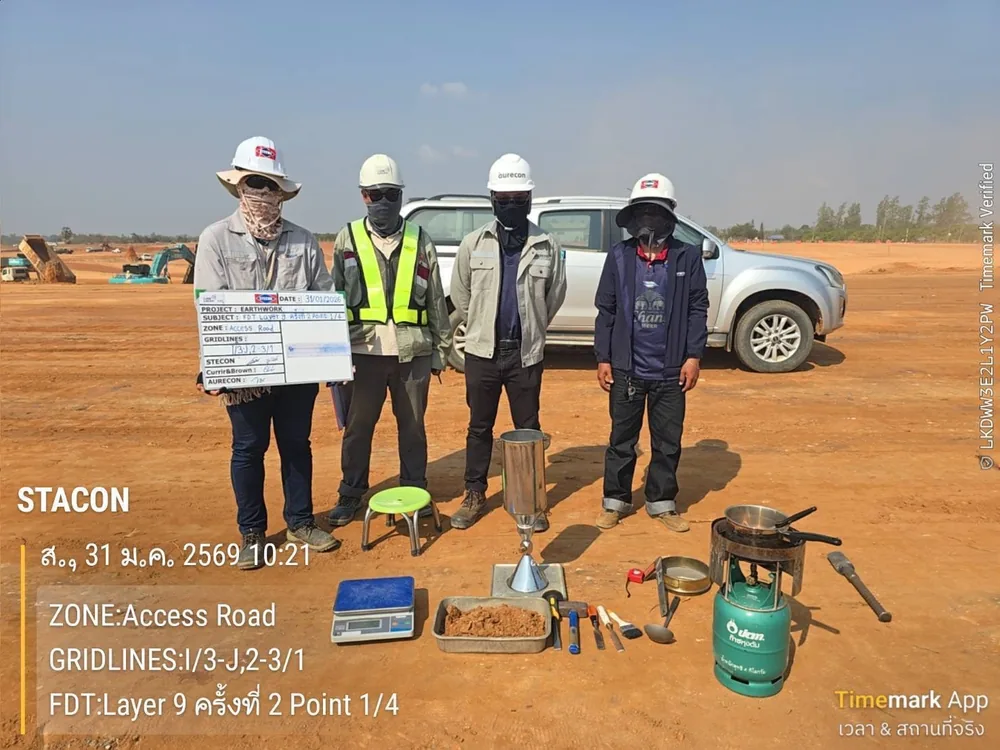
A commonly forgotten cost is the laboratory Compaction Test (Standard Proctor ASTM D698 or Modified Proctor ASTM D1557), which must be done for every fill material used. If the soil source changes mid-project, it must be retested. See the full procedure at Field Density Test: measuring in-place soil density, and if results fail the criteria, read Field Density failed: what to do
Is the DCP Test really the cheapest, and when should it be used?
DCP (Dynamic Cone Penetrometer) drives a steel cone with an 8 kg hammer and measures penetration per blow per ASTM D6951. The equipment can be carried by 2 people and each point takes only a few minutes, making it the lowest-cost method per point in the group. It suits 3 situations:
- Finding soft spots in fill before choosing locations for the more expensive Field Density or Plate Bearing tests
- Assessing the in-situ CBR of the existing subgrade for roads and parking areas that do not yet need laboratory values
- Checking the uniformity of compacted layers at many points on a limited budget
The limitation is that DCP gives CBR from correlations and can test to a depth of only about 1 meter. Work that needs bearing capacity values for direct design still requires Plate Bearing or soil investigation with SPT. Read how to interpret the results at What is a DCP Test?
What factors make quotations differ the most?
When quotations from several providers differ widely, it usually comes down to these 5 factors:
- Who supplies the reaction load (Plate Bearing) — the single most influential factor
- Number of trips — fill jobs that must test every layer and call the crew in and out several times pay mobilization again every time
- Distance and accommodation — upcountry jobs add travel, equipment transport and crew accommodation costs
- Whether the Compaction Test is included — a cheaper quotation may exclude laboratory costs
- Report level — a test-results-only report differs from one that analyzes design k or CBR values and is signed by a licensed engineer
What should a good field soil testing quotation specify?
Before comparing prices, compare the scope of work. A complete quotation should specify at least:
- Test methods with reference standards, e.g. ASTM D1195/D1196, ASTM D1556, ASTM D6951
- Number of points per method, plate size (Plate Bearing) and maximum test load
- Which party supplies the reaction load, machinery and site preparation
- Whether the laboratory Compaction Test is included, and the number of material samples
- A clear statement of whether travel, equipment transport and accommodation are included
- Report format, number of copies, delivery date, and certification by an engineer licensed by the Council of Engineers Thailand (COE)
Which SPN services have clear starting prices?
Field soil testing is quoted per project because site variables differ widely, but SPN's other main services have reference starting prices:
- Soil investigation — 2–3 storey houses start at about THB 20,000–40,000 (2–3 boreholes, including basic lab tests and an engineer-certified report)
- Pile testing — Seismic Integrity Test about THB 100–150/pile · Dynamic Load Test (PDA) from about THB 5,500/pile · Static Load Test THB 50,000–150,000+/pile
- Structural testing (NDT) — price levels compared for Rebound Hammer, UPV, GPR, Core Test and Floor Load Test
All prices above exclude travel and equipment mobilization costs, which are charged extra depending on the distance to site.
Summary
Field soil test prices in 2026 are based on the number of points, number of trips, supply of reaction load, laboratory costs and distance to site. DCP and Field Density are in the lowest per-point price group, while the Plate Bearing Test is the highest because it needs several tonnes of reaction load and takes half a day to a full day per point. The most effective savings come from completing all test points in a single trip, using machinery already on site as the reaction load, and testing alongside soil investigation work already on site. Send your test-point layout and job type to SPN for a free quotation within 24 hours; our engineering team works on sites nationwide. See service areas and soil boring starting prices on the soil investigation service page.
This article provides general information on pricing structure. The price levels in the table compare methods and are not SPN's service prices. Test method selection, number of points and interpretation of results should follow project specifications and the judgment of a licensed engineer.