
What determines the price of structural testing?
The price of structural testing (Structural Testing / NDT) is a service fee based on the actual quantity of work, not a price per square meter of building. Every provider prices from the same five components:
- Mobilization — travel, equipment transport and crew accommodation for provincial sites. This is a fixed cost per trip, independent of the number of points.
- Unit test cost — charged per point, per member, per specimen or per square meter, depending on the method.
- Access cost — scaffolding, boom lifts, opening ceilings, removing finishes or working at height.
- Laboratory testing cost — e.g. compressive strength testing of core specimens.
- Engineering report cost — analysis of results, conclusions and recommendations, and certification by a licensed engineer.
Because of this price structure, testing 5 points versus 20 points on the same trip does not cost 4 times as much, since mobilization is spread over every point. This is why completing all work in a single trip reduces the total cost the most.
Which methods are low-cost and which are high-cost? Price level by method
The table below compares the relative price level of each structural testing method, where 💰 is the lowest price band and 💰💰💰 the highest. Use it for preliminary budgeting and to choose the method that answers the question you need answered.
← Scroll to see the full table →
| Test method | Reference standards | What it tells you | Pricing unit | Price level |
|---|---|---|---|---|
| Rebound Hammer (Schmidt hammer) | ASTM C805 | Approximate surface compressive strength · uniformity | Per point | 💰 |
| Carbonation Test | EN 14630 · RILEM CPC-18 | Carbonation depth that puts the reinforcement at risk of corrosion | Per point | 💰 |
| Cover Meter / Rebar Scan | BS 1881-204 | Location, size and cover of reinforcement | Per member | 💰 |
| UPV (ultrasonic pulse) | ASTM C597 | Concrete uniformity · voids · deep cracks | Per point | 💰 |
| Half-Cell Potential | ASTM C876 | Probability of active reinforcement corrosion | Per grid/m² | 💰💰 |
| GPR concrete scanning | ASTM D6432 | Map of reinforcement, embedded conduits and member thickness | Per m² | 💰💰 |
| Impact Echo | ASTM C1383 | Slab thickness and internal voids when only one side is accessible | Per point | 💰💰 |
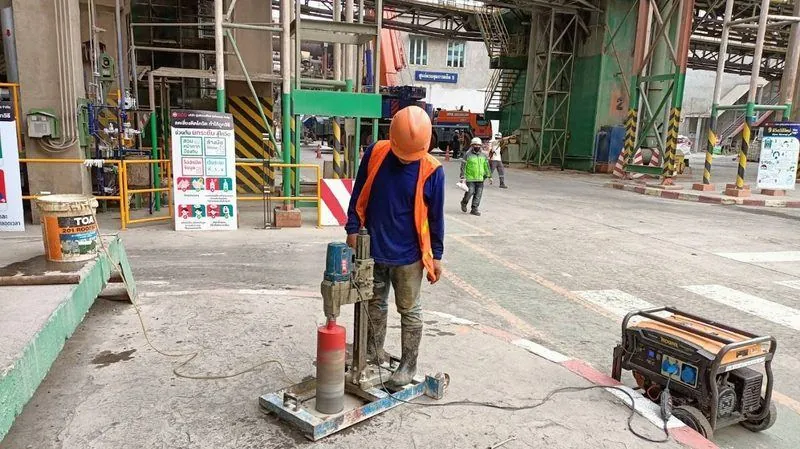
| Core Test (core sampling) | ASTM C42 · ASTM C39 | Actual concrete compressive strength usable in calculations | Per specimen | 💰💰 |
| Pull-Out Test (chemical anchors/studs) | ASTM E488 | Actual pull-out capacity of installed anchors | Per point | 💰💰 |
| Parallel Seismic | ASTM D8381/D8381M-21 | Length of existing piles under a completed building | Per pile (requires a guide borehole) | 💰💰💰 |
| Floor Load Test | ACI 318-19 Chapter 27 | Proves the floor's load capacity with real loads | Per test area | 💰💰💰 |
💰 = low price band · 💰💰 = moderate · 💰💰💰 = high — a comparison between methods for preliminary budgeting only. This is not SPN's service price list and excludes travel and equipment transport, which are charged additionally based on distance to site.
A lower price per point is not always better value, because each method answers a different question — the Rebound Hammer is cheap but gives a surface estimate, while the Core Test costs more but gives a compressive strength that can be used to calculate structural capacity. See more technical differences at NDT vs Core Test: what's the difference?
What factors cause the biggest price differences?
When quotes from several providers differ widely, the gap usually comes from these six factors:
- Number of test points and number of trips — the biggest factor. Jobs that need several site visits (e.g. waiting for ceilings to be opened or areas to be closed off) incur mobilization every time.
- Distance to site — provincial jobs add travel, equipment transport and crew accommodation.
- Difficulty of access — tall columns, slab soffits or points requiring scaffolding/boom lifts multiply the working time per point.
- Working hours — work in buildings still in operation often has to be done at night or on holidays, which incurs overtime.
- Level of reporting detail — a results-only summary report differs from a report that includes a structural capacity assessment and repair recommendations.
- Surface repair after testing — for methods that require drilling, such as the Core Test and Pull-Out Test, state clearly whether patching the holes is included.
Which test package should you choose? 3 packages used in practice
Rather than choosing methods one by one, in practice they are grouped into packages by purpose, which makes the budget easier to control:
← Scroll to see the full table →
| Test package | Suited to | Methods usually included | Overall price level |
|---|---|---|---|
| Initial screening package | You want an overview of the building's condition before committing to a detailed investigation | Visual condition survey + Rebound Hammer + Cover Meter | 💰 |
| Pre-purchase / pre-lease package | Inspecting a second-hand building or warehouse before signing a contract | Screening package + UPV + Core Test at selected points + GPR rebar scanning | 💰💰 |
| Strength verification package | Increasing the imposed load, changing the use, or installing new machinery | Pre-purchase package + Impact Echo + Floor Load Test per ACI 318-19 | 💰💰💰 |
The price levels above compare test packages; they are not SPN's service prices · The actual scope is set by an engineer after reviewing the drawings and site conditions
The figure below places each test method on a single example building, with the price level of each method — note that the cost does not come from testing alone but also includes access costs such as scaffolding, boom lifts or ceiling removal, which are often left out of the first quote.
If you are inspecting a building before buying or leasing, see the full inspection checklist at Structural inspection before buying or leasing a building or warehouse, and if your question is how much load a floor can carry, see How much load can a factory or warehouse floor carry?
What should a good quotation specify?
Compare the scope before comparing prices. A complete structural testing quotation should specify at least:
- Test methods with reference standards, e.g. ASTM C805, ASTM C42/C39
- Number of test points per method, and the locations or members to be tested
- A clear statement of whether travel, equipment transport, accommodation and access work are included
- Whether laboratory testing and surface repair after drilling are included
- Report format, number of copies, and certification by an engineer licensed by the Council of Engineers Thailand (COE)
- Report delivery time counted from completion of site work
Items often missing from the first quotation are scaffolding/boom lifts, after-hours work, removal and reinstatement of finishes, and a second site visit when the area is not ready. Ask clearly from the start who is responsible for these.
How can you reduce cost without reducing result quality?
- Complete all work in a single trip — prepare the area, close it off and open ceilings before the team arrives on site.
- Screen with low-cost methods first — use the Rebound Hammer and UPV to survey broadly, then core only where results are abnormal.
- Have the original construction drawings ready — as-built drawings can greatly reduce the number of rebar scanning points.
- Define the question clearly before hiring — "Can the floor carry the new machinery?" leads to a more cost-effective test package than ordering every method indiscriminately.
How many days does it take to get the report?
typical test package per building
Floor Load Test
signed report
The durations above are a general guide for sites that are ready. If you need to wait for compressive strength results of specimens or there are many test points, the duration will be longer according to the actual scope.
Which SPN services have clear starting prices?
Some types of work have a more standard scope, so starting prices can be quoted directly:
← Scroll to see the full table →
| Service | Approximate starting price | Details |
|---|---|---|
| Soil investigation for a residential house | THB 20,000–40,000/job (2–3 boreholes, including basic testing and report) | Soil boring prices 2026 |
| Seismic Integrity Test | ~THB 100–150/pile | Pile testing prices 2026 |
| Dynamic Load Test (PDA) | From ~THB 5,500/pile | Pile testing prices 2026 |
| Static Load Test | THB 50,000–150,000+/pile | Pile testing prices 2026 |
This price excludes travel and equipment mobilization costs, which are charged extra depending on the distance to site.
Summary
Structural testing prices depend on the method, number of points, difficulty of access and distance to site, not on building size. Indirect methods such as the Rebound Hammer and UPV are in the low price band and suit area screening, while the Core Test, Parallel Seismic and Floor Load Test are in the high band because they give strength-related answers that can be relied on. The most effective way to control the budget is to define the question clearly, choose a test package that matches it, and complete the work in a single trip — see an overview of all test methods in the NDT guide for concrete structures, and all services on the Non-Destructive Evaluation (NDE) page.
SPN Soil Engineering provides structural testing and NDT nationwide, with reports certified by civil engineers licensed by the Council of Engineers Thailand (COE). Send your scope of work or building drawings to our engineering team for a free quote within 24 hours.