How Many Days Does PDA Pile Testing Take in Total?
The total time for a PDA test is generally about 1–2 weeks, counted from the day you contact us to book until you receive the certified report. The actual on-site testing is the shortest part, at about 1 day per 5–10 points.
A PDA test is a dynamic method of testing pile load capacity (Dynamic Load Test) in accordance with DPT standard 1252-51 and ASTM D4945. The on-site testing itself does not take long, but the “total time” you should plan for runs from booking until the day you receive the report.
The factors that make the total time shorter or longer are:
- Number of piles to be tested (the more piles, or the more areas they are spread over, the more time on site)
- Concrete age of the piles — they must reach sufficient strength before testing
- Readiness of the pile heads (they must be trimmed so sensors can be installed)
- Distance to site and the work queue at that time
- Site conditions on the scheduled day, such as access for the equipment truck and the drop-weight lifting machine
How Many Steps Does a PDA Test Have, from Booking to Report?
A PDA test has 5 main steps: booking, pile head preparation, on-site testing, CAPWAP analysis and issuing the certified report. Steps 1 and 2 can run in parallel.
The figure below places all 5 steps on a single timeline. Note the red dashed frame: waiting for concrete age and coordinating the schedule is the critical period that usually determines the total time, while the on-site test day (orange bar) is the shortest part of the whole timeline.
Step 1: Booking and Confirming Job Details
The first step is to provide the job details: pile type and size, number of piles to be tested, site location and design load. Our team will assess the job and issue a quotation; once confirmed, the test date is locked in. This step usually takes 1–3 working days for coordination and scheduling, so it is best to get in touch while the piles are still waiting for concrete age.
Step 2: Preparing Pile Heads and Checking Concrete Age
Before testing, concrete piles must have enough age and concrete strength to withstand the hammer impact without damage. The site must prepare the pile heads to be level and square so that the force sensors (strain transducers) and accelerometers can be installed. See how to prepare them in Preparing the pile head before testing.
The duration of this step depends on the project's concrete pouring plan. For factory-cast driven piles, what usually determines the test date is the waiting period for the soil around the pile to recover (soil setup) as specified by the engineer. For details on how long to wait, see the article Concrete age and pile testing.
Step 3: On-Site Testing (~1 Day per 5–10 Points)
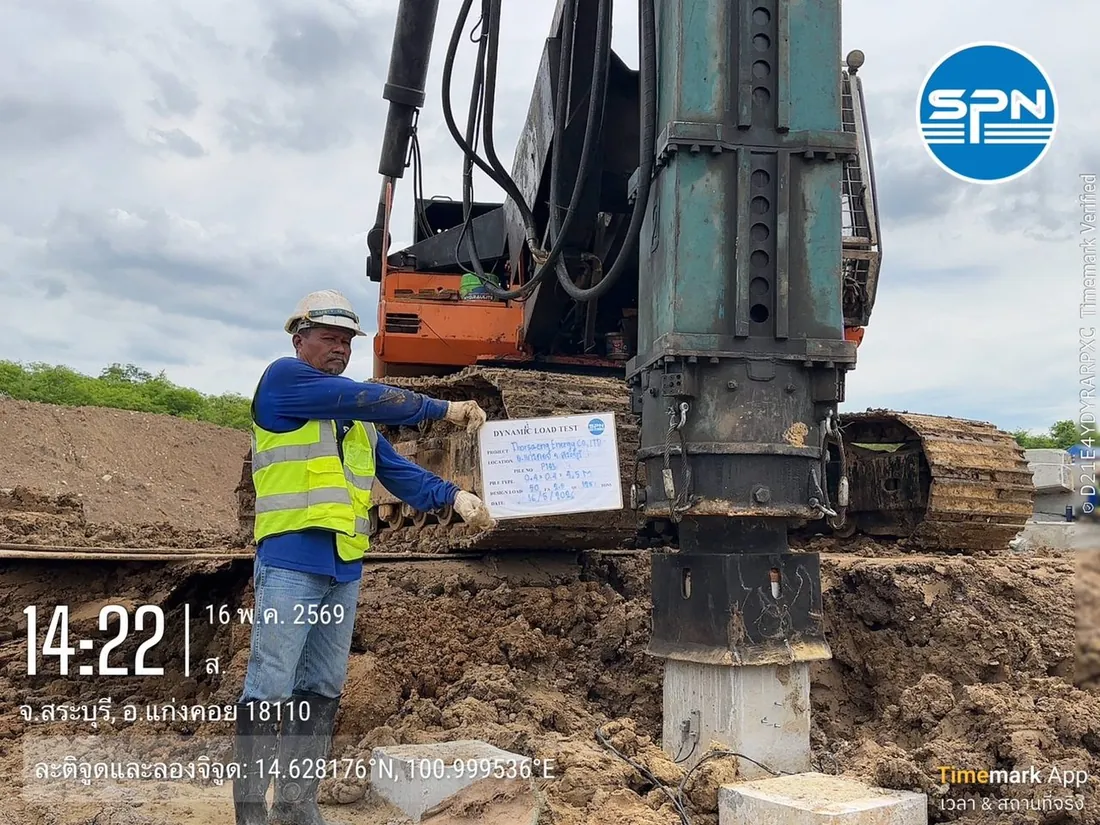
On test day, the team installs sensors on the pile head, then releases a drop weight onto the pile head while recording force and wave velocity signals, before moving the hammer setup to the next pile. Testing each pile does not take long; several piles can generally be tested in one day if they are in the same area.
The planning midpoint is about 1 day per 5–10 points (depending on each project's specifications). For example, 20 points in the same area will take about 2–4 days of on-site testing. If the piles are spread over several areas, or some pile heads are not ready, the number of points per day will drop.
Step 4: CAPWAP Analysis
After the field data is collected, an engineer analyzes the signals with the CAPWAP program to separate end bearing from skin friction and evaluate the pile load capacity. This step is done in the office and takes a few more working days of analysis. See details in the article What is CAPWAP?
Step 5: Issuing the Certified Report
The final step is preparing the summary report, signed and certified by a civil engineer licensed by the Council of Engineers Thailand (COE). The report is generally delivered within a few working days after testing and analysis are complete, and can be used for building permit applications with the relevant authorities.
How Many Days Does Each Step of a PDA Test Take?
In short: booking 1–3 working days, on-site testing ~1 day per 5–10 points, CAPWAP analysis and reporting a few working days each, while pile head preparation depends on the project's concrete pouring plan.
← Scroll to see the full table →
| Step | What to do | Approximate time |
|---|---|---|
| 1. Booking | Confirm job details + quotation + scheduling | 1–3 working days |
| 2. Pile head preparation | Concrete curing + pile head trim | Per project concrete pour plan |
| 3. On-site testing | Install sensors + drop-weight impact | ~1 day per 5–10 points |
| 4. CAPWAP analysis | Separate end bearing/skin friction, evaluate capacity | A few days |
| 5. Certified report | Summary of results + engineer's certification | A few days |
The figures above are typical time frames for planning; actual duration depends on the number of piles, concrete age and distance to site — you can request a timeline specific to your job when you request a quote.
How many points can be done on test day depends on whether every pile is ready. The 3D view below shows one day in which the testing team works through the piles one by one in sequence, while the box on the right summarizes the per-pile work cycle and what the site should prepare before the scheduled day.
What Information Do You Need to Book a PDA Test?
Complete information from the first contact helps us issue the quotation and lock in the date faster. Have this information ready when you contact us to book:
- Pile type and size (e.g. driven pile, bored pile, diameter)
- Number of piles to be tested
- Design load per pile
- Site location (province/district) for estimating travel costs
- Expected date the piles will be ready for testing (based on the concrete pouring plan)
Summary
A PDA test takes about 1–2 weeks in total from booking to receiving the report; on-site testing takes about 1 day per 5–10 points, and the certified report is delivered within a few working days. The period that usually determines the total time is waiting for concrete age and coordinating the schedule.
To speed things up, book in parallel with the concrete curing period, and have the pile heads and pile data ready before the scheduled day. See an overview of SPN's pile testing services on the service page.