
What services does SPN provide in Chon Buri, Rayong and the EEC?
SPN provides full-range geotechnical services in the Eastern region. Work we regularly carry out in this area includes:
- Soil investigation (Soil Boring + SPT) — new factories and extensions, warehouses, liquid storage tanks, ports and infrastructure, with lab testing and engineer-certified reports
- Field soil testing — Plate Bearing Test for factory floors and container yards · Field Density and DCP for controlling fill and road works in estates
- Pile testing — Dynamic Load Test (PDA) per ASTM D4945 and DPT 1252-51 · Seismic Integrity Test per DPT 1551-51 · Static Load Test for factory piles and heavy machinery
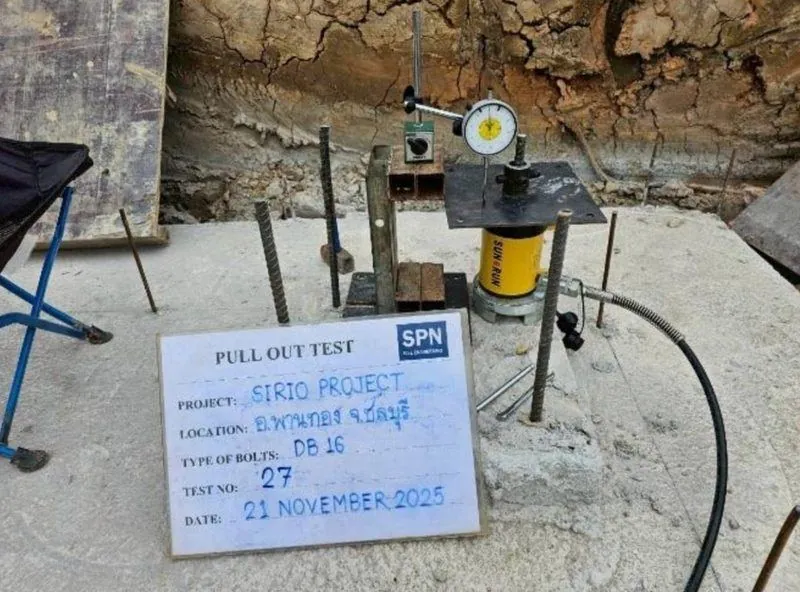
- Non-destructive structural testing (NDT) — chemical anchor Pull-Out Test, Core Test, Rebound Hammer and GPR for factories adding extensions or installing new machinery
- Instrumentation installation — Settlement Plates and Piezometers for large-scale factory site filling and leveling
How do Chon Buri–Rayong soils differ from Bangkok?
Soil conditions in the Eastern region are far more variable than in Bangkok. While Bangkok and its vicinity have a fairly uniform thick layer of soft clay (Soft Bangkok Clay), the Chon Buri–Rayong area can change within a few kilometers. Typical conditions from SPN's actual projects are:
- Coastal plains (the Chon Buri–Rayong coastline, including petrochemical estates) — usually coastal sand and marine sediments, with a high and possibly saline groundwater table. Watch for borehole collapse and plan fill works to suit the groundwater.
- Inland and foothill areas (inland industrial estates of Chon Buri and Rayong) — usually sandy clay and lateritic soil from weathered rock (residual soil); some locations have shallow weathered rock, so piles can be shorter than in Bangkok or spread footings may be used. This must be confirmed by soil investigation because the depth to the hard layer changes quickly.
- Lowlands and former paddy fields (parts of Chachoengsao, Prachin Buri and the border with Samut Prakan) — pockets of soft soil occur, so boreholes must be spread to cover heavily loaded zones.
Because of this variability, using soil data from a neighboring plot to design a factory or warehouse in the Eastern region is riskier than in Bangkok. Read guidance on setting the number and depth of boreholes in How many boreholes and how deep? and the land checklist before building a factory
What has SPN done in Chon Buri–Rayong?
Examples of SPN projects in the EEC range from soil investigation to post-construction testing and inspection:

← Scroll to see the full table →
| Area | Project type | Work performed |
|---|---|---|
| Rayong — petrochemical industrial estate | Petrochemical plant | Soil boring inside the estate under the plant's work permit and safety system |
| Rayong — industrial plant | New factory and extension | Soil boring + SPT with lab testing for design of machine foundations and production buildings |
| Rayong — factory project | Prestressed concrete driven piles | High-strain Dynamic Load Test (PDA) to verify pile load capacity (ASTM D4945 · DPT 1252-51) |
| Rayong — industrial estate | Slab on grade / concrete yard | Plate Bearing Test using the site excavator as reaction load (ASTM D1195/D1196 · DPT 1253-62) |
| Chon Buri — infrastructure project | Deep open excavation area | Soil boring for design of the earth retaining system and foundations |
| Chon Buri — LPG oil terminal / fuel depot | Port and fuel storage tanks | Soil boring for tank foundations and port structures |
| Chon Buri — building project | Completed concrete structure | Chemical anchor Pull-Out Test (ASTM E488) and Concrete Core Test (ASTM C42), Si Racha District |

What do you need to prepare before working in an industrial estate?
Work in industrial estates and petrochemical plants involves more safety procedures than typical sites, which affects the schedule. SPN is familiar with these requirements from regular work in the area. Project owners should prepare the following in advance:
- Site access documents — team list, ID card copies, and vehicle and machinery registrations, sent to the plant's or estate's safety department in advance as each site requires
- Safety training and Work Permit — most petrochemical plants require every team member to complete training and hold a daily work permit; allow 1 day before drilling starts
- Underground utility plans — locations of pipes, cables and underground chemical lines, to set safe borehole locations. If no drawings are available, SPN can scan with GPR before drilling
- Personal protective equipment per plant requirements — the SPN team already uses full PPE as standard, but some plants require additional equipment such as gas detectors, which must be known in advance
How are prices and travel costs to Chon Buri–Rayong calculated?
SPN's main service prices use the same rates nationwide, plus travel and equipment mobilization costs based on the distance to the site:
- Soil investigation — 2–3 storey houses start from about THB 20,000–40,000 (2–3 boreholes, including basic lab testing and an engineer-certified report); factory prices depend on the number and depth of boreholes. See Soil boring prices 2026
- Pile testing — Seismic Integrity Test about THB 100–150/pile · Dynamic Load Test (PDA) from about THB 5,500/pile · Static Load Test THB 50,000–150,000+/pile. See Pile testing prices 2026
- Eastern region travel costs — Rayong, Chon Buri and Chanthaburi are charged extra based on site distance and number of overnight stays, stated clearly in the quotation
The prices above are approximate starting prices and do not include travel and equipment mobilization costs, which are charged based on the distance to the site. Send the location and scope of work to get a free quote within 24 hours.
Summary
Chon Buri–Rayong is an area where SPN has an ongoing track record: soil boring in petrochemical estates and factory extensions, PDA pile testing, Plate Bearing Tests for factory floors, and post-construction structural inspection. Eastern soils are much more variable than Bangkok's, so soil investigation on the actual plot is a step that cannot be skipped. The SPN team travels from Samut Prakan and reaches the site within a day, is familiar with estate work permit systems, and delivers reports certified by a licensed engineer (COE license) for building permit applications and submission to relevant authorities. See all service areas on the soil investigation service page
The soil conditions in this article are a general overview of the area based on field experience, not design data for any particular plot. Actual foundation design must be based on the project's own soil investigation results and is the responsibility of the licensed design engineer.