A restrike uses the same equipment, gauges and analysis method as the first PDA round; only the timing of the test differs. The applicable standards are DPT 1252-51 (standard for dynamic pile testing) and ASTM D4945, whose current edition is D4945-26.
The diagram below compares the same pile at the end of driving (EOD) and at restrike after a waiting period (BOR). Note the excess pore water pressure around the pile that has dissipated, and the graph on the right showing capacity increasing with time (set-up) or decreasing (relaxation).
What Are EOD and BOR, and How Do They Differ?
EOD (End of Driving) is the value PDA measures toward the end of the initial pile driving, while BOR (Beginning of Restrike) is the value measured from the first few restrike blows after a waiting period. Both use the same equipment and analysis method, but they give the pile capacity at different points in time.
- EOD = capacity at the moment driving stops
- BOR = capacity after the soil around the pile has had time to rest
- The difference between BOR and EOD = the change in capacity over time
The BOR value must come from the first few restrike blows only. If driving continues, the soil around the pile is disturbed again and some of the capacity regained during the wait is lost. In addition, the hammer must have enough energy to move the pile slightly with each blow; if the pile barely moves, the measured value is only a lower bound of the true capacity.
Soft clays like the Bangkok soft clay usually show a clear capacity gain from EOD to BOR, so restrike testing is very important for driven piles in such areas.
What Is Soil Set-up, and Why Does Driven Pile Capacity Increase Over Time?
Soil set-up is the phenomenon in which pile capacity increases with time after driving. The main cause is the gradual dissipation of the excess pore water pressure generated during driving, which makes the soil around the pile denser and restores skin friction.
During driving, the pile displaces the soil so that the soil structure temporarily loses strength and high water pressure develops around the pile. Over time, the water pressure drains away and the soil around the pile grips the pile surface better again, so the measured capacity is higher than at EOD. This phenomenon is pronounced in clay, while sand usually sets up faster.
The capacity gained from set-up comes mostly from skin friction; end bearing usually changes little. Set-up capacity tends to rise quickly soon after driving and then gradually slows, which is why the graph in the first diagram shows time after driving on a logarithmic scale.
In practice, evaluating capacity from EOD alone may give a value lower than the pile's true capacity under service loads. Restrike testing therefore reflects a capacity closer to actual service conditions.
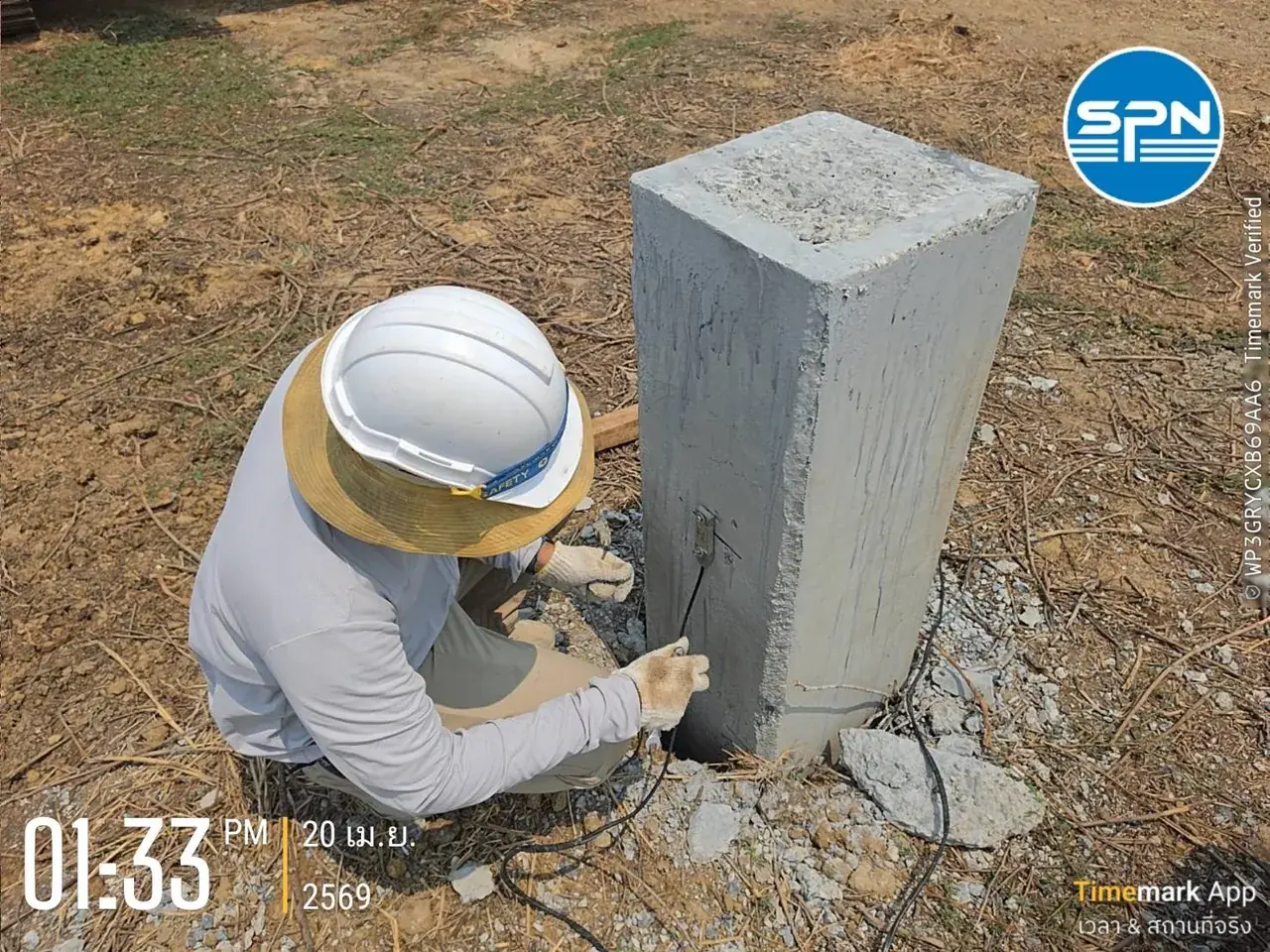
The 2D section and 3D model below simulate a restrike test on site. Look at the hammer in the pile rig leader, the gauges attached to the side of the pile, and the zone of clay around the pile that was displaced and carries excess pore water pressure at the end of driving. This zone is why capacity at EOD is usually lower than at BOR in clay.
What Is Relaxation? Can Pile Capacity Decrease After Driving?
Relaxation is the opposite of set-up: pile capacity decreases with time after driving. It occurs in some soil types, such as saturated dense fine sand, weathered rock, and some shales.
In dense sand, the soil dilates as the pile displaces it, creating temporary negative pore water pressure, so resistance at the end of driving is higher than normal. When the water pressure returns to its original state, the capacity drops. This effect usually occurs at the pile toe (end bearing), so EOD values in such soils may exceed the long-term capacity.
Because capacity can genuinely decrease in some soil conditions, restrike is a check of the actual capacity after the soil has rested. The results must be evaluated and judged by the project's responsible engineer, not concluded from the numbers alone.
Why Is PDA Repeated? Is the End-of-Driving Value Alone Enough?
The EOD value alone is usually not enough, because the capacity measured at the end of driving may not be the capacity the pile actually has in service. Re-testing after a waiting period gives values that better reflect actual conditions, for 4 main reasons.
- Reflects actual service capacity — the structure carries load after construction is complete, when the soil has set up, not at the moment driving ends
- Avoids underestimation — in clay, EOD usually gives a value below the long-term capacity; judging on this value alone may lead to unnecessarily longer or more piles
- Detects relaxation — in dense sand or some rocks, capacity may drop after driving, so the EOD value may be too high, which is important safety information
- Supports CAPWAP analysis — BOR signals are often used for CAPWAP analysis to separate skin friction from end bearing; compared with the EOD results, this shows in which soil layers the capacity changed
Capacity from the restrike round is checked against the project specification criteria just like ordinary PDA results. See how to read the values and the applicable criteria in How to read PDA test results
How Many Days After Driving Should a Restrike Test Be Done?
In practice, the wait before restrike is usually a few days to 1–2 weeks or more, so that soil set-up can develop sufficiently. This period depends mainly on soil type: sand sets up quickly and needs less time, while soft clay needs longer because water pressure drains slowly.
However, the appropriate waiting period for each project must be set by the responsible engineer, based on the actual soil profile, soil investigation results and project specifications. This article explains general principles only and does not set a fixed number of days in place of the project engineer.
For driven piles, concrete age is usually not what governs the wait, because precast concrete piles are cured to strength at the factory. The wait before PDA testing therefore depends mainly on soil set-up. Compare the waiting periods for each test method in At what concrete age can piles be tested?
EOD vs BOR Comparison Table
The table below summarizes the differences between EOD and BOR in 5 aspects, from the timing of measurement and the soil condition around the pile to the applicable standards.
← Scroll to see the full table →
| Topic | EOD (End of Driving) | BOR (Beginning of Restrike) |
|---|---|---|
| Timing of measurement | End of initial driving | Restrike after a waiting period |
| Soil condition around pile | Still displaced, high water pressure | Rested, water pressure partly dissipated |
| Capacity in clay | Usually below long-term capacity | Usually higher (set-up) |
| What it tells you | Momentary capacity at end of driving | Capacity close to service conditions |
| Standard | DPT 1252-51 / ASTM D4945 | DPT 1252-51 / ASTM D4945 |

Is Restrike Used for All Pile Types?
No. Restrike testing is used mainly for driven piles, because there must be an EOD value from initial driving to compare with the value after the wait, and because the soil around the pile is disturbed by driving, producing set-up or relaxation to measure.
Bored piles have no driving stage, so there is no EOD value to compare. Bored piles can still be PDA-tested normally, using a drop weight once the concrete has reached its specified strength, but this is a single-round test, not a restrike. Read more in Can PDA test bored piles? and an overview of the method in Dynamic Load Test (PDA Test)
Summary
A restrike test is a repeat PDA test after a waiting period following pile driving, to compare against EOD and capture soil set-up (capacity gain) or relaxation (capacity loss) over time. The results are closer to the capacity under actual service conditions than a single measurement at the end of driving. The waiting period and interpretation of results must be set by the responsible engineer based on each project's actual soil profile.
SPN Soil Engineering provides pile testing services with PDA and restrike, including CAPWAP analysis, nationwide across all 77 provinces. Reports are certified by a civil engineer licensed by the Council of Engineers Thailand (COE). Contact us for a free quotation within 24 hours.