Overall Timeline: 5 Main Steps
The figure below summarizes all 5 steps on a single timeline. The orange span is the period counted toward getting the report, from the first day of drilling until the engineer signs and certifies it.
← Scroll to see the full table →
| Step | Typical duration |
|---|---|
| 1. Request a quotation and confirm the job | Free quotation within 24 hrs |
| 2. Schedule the work and prepare the site | Depends on the work queue and site readiness |
| 3. Field drilling | About 1–2 days/borehole (depending on depth and soil conditions) |
| 4. Laboratory testing of soil samples | Several days to about 1–2 weeks, depending on the tests |
| 5. Analysis and engineer-certified report | Included at the end of step 4 |
The whole process from the start of drilling to the complete report typically takes about 7–14 working days. Each step is detailed below.
Step 1: Request a Quotation
Information to prepare for a fast and accurate quotation:
- Site location (coordinates or a shared location pin)
- Type of building to be constructed, e.g. a 2-storey house, warehouse or office building
- Number of boreholes and depth specified by the designer (if any), or ask an engineer to recommend them — see the approach in How many boreholes and how deep
- Site conditions, e.g. whether vehicles can access the site and whether there are existing structures
SPN prepares a free quotation within 24 hours. Soil investigation with testing for a house starts from about THB 20,000–40,000 for 2–3 boreholes (see details in Soil boring prices 2026 or see the scope of our soil investigation and testing services). This price excludes travel and equipment mobilization, which are charged extra according to the distance to the site.
Step 2: Scheduling and Site Preparation
Once the job is confirmed, the team will schedule the drilling date. What the owner can prepare to avoid lost time on site:
- Clear an access route for the vehicle and drilling rig to reach the borehole locations
- Point out water pipes, underground power cables or other existing utilities (if any)
- Provide a water source near the drilling point, since wash boring requires water; if none is available, let the team know in advance so they can make arrangements
Step 3: Field Drilling (1–2 Days/Borehole)
On drilling day, the survey team will:
- Set up the drilling rig at the specified borehole location
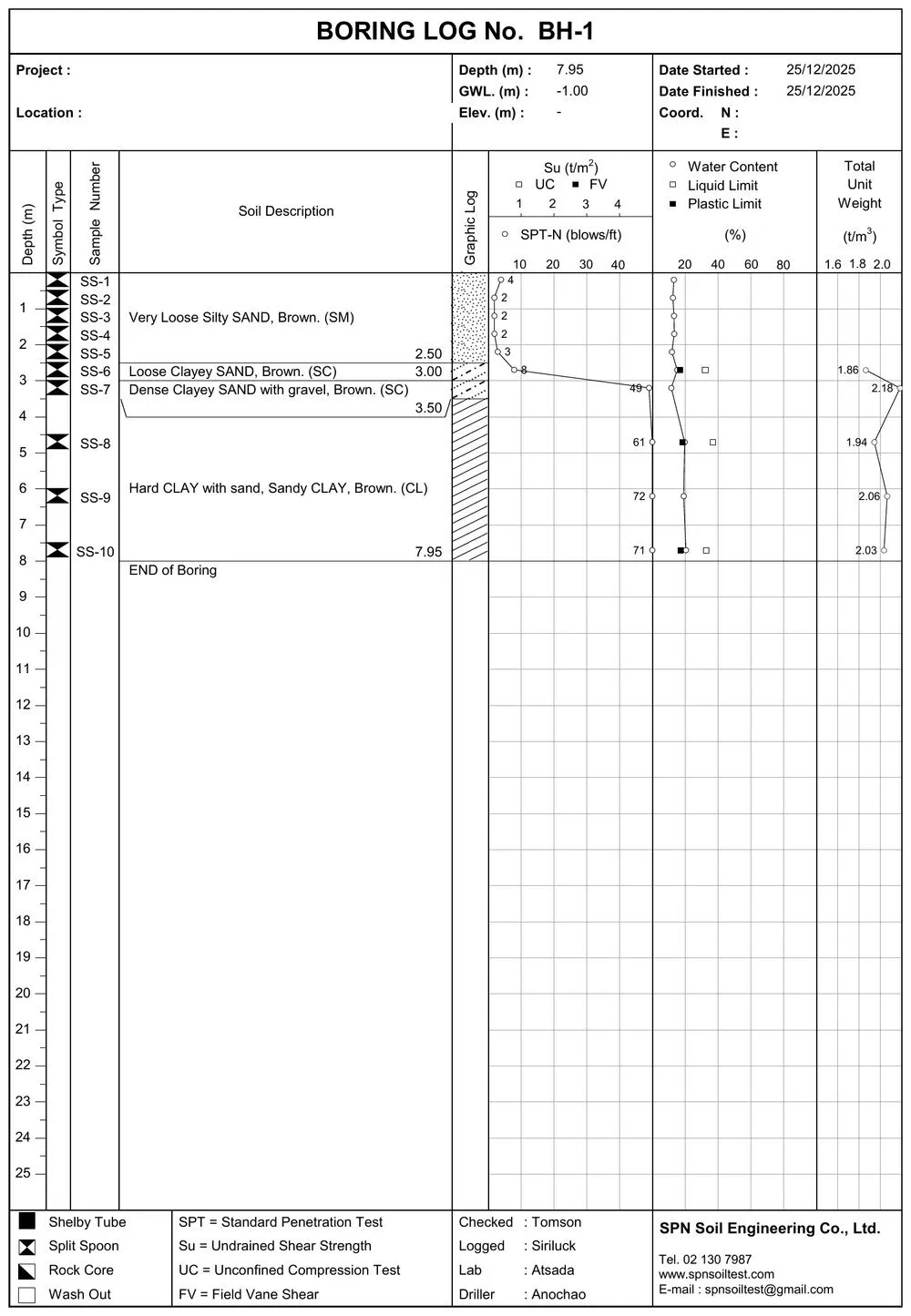
- Drill and perform the Standard Penetration Test (SPT) at specified depth intervals and collect soil samples (read about N-values in What is the SPT N-value and how to interpret it)
- Record the soil type, soil color, groundwater level and N-values in the field log
- Seal the soil samples in containers and send them to the laboratory
Factors that make field work slower or faster: borehole depth, soil conditions (very stiff soil or gravel layers slow drilling), weather and site access.
Step 4: Laboratory Testing
The soil samples are tested to ASTM standards. Common tests include moisture content, Atterberg limits, sieve analysis and the compressive strength of the soil. The duration depends on the number of samples and the types of tests — some tests, such as the consolidation test, include stages that must wait for the soil's natural response and cannot be rushed. Read about each test in What laboratory soil tests are there
Step 5: Analysis and Report Preparation
The engineer compiles the field data and lab results into a soil investigation report comprising the Boring Log, laboratory test results, a summary of the soil profile and preliminary foundation recommendations. SPN reports are certified by a civil engineer licensed by the Council of Engineers Thailand (COE) and can be used for building permit applications (check the full report contents in Soil investigation report checklist for building permit applications)
How Can You Get the Report Sooner?
- State when you need the report as early as the quotation request so the queue and lab work can be planned properly
- Get the site ready before drilling day to reduce idle time on site
- Specify the number of boreholes/depth from the designer clearly from the start to avoid changing the scope midway
Summary
Soil investigation is not just "drilling day"; it also includes laboratory testing and the engineer's analysis. For a typical house, allow about 7–14 working days from drilling to the complete report, plus lead time for scheduling. The earlier you plan, the more smoothly your design and building permit application will go.
The durations in this article are typical values for preliminary planning. Actual durations depend on the number of boreholes, depth, tests, weather and the work queue at the time.