The figure below compares 2 quotations against the 7-point checklist in this article. The cheaper one is often cheaper because it leaves some items out, which can ultimately make the report unusable.
1. Is the Report Certified by an Engineer Licensed by the Council of Engineers (COE)?
This is the most important point. Soil boring and the interpretation of its results are engineering work. A report with no engineer's signature and certification:
- May not be accepted by the structural designer for calculations
- Is usually not accepted by the relevant authorities as part of a permit application (see the relevant requirements in Summary of the 2023 foundation Ministerial Regulation)
Ask to see a sample report before hiring. Check whether it has a certification page signed by an engineer with a license number, which you can verify with the Council of Engineers Thailand.
2. Which Standards Are the Tests Based On, and Can They Say Clearly?
Field and laboratory tests should cite verifiable standards, such as ASTM standards for SPT and laboratory soil property testing. Be wary of a company that cannot answer questions about standards, or answers vaguely.
Ask directly: "Which standard do you follow for SPT?" and check whether the quotation or sample report cites the reference standards.
3. Is the Scope of Work in the Quotation Complete?
A good quotation must clearly state at least:
- Number of boreholes and depth (or the termination criterion, e.g. drilling until reaching a hard stratum per the specified criteria — see the reasoning in How many boreholes and how deep?)
- Field tests, e.g. SPT at what depth interval
- Laboratory tests included in the price
- What is included/excluded, e.g. equipment mobilization, water, extra drilling if deeper than specified
Unusually low prices usually come from cutting out key tests, leaving a report that cannot be used for actual design. Always compare prices for the same scope of work — see the standard price structure in Soil investigation prices 2026
4. What Does the Delivered Report Include?
A complete soil investigation report should include:
- A borehole location plan referenced to the land plot
- Boring logs showing soil layers, SPT N-values and the groundwater level
- Laboratory test results, with reference standards
- A summary of subsoil conditions and preliminary foundation recommendations
- An engineer's certification page
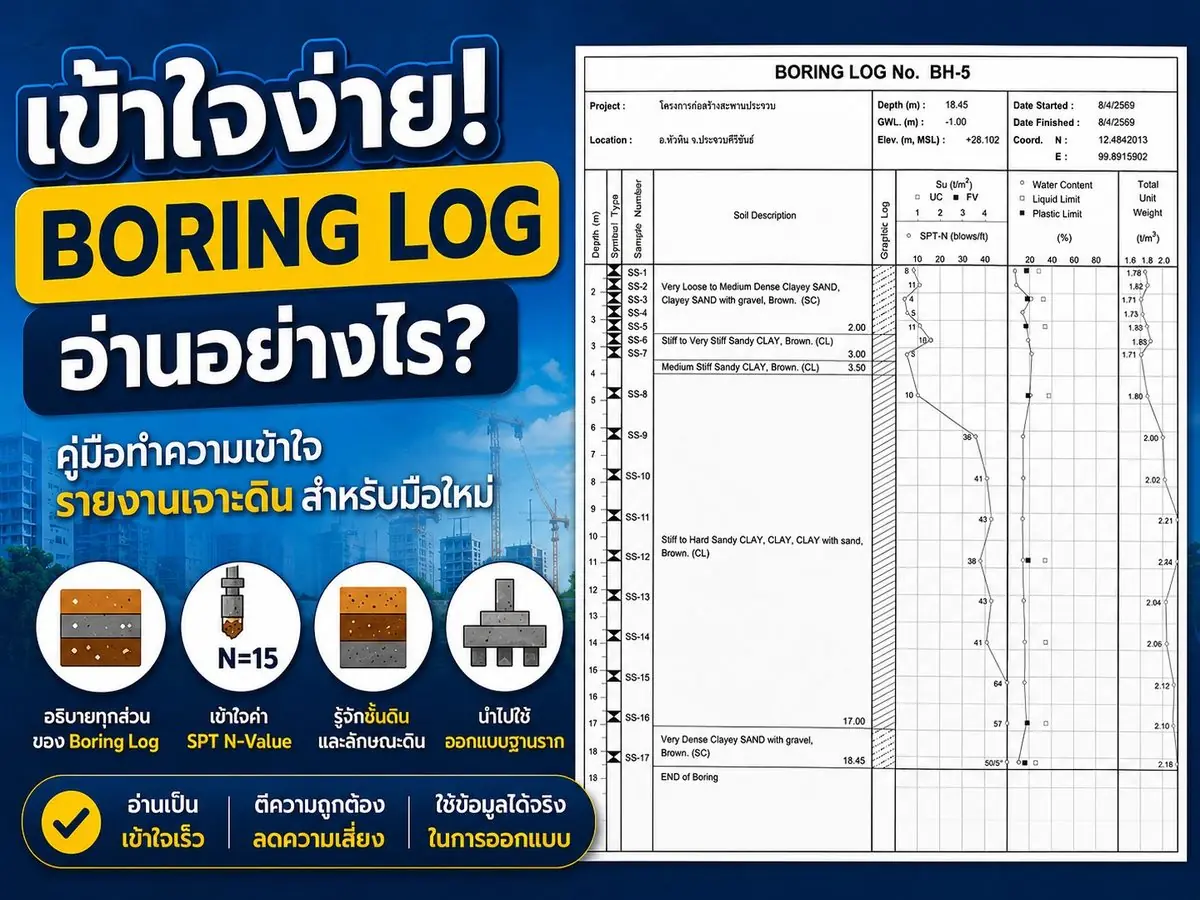
Ask to see a sample report (with the client's name redacted) before deciding; professional companies are always happy to show one. See the full checklist of report contents in Soil investigation report checklist for building permit applications
5. Are the Equipment and Crew Real?
- Owns its own drilling rigs and test equipment, or can explain what equipment it uses
- Has a soil testing laboratory, or can say where samples are sent for testing
- Has a field crew that works systematically and keeps a real field log on site
Look at photos of real projects and ask about projects done in nearby areas. An experienced company can describe the soil conditions of that area right away.
6. Can Their Experience and Track Record Be Verified?
Look at how many years the company has been operating, the types of projects it has done (houses, factories, high-rises, public-sector work) and its service area. Companies that take on many types of projects in many areas have usually encountered many different soil conditions, which helps them give better advice on site.
For example, SPN Soil Engineering has worked in geotechnical engineering for over 20 years, with more than 500 projects, serving all 77 provinces, including offshore work — see the scope of our soil investigation and testing services
7. Communication and Service After the Report Is Delivered
Soil boring does not end with sending a PDF file. Questions to ask before hiring:
- If the designer has questions about the report, can they ask the certifying engineer?
- How many days after drilling is finished will the report be delivered? (see the standard timeline in How long does soil boring take?)
- How quickly do they reply with a quotation? — responsiveness during sales often reflects the care you will get during service
7-Point Checklist Summary
← Scroll to see the full table →
| No. | What to check | Red flags |
|---|---|---|
| 1 | Licensed PE certifies report | No signature page / no license number given |
| 2 | Test standards (e.g. ASTM) | Cannot answer questions about standards |
| 3 | Scope of work in the quotation | Unusually cheap, no test list |
| 4 | Report contents | Refuses to show a sample report |
| 5 | Equipment / crew / lab | No photos of real work, cannot explain the equipment |
| 6 | Experience and track record | No verifiable references |
| 7 | Communication after delivery | Hard to reach, no engineer to answer questions |
Summary
Choosing a soil investigation company should not be about price alone, because what you are really buying is "the data the engineer uses to design the foundation for the whole building". Check everything: the engineer's license, test standards, scope of work, sample report, equipment, track record and after-sales service, and you will get a report that is genuinely usable and worth every baht.
This article is intended as general guidance for clients. Requirements vary from project to project, so consult the design engineer or project consultant before making a decision.