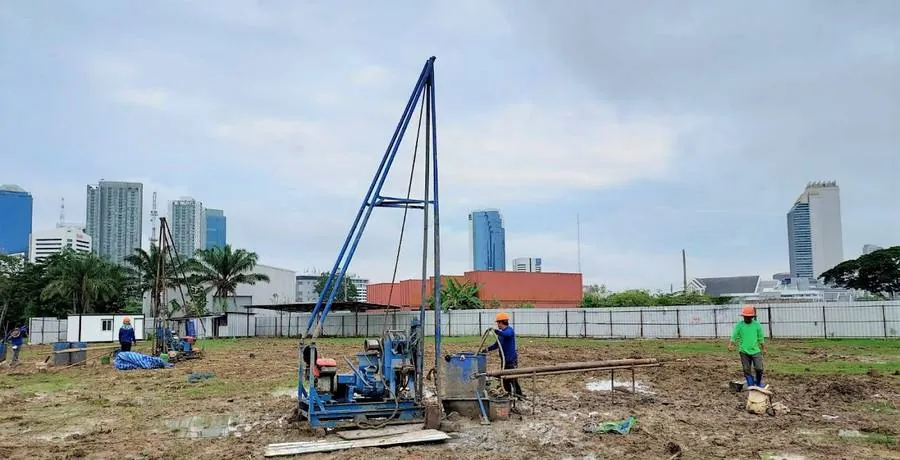
What work does SPN carry out in Bangkok and its vicinity?
The work SPN regularly carries out in Bangkok and its vicinity covers every stage of a project, from pre-design through construction:
- Soil investigation (Soil Boring + SPT) — houses, commercial buildings, condominiums, high-rises and warehouses in the metropolitan area, with lab tests and reports certified by an engineer
- Pile testing — Seismic Integrity Test to DPT 1551-51 for testing every pile · Dynamic Load Test (PDA) to ASTM D4945 and DPT 1252-51 · Static Load Test for high-rise buildings
- Instrumentation — Inclinometers, settlement plates and piezometers for deep excavations and fills on soft clay
- Non-destructive structural testing (NDT) — GPR scanning of the ground and structures, Rebound Hammer, UPV and core tests for old buildings, extensions and building purchases/sales
- Geotechnical design — foundations, retaining walls and temporary earth-retaining systems on soft clay
How does soft Bangkok clay affect soil investigation?
Bangkok and its vicinity sit on a layer of soft clay (Soft Bangkok Clay) about 12–20 meters thick that has low bearing capacity and keeps settling, so almost every building needs piles to transfer loads down to the dense sand layer below. Soil investigation in this area differs from other regions in several ways:
- Boreholes must reach the bearing sand layer — not just pass through the soft clay, because engineers use the SPT N-values of the sand layer to set the pile tip level. The EIT guideline for buildings of up to 5 stories in Bangkok is about 30 meters, getting deeper with building height.
- Soil layers can differ at the district level — from actual projects and public data, the Bang Phli area of Samut Prakan has upper soft clay up to about 26 meters thick, Bang Rak has a very soft mud layer at about 38–50 meters depth, and the Thonburi side often has silty sand seams within the soft clay.
- Undisturbed samples of the soft clay must be taken (Shelby tube, ASTM D1587) for Unconfined Compression and Consolidation tests, which are used to assess settlement and pile skin friction.
- Ground settling around buildings (Negative Skin Friction) — land subsidence and fill settlement make the ground around a house settle differently from the house itself on piles; soil data is needed to design for this.
Read more in Bangkok soft clay and foundation design, Negative Skin Friction in Bangkok and How many boreholes, and how deep
What real projects has SPN done in Bangkok and its vicinity?
← Scroll to see the full table →
| Area | Project type | Work done |
|---|---|---|
| Central Bangkok | Condominium | Soil borings down to the bearing sand layer + SPT + Shelby tube sampling for high-rise pile design |
| Bang Phli, Samut Prakan | Deep excavation along sheet piles | Installed inclinometer casings to measure lateral soil movement throughout excavation |
| Sathon area, Bangkok | Downtown construction project | GPR underground scanning for pipes and buried objects before boring and pile driving |
| Bangkok | Old timber building | GPR scanning for buried objects around an old building before renovation |
| Bangkok and vicinity | Retaining wall on soft clay | Soil investigation and retaining wall design — see Case Study |
| Bangkok | Urban deep excavation | Excavation performance monitoring system — see Deep excavation monitoring in Bangkok |


What does urban soil investigation need to manage in particular?
Work in Bangkok is constrained more by space and neighbors than by technical issues. Before mobilizing, SPN plans the following with the project owner:
- Access and rig area — the tripod rig and equipment truck need working space and soi access; for narrow sites, demountable equipment can be carried in through walkways.
- Drilling water and mud drainage — urban work must keep drilling water from flowing onto roads or into public drains.
- Noise, vibration and working hours — especially for pile testing and pile driving; adjacent buildings should be surveyed before work starts. Read Adjacent building survey and vibration monitoring
- Buried utilities — obtain drawings from the relevant agencies, or scan with GPR before setting borehole locations.
How are prices and travel costs calculated in Bangkok and its vicinity?
Bangkok and its vicinity have SPN's lowest starting travel costs because they are within direct reach of our Bang Sao Thong office:
- Soil investigation — 2–3 story houses start at approximately THB 20,000–40,000 (2–3 boreholes, 20–30 m deep, including basic lab tests and a report certified by an engineer). See Soil boring prices 2026 and Does a 2-story house need soil boring?
- Pile testing — Seismic Integrity Test approx. THB 100–150/pile · Dynamic Load Test (PDA) from approx. THB 5,500/pile · Static Load Test THB 50,000–150,000+/pile. See Pile testing prices 2026
- Travel cost — Bangkok and its vicinity are charged by actual distance, at the lowest starting rate compared with other regions.
The prices above are approximate starting prices and exclude travel and equipment mobilization, which are charged extra according to the distance to the site. Send the site coordinates and scope to receive a free quotation within 24 hours.
Summary
Bangkok and its vicinity are SPN's core area — from soil investigation for downtown condominiums to inclinometer installation for deep excavation in Bang Phli and GPR scanning in Sathon. Soft Bangkok clay means every project must bore down to the bearing sand layer and sample the soft clay properly, while district-level differences such as Bang Phli or Bang Rak underline that data from an adjacent plot cannot be substituted. The SPN team reaches sites fastest from our Samut Prakan office and delivers reports certified by a licensed engineer (COE license) that can be used for building permit applications. See starting prices and all service areas on the soil investigation service page
The soil layer thicknesses and borehole depths in this article are typical area values from the EIT guideline and field experience, not design data for any particular plot. Actual foundation design must be based on the project's own soil investigation results and is the responsibility of a licensed design engineer.