What types of soil samples are taken in soil investigation?

Soil samples from a soil investigation fall into 2 main types, depending on the condition of the soil recovered.

  • Disturbed sample — the soil structure is disturbed during sampling. It can be used for soil classification, moisture content and basic index properties, but not for direct strength testing.
  • Undisturbed sample — taken with minimum disturbance to the soil structure, so the soil fabric stays close to its in-situ state. It can therefore be used for strength and consolidation testing.

The most common samplers for each type are the Split Spoon (SS) and the Shelby Tube (ST), respectively — which is where the abbreviations in the sample column of a Boring Log come from.

What is an SS (Split Spoon) sample?

A Split Spoon sampler is a thick-walled steel tube split lengthwise into 2 halves, assembled and connected to the drill rods. The sample is taken by driving the sampler into the soil during the Standard Penetration Test (SPT) per ASTM D1586 — the number of blows needed to drive the sampler is the N-value used to assess soil density or consistency (see how to interpret it in What Is the SPT N-Value).

When the sampler is pulled up and split open, the soil core inside is exposed. The driving disturbs the soil structure, so an SS sample is a disturbed sample. Its strength is that it gives both a soil sample and an N-value in one operation, and it works in clay, sand and hard soil alike.
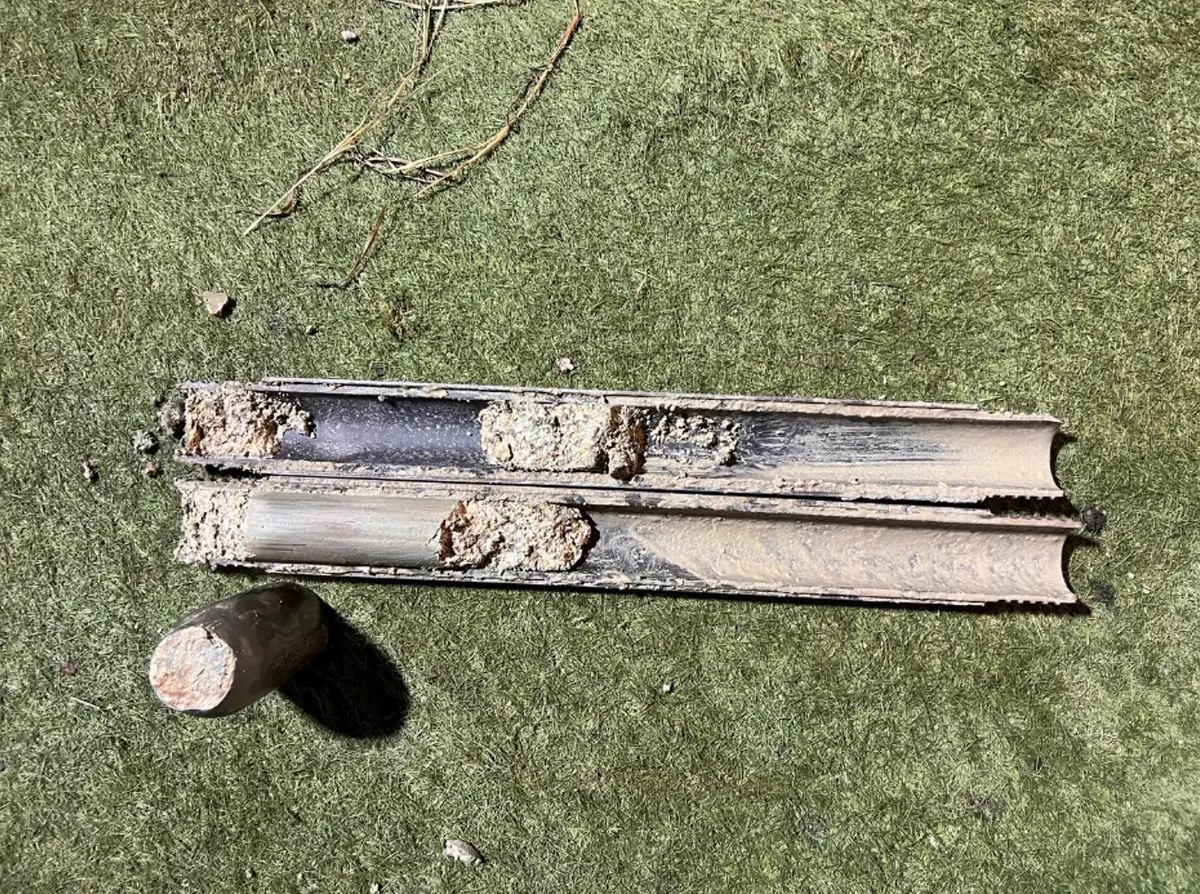
Split Spoon sampler split into 2 halves on grass, showing the soil sample inside the barrel, with a soil core laid beside it
SS sampler split open — the soil sample recovered together with the N-value from driving, used for soil-layer classification and further laboratory testing (photo: SPN site work)

What is an ST (Shelby Tube) sample?

A Shelby Tube (thin-walled tube) is a thin-walled steel tube with a sharpened cutting edge. The sample is taken by pushing the tube into the soil slowly and continuously, without driving, per ASTM D1587-15. The thin wall and smooth push keep disturbance of the soil inside the tube to a minimum, so an ST sample is an undisturbed sample.

ST sampling suits soft to medium-stiff clay, the soil condition most common in Bangkok and its vicinity (Bangkok soft clay layers). Right after sampling, the crew seals the tube ends with paraffin wax to preserve moisture and transports it carefully to the laboratory. The limitation is that it cannot be used in sand or very hard soil, because sand does not stay in the tube and hard soil will not let the tube be pushed in.

Steps for taking an undisturbed sample with a Shelby Tube (thin-walled tube) Borehole section in five steps. Step one: clean out the borehole bottom, then lower the Shelby tube attached to the drill rods until it touches the bottom. Step two: push the tube into the soft clay layer slowly and continuously with steady force, without driving or rotating. Step three: push to the specified length without exceeding the tube length. Step four: withdraw the tube together with the clay core inside. Step five: immediately seal both ends with paraffin wax, cap them and label with the borehole number and depth before transporting to the laboratory. Method per ASTM D1587-15. Undisturbed (UD) sampling with a Shelby Tube — 5 steps Not to scale 1 Lower tube On cleaned bottom Rods steady, no impact 2 Push steadily Slow, even force No driving/rotating 3 Full push ≤ tube length Overpush squeezes 4 Withdraw Pull slowly with core Check valve holds it 5 Seal at once BH-1 4.5–5.1 m Wax both ends Cap + depth label Paraffin Paraffin Method per ASTM D1587-15 · tube length and push length per project specs
5 steps for undisturbed (UD) sampling with a Shelby Tube — lower the tube to the cleaned borehole bottom, push slowly and continuously without driving or rotating, do not push beyond the tube length, withdraw with the soil core, then immediately seal both ends with paraffin wax and attach a depth label
Status of ASTM D1587

ASTM withdrew ASTM D1587/D1587M-15 from active status in 2024. Withdrawal means ASTM has stopped reviewing the document and will not issue a revised edition — it does not mean thin-walled tube sampling is wrong or invalid. Field practice remains exactly the same. What needs care is the contract documents: specifications should state the edition year explicitly, e.g. “ASTM D1587-15”, rather than “latest edition” (the same principle is explained in How to specify a withdrawn standard).

Comparison of the Split Spoon (SS) and Shelby Tube (ST) soil samplers at the borehole bottom The left panel shows a Split Spoon sampler attached to the drill rods, with a head containing a check valve, a barrel split into two halves and a driving shoe at the tip. It is driven by a 63.5 kg hammer free-falling 76 cm per ASTM D1586 into a sand layer over three 15 cm increments; the first is the seating drive and is not counted, and the N-value is the number of blows for the second plus third increments. Outside diameter 50.8 mm, inside diameter 34.9 mm. When split open it gives a disturbed sample. The right panel shows a thin-walled Shelby Tube with a sharpened edge, pushed continuously into a soft clay layer without driving per ASTM D1587-15. The commonly used outside diameter is 76.2 mm. It gives an undisturbed sample, sealed with paraffin wax at both ends with caps and a depth label before going to the laboratory. The bottom strip summarizes the follow-up laboratory tests for each sample type. SS vs ST — two samplers at the hole bottom Not to scale SS — Split Spoon Driven during SPT · ASTM D1586 ST — Shelby Tube (thin-wall) Pushed, not driven · ASTM D1587-15 1 15 cm 2 15 cm 3 15 cm 63.5 kg ram 76 cm free fall Head + valve Retains sample on pull Split barrel OD 50.8 / ID 34.9 mm Driving shoe ① seating, not counted · N = ② + ③ Steady push force No drive/rotate Head + valve Thin-walled, sharp Common OD 76.2 mm Soft clay in tube Min. disturbance No driving/rotating · seal on withdrawal SS split → disturbed Class. · moisture · Atterberg · sieve BH-1 4.5 m ST waxed → undisturbed Unconfined · Consolidation
Comparison at the borehole bottom — SS is driven by a 63.5 kg hammer falling 76 cm over 3 increments of 15 cm (N-value = increments 2 + 3) and gives a disturbed sample, while the thin-walled, sharp-edged ST is pushed continuously into soft clay and gives an undisturbed sample. The bottom row summarizes the follow-up laboratory tests.

How do SS and ST differ?

← Scroll to see the full table →

Comparison of SS (Split Spoon) and ST (Shelby Tube) soil sampling
TopicSS — Split SpoonST — Shelby Tube
SamplerThick wall, splits into 2 halvesThin wall, sharp edge
Sampling methodDriven with a standard hammer (during SPT)Pushed slowly and continuously, no driving
Sample conditionDisturbedUndisturbed
StandardASTM D1586 (Active)ASTM D1587-15 (withdrawn by ASTM in 2024)
Suitable soilsAll types — clay, sand and hard soilSoft to medium-stiff clay
Additional dataSPT N-value—
Follow-up lab testsClassification, moisture content, Atterberg Limits, SieveUnconfined Compression, Consolidation, etc.

Why does one borehole need both SS and ST?

Because each soil layer needs a different kind of data. In actual drilling, the crew switches samplers according to the soil encountered — soft clay layers, which govern foundation settlement, are sampled with ST for direct strength and compressibility testing, while sand and hard soil layers where an ST cannot be pushed are sampled with SS together with the N-value. Samples are typically taken every 1.0–1.5 m or whenever the soil layer changes. The position and type of every sample are recorded in the Boring Log with the SS/ST symbol.
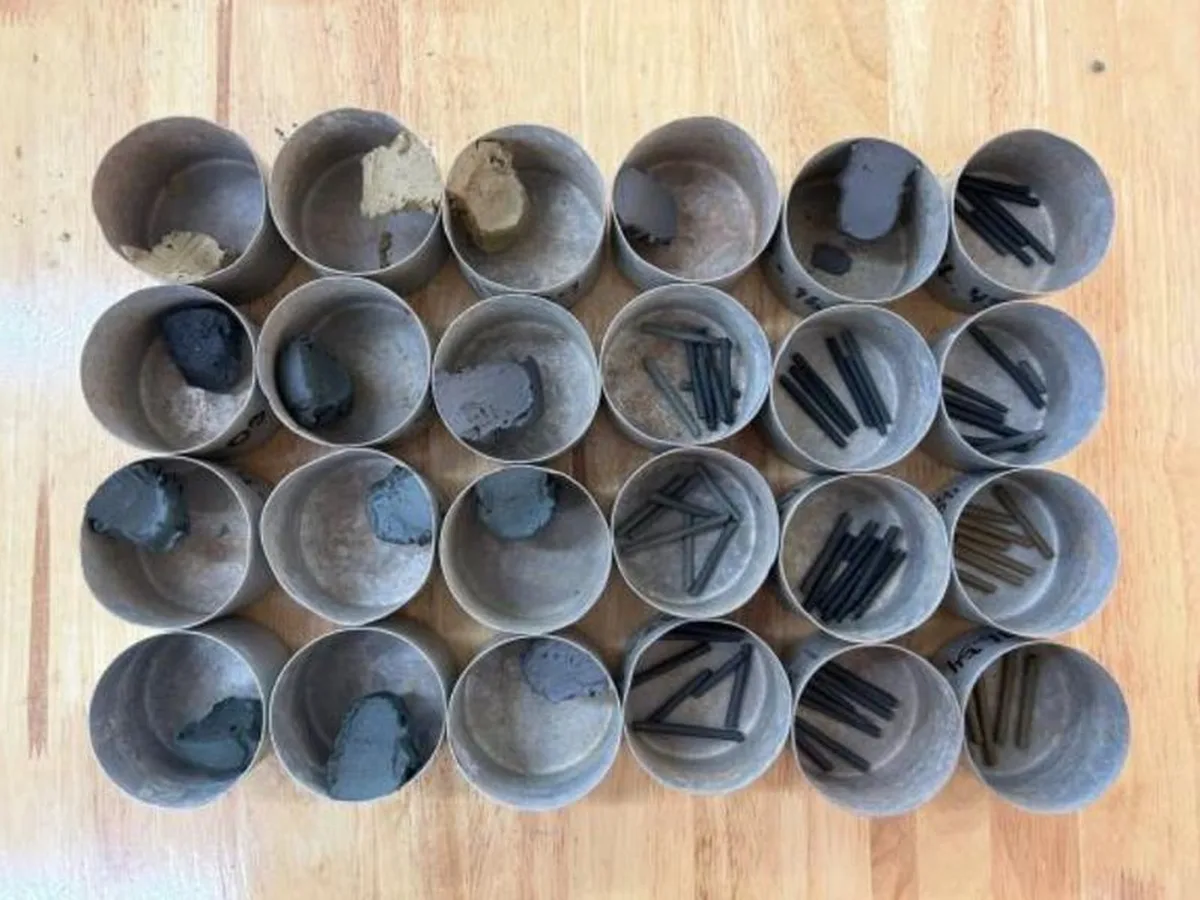
Soil samples from a soil investigation arranged in containers for moisture content testing in the laboratory
Soil samples from the borehole arranged for laboratory testing — the destination of every SS and ST sample (photo: SPN laboratory)

Which laboratory tests are run on the samples?

SS samples are used for index tests: soil classification, moisture content, Atterberg limits and particle-size (sieve) analysis. ST samples are used for mechanical tests that require undisturbed soil, such as the Unconfined Compression Test and the Consolidation Test — the key data engineers use to assess soil bearing capacity and settlement. See each test in detail in What laboratory soil tests are there.

3D model of a disassembled Split Spoon sampler and a sealed Shelby Tube ready for the laboratory 3D view of parts laid on the ground. On the left, a disassembled Split Spoon sampler: a head with vent holes and a check valve, the two split-barrel halves opened up with the lower half holding a sand core broken into lumps by driving, and a tapered driving shoe. On the right, a thin-walled Shelby Tube holding an undisturbed clay core, both ends sealed with paraffin wax and caps, labeled with borehole number and depth. The bottom-right inset compares tube wall sections: the SS wall is thick, outside diameter 50.8 mm and inside diameter 34.9 mm; the ST wall is thin, with a commonly used outside diameter of 76.2 mm. The thinner the wall, the less the soil is disturbed. Sizes in the image are exaggerated for clarity. 3D model — SS and ST parts Not to scale BH-1 4.5 m Split Spoon (SS) — exploded Head + vents Check valve Top half off Split barrel Driving shoe Tapered shoe Sand core in lumps Disturbed sample Shelby Tube (ST) Wall cut to show inside Undisturbed clay core Undisturbed · thin wall Wax + cap Wall comparison SS Thick ST Thin Sizes exaggerated for clarity
3D model — exploded Split Spoon parts (head, 2-piece split barrel with a sand core broken into lumps, and driving shoe) compared with a Shelby Tube full of undisturbed clay and sealed with paraffin wax. The bottom-right inset compares tube wall thickness (sizes exaggerated for clarity).

All of this is part of SPN's soil investigation and testing service. The final report is certified by a civil engineer licensed by the Council of Engineers Thailand (COE) and can be used for building permit applications.
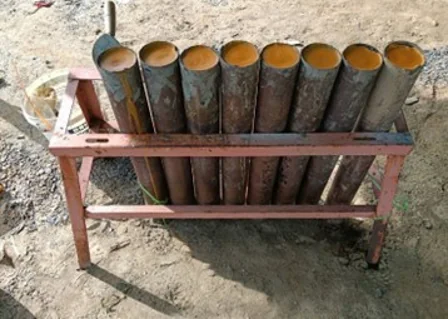
Several soil sample tubes arranged on a steel rack on site, awaiting transport to the laboratory
Sample tubes from the borehole arranged on a rack — sealed to preserve moisture before transport to the laboratory (photo: SPN site work)

Summary

SS is a disturbed sample from a split-barrel sampler driven during the SPT — giving both soil and an N-value. ST is an undisturbed sample from a thin-walled tube pushed into soft clay — used directly for strength and settlement testing. A good borehole therefore alternates between both according to the soil layers. Next time you open a soil boring report and see SS/ST, you will know immediately how each sample was taken and what it is telling you.